

The Director General of the National Orientation Agency (NOA), Lanre Issa-Onilu, has commended the achievements of Nigeria’s security agencies in transforming the country’s borders from crime corridors into fortified barriers against human trafficking and related transnational crimes.
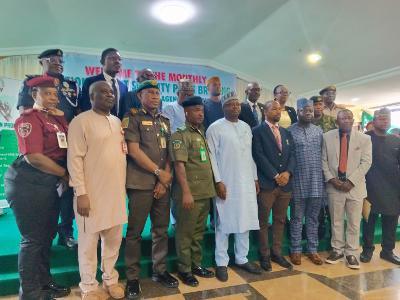
Speaking in Abuja at the maiden National Joint Security Press Briefing, themed “Disrupting Criminal Networks and Securing Communities,” Mr. Issa-Onilu praised the enhanced synergy among agencies, which he said has led to remarkable successes in crime fighting across the country.
 “The Federal Government has escalated security operations nationwide, merging tactical enforcement with intelligence-led interventions. Banditry, insurgency, trafficking, and other crimes are being tackled through seamless inter-agency cooperation, resulting in major arrests, rescues, and asset seizures. From the North-East to the Niger Delta, our security forces are reclaiming peace—one operation at a time. Nigeria is fighting back decisively and collaboratively,” he said.
Highlighting recent security data, he disclosed that the Nigeria Police Force conducted 326 operations, resulting in 2,109 arrests and the rescue of 175 kidnap victims. He added that the military neutralised 78 terrorists and dismantled six arms trafficking rings, while the National Drug Law Enforcement Agency (NDLEA) carried out 1,572 raids, seizing nearly 2.9 million kilogrammes of narcotics, including cannabis, tramadol, and methamphetamine.
He further revealed that 82 victims of human trafficking were rescued and 495 irregular migrants repatriated through a renewed border control approach supported by international partners.
 “Through international partnerships and domestic vigilance, Nigeria is reforming its border and migration systems to block irregular migration and human trafficking. The Nigeria Immigration Service (NIS) is also driving identity governance with support from the UN and ECOWAS. Our borders are no longer gateways to crime—they are now barriers to exploitation and trafficking,” he said.
The NOA boss also highlighted additional efforts, including the issuance of 3,786 e-visas, the return of 214 Nigerians from Niger Republic, and the deportation of 110 from Saudi Arabia. Arms recovered include 12 AK-47 rifles, two General Purpose Machine Guns (GPMGs), and over 2,200 rounds of ammunition.
On pharmaceutical crime, he noted that the National Agency for Food and Drug Administration and Control (NAFDAC) intercepted 10 containers of tramadol and five containers of expired tomato paste.
“Drugs and illegal arms are the oxygen of criminality. Federal enforcement agencies are systematically disabling these supply chains—on highways, at borders, and in markets—while investing in public education and rehabilitation,” he noted.
Speaking on infrastructure and natural resource protection, Issa-Onilu revealed that the Nigeria Security and Civil Defence Corps (NSCDC) dismantled 12 illegal refineries, three illegal mining gangs, and impounded seven trucks used for oil theft. The Nigerian Navy also seized ₦752.2 million worth of stolen petroleum products.
“Every illegal refinery and tampered railway track is an attack on our economy. Protecting oil pipelines, roads, power lines, and mines is not just security—it’s economic survival,” he stressed.
On humanitarian and civic engagement, he said the National Emergency Management Agency (NEMA) supported flood victims and rehabilitated Boko Haram escapees in over 15 states, while the Independent Corrupt Practices and Other Related Offences Commission (ICPC) hosted 352 anti-corruption events, reaching over 200,000 citizens. NOA itself led 80 nationwide campaigns against misinformation.
“Security is not only boots on the ground—it’s also food on tables, public trust, and youth empowerment. From flood alerts to deradicalization, the government is responding to citizens’ needs with urgency and compassion,” he said.
Issa-Onilu also commended efforts toward strengthening accountability and improving Nigeria’s global standing, noting that the ICPC recovered ₦21 billion and $1 million in looted funds, while the Nigeria Correctional Service reported the rehabilitation of 15,000 inmates—800 of whom are currently enrolled in university programmes.
On financial crimes, he noted that the country is on track to exit the Financial Action Task Force (FATF) grey list following recent anti-money laundering reforms.
“Security does not begin on the battlefield. It begins in our homes, our values, our truthfulness, and our resolve. Let us protect what is ours and unite for a peaceful, progressive Nigeria,” he urged.
He concluded by calling on Nigerians to take ownership of the fight for peace, not just through vigilance, but by upholding national values and promoting unity.
PIAK