


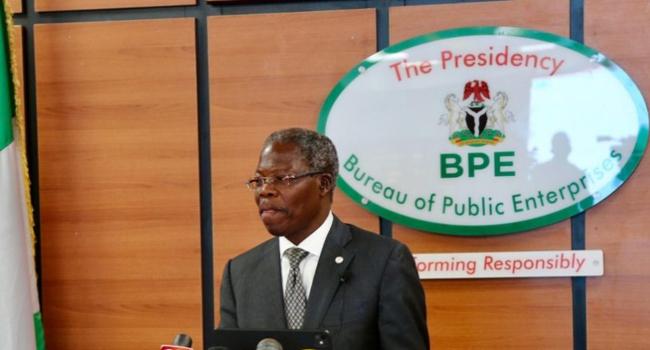
The Bureau of Public Enterprises (BPE) has unveiled a detailed asset optimisation and power sector restructuring plan projected to generate ₦189.1 billion revenue for the Federation in 2026, as part of broader efforts to support fiscal consolidation and economic growth.
The Director-General of BPE, Ayodeji Gbeleyi, disclosed this at the Annual General Meeting (AGM) of the Finance Correspondents Association of Nigeria (FICAN) in Abuja.
He stated that the Bureau’s approved 2026 work plan comprises 15 strategic projects designed to reduce reliance on debt financing and support government capital expenditure priorities.
Gbeleyi noted that the reform programme aligns with President Bola Tinubu’s ambition of building a $1 trillion Gross Domestic Product (GDP) economy by 2030.
According to him, “achieving this target will require structural reforms, disciplined asset management, private capital mobilisation, and strengthened institutions rather than incremental policy adjustments.”
He said that BPE remitted approximately ₦185 billion to the Federation Account in 2025, underscoring the role of asset transactions in easing fiscal pressures and promoting macroeconomic stability, a key foundation for sustained GDP growth.
The 2026 portfolio includes the proposed commercialisation of two of the 10 National Integrated Power Plants (NIPPs), the public listing of a distribution company on the Nigerian Exchange Limited (NGX), concession of the Oyan Dam, and asset optimisation initiatives in the oil and gas sector.
Represented at the event by the Director of Industries and Services, Toibudeen Oduniyi, the Director-General said; “the solid minerals sector also presents significant opportunities for export diversification and value-chain development.”
He stated that the Bureau’s ongoing initiative to lease four coal blocks aims to transition dormant assets into productive ventures, thereby expanding non-oil GDP.
Beyond revenue generation, Gbeleyi emphasised that the transactions are structured to enhance operational efficiency, unlock stranded value, attract domestic and foreign investment, deepen the capital market, and stimulate job creation.
Power sector and institutional reforms central to the Bureau’s reform agenda is the recalibration of the Nigerian Electricity Supply Industry (NESI), long considered a constraint to industrial competitiveness.
To enhance regulatory clarity and market discipline, BPE has strengthened engagement with key sector institutions, including the Nigerian Electricity Regulatory Commission (NERC), Transmission Company of Nigeria (TCN), Nigerian Bulk Electricity Trading Plc (NBET), and the recently operational Nigerian Independent System Operator (NISO).
The Bureau is also advancing the Distribution Sector Recovery Programme (DISREP) to bridge Nigeria’s metering gap and strengthen distribution infrastructure, alongside the development of strategic infrastructure projects through Public-Private Partnerships (PPPs).
On dispute resolution and investor confidence, Gbeleyi said that “BPE is actively resolving legacy disputes that have historically constrained asset performance and dampened investor confidence.”
Through sustained engagement with the Office of the Attorney-General of the Federation and other relevant institutions, the Bureau, he said has recorded significant progress in resolving arbitration cases and longstanding litigations.
He noted that the adoption of alternative dispute resolution mechanisms has delivered measurable financial and relational benefits, reinforcing policy stability.
According to him, “Nigeria’s substantial infrastructure gap requires robust private sector participation, and the Bureau is therefore collaborating with government stakeholders and development finance institutions to develop a pipeline of catalytic PPP projects across energy, transport, agriculture, housing, and ICT.”
“Our approach is anchored on policy predictability, legal and regulatory clarity, commercial viability, stakeholder alignment, and long-term value optimisation,” he said.
Reaffirming the Bureau’s commitment to transparency and accountability, Gbeleyi stressed that accurate and responsible financial journalism plays a critical role in strengthening market confidence, promoting accountability, and fostering informed public discourse around reform, privatisation, commercialisation, and PPP initiatives.