

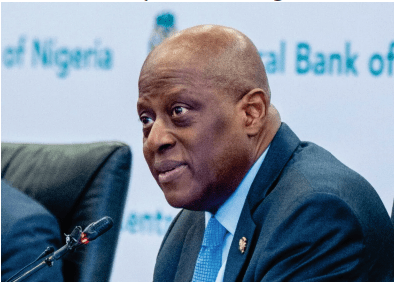
The Central Bank of Nigeria has called for a major shift in the architecture of global finance, urging developing economies to actively shape rather than merely adopt emerging digital payment standards, as technology rapidly transforms international trade and capital flows.
Speaking at the G-24 Technical Group Meetings in Abuja, the CBN Governor, Olayemi Cardoso, said efficient cross-border payments have become a development priority, not just a financial innovation.
He stressed that an economy cannot be truly inclusive if citizens and small businesses cannot move money quickly, safely, and affordably across borders.
“If people cannot transfer funds easily across towns, borders, and continents, they cannot fully participate in modern economic life,” Cardoso said.
Cardoso noted that developing countries currently face high remittance costs, slow settlement times, and barriers to participation in global trade.
“Across the world, cross‑border payments are becoming the backbone of the international monetary and financial system. For G‑24 economies, inefficiencies in these systems translate directly into higher remittance costs, costly FX transactions, fragmented settlement processes, and barriers to MSME participation in global trade.
“Improving cross‑border payments, therefore, is not simply a technical reform; it is a macroeconomic and development priority. The channels through which capital, remittances and trade flows move now form a critical part of global financial stability architecture. Today, cross‑border payments remain too slow, too costly, and too fragmented, especially for developing economies. With global remittance corridors costing over 6.0 per cent, settlement lags of several days, and compliance burdens that exclude MSMEs, millions remain disconnected from global opportunity”.
He therefore urged G-24 members to leverage Digital innovation to modernize payments infrastructure, instant payment systems, interoperable digital platforms, distributed ledger technology, and robust digital identity frameworks.
Speaking on Nigeria’s Reforms and Rising Remittances, the CBN Boss said Nigeria has already begun implementing structural reforms to modernise its financial ecosystem.
“To deepen regional integration, the CBN introduced the simplified KYC/AML requirements for low‑value cross‑border transactions to encourage broader participation in PAPSS. This has eased transaction processes for Nigerian SMEs by reducing paperwork and enabling faster, more seamless intra‑African trade payments. We have also embraced fintech innovation to drive the next generation of secure, instant cross‑border payments. Our Regulatory Sandbox now allows payment‑focused fintechs to test new cross‑border solutions under close CBN supervision, ensuring innovation proceeds without compromising stability”
“As a result of these reforms, remittance inflows now average about $600 million per month, and we are confident of reaching a $1 billion monthly milestone in the near term”.
Cardoso highlighted Africa’s regional payment system as proof that developing regions can build their own financial infrastructure to support trade.
Despite the opportunities, the CBN governor warned that unregulated expansion of private payment platforms and stablecoins could weaken monetary policy, increase exchange-rate volatility and fragment financial systems.
He called for stronger coordination among central banks and international institutions, including the IMF, to build a fair, rules-based system.
Nigeria’s Minister of Finance and the coordinating Minister of the economy, Wake Edun, called on delegates to “use this Technical Group Meeting to harmonise our positions, sharpen our policy instruments, and present a coherent voice to the global community”
“Together, the Global South can build an economy that is integrated by choice, resilient by design, and inclusive by nature”.
For the Director and Head of Secretariat, The G-24, Dr Iyabo Masha, “Fiscal authorities should strengthen fiscal and debt sustainability frameworks, as these are central to anchoring expectations and mobilising investment. Central banks should enhance the credibility of monetary and financial stability frameworks, prioritise exchange rate management, maintain adequate reserves, anchor inflation expectations, and strengthen macroprudential policies”
The 2026 G‑24 Technical Group Meetings (TGM) are themed: “Mobilising finance for sustainable, inclusive, and job-rich transformation”