


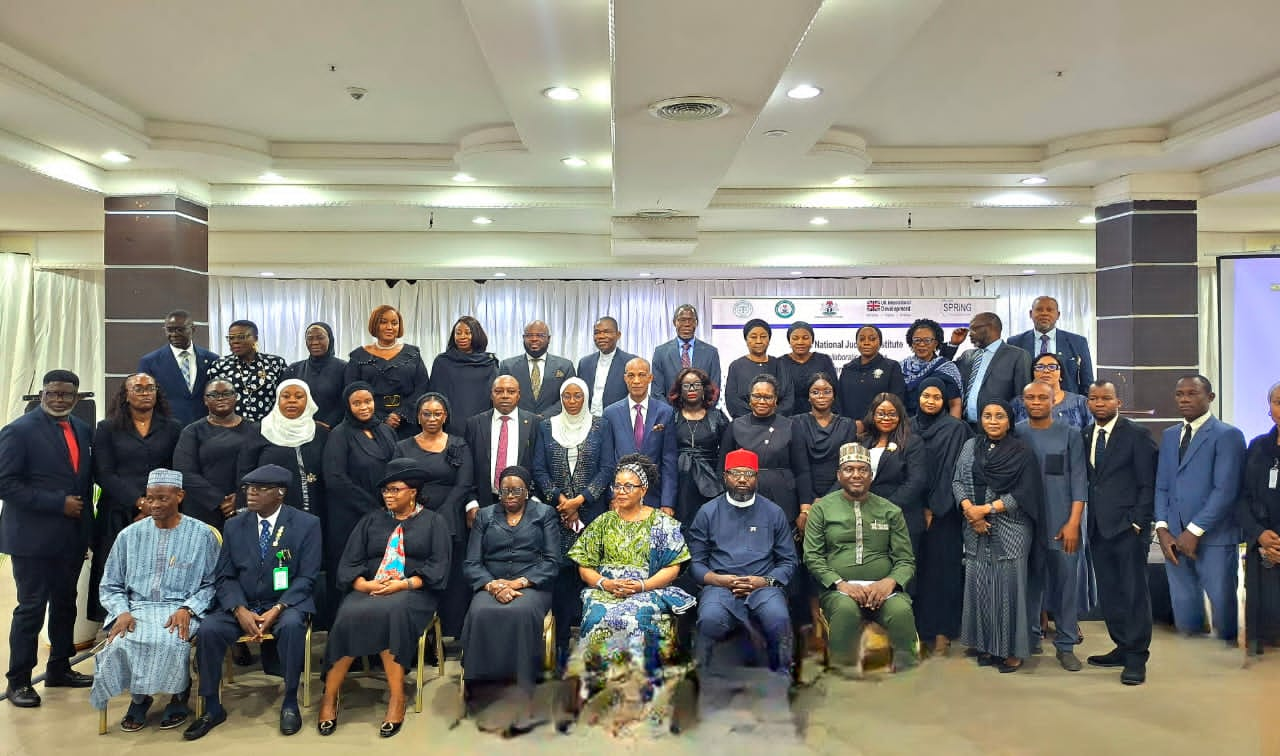
The Chief Justice of Nigeria (CJN), Kudirat Kekere-Ekun, has urged judges to advance the Women, Peace and Security (WPS) agenda in courtrooms nationwide, to ensure that justice delivery reflects the realities of conflict and gender-based harm.
She made the call in Abuja at a Capacity Strengthening and Dialogue Workshop for Judicial Officers on the Women, Peace and Security (WPS) Agenda, organised by the National Judicial Institute (NJI) in collaboration with the Federal Ministries of Women Affairs and Justice, with support from the United Kingdom Foreign, Commonwealth and Development Office through the SPRiNG programme.
The workshop, themed “Operationalising the Third National Action Plan on Women, Peace, and Security”, also aims to synergise inputs for the validation of a National Judicial Guide on Women, Peace, and Security.
Kekere-Ekun said sustainable peace depends on a responsive, accessible and accountable justice system, noting that informed and properly supported courts strengthen accountability, deter wrongdoing and promote public confidence in the rule of law.
“For the judiciary, operationalising the NAP III means ensuring that the core principles of the women, peace, and security agenda are reflected in how cases are heard, how procedures are applied, and how judges are trained. She said
She acknowledged that despite Nigeria’s progressive legal framework, gaps persist between legal standards and the lived experiences of court users, particularly survivors of conflict-related sexual violence, displaced women and girls, persons with disabilities and other vulnerable groups.
“Where court processes are slow, inaccessible, or insensitive to the realities of conflict and gender-based harm, justice is weakened,” she stated.
She said the challenges stem from the complexity of cases, limited data, evolving laws and lack of tailored guidance rather than lack of judicial commitment, underscoring the need for structured support and consultation. She welcomed the integration of the guide into judicial education to promote consistency while preserving judicial discretion.
“The courts, beyond the resolution of disputes, are institutions entrusted with the protection of rights, the preservation of human dignity, and the maintenance of social order.” She said
Also speaking, the Attorney General of the Federation and Minister of Justice, Lateef Fagbemi, commended the NJI and SPRING for strengthening justice delivery through inclusive and rights-based approaches.
Represented by the Head, Sexual and Gender Based violence Response Unit, Mrs Yewande Gbola-Awopetu, Fagbemi said the courts are central to translating constitutional and international obligations into lived realities for women and girls affected by conflict and structural inequality.
The NJI Administrator, Justice Babatunde Adejumo, said the initiative aligns with global standards and supports implementation of UNSCR 1325.
“In performing its adjudicatory functions, the courts can elicit accountability from perpetrators of conflict-related sexual violence and gender-based violence, enforce reparations and other reliefs for victims, and ensure deterrence through conviction.”

For the SPRING Programme, Gender Equality, Disability and Social Inclusion Lead for SPRiNG, Amina Akano-Bello, said the workshop would review and validate the WPS Guide for the Nigerian Judiciary, as an instrument for operationalising the NAP on Women, Peace and Security to translate commitments into judicial actions.
“The role of the judiciary and more broadly justice sector institutions is critical to our shared commitments to fulfilling the transformative agenda of the UNHCR 1325 on Women, Peace and Security. She said.
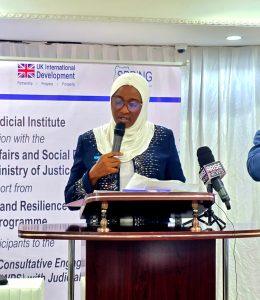
“Nigeria has so far implemented two National Action Plans, and just in Dec.2025, the third NAP on Women, Peace and Security was launched, and SPRiNG is supporting NJI to strengthen the judiciary’s knowledge in advancing the NAP,” Akano-Bello added.
She stated that the SPRiNG initiative is dedicated to supporting efforts to foster a more stable Nigeria, where citizens experience reduced violence and strengthened resilience to climate pressures.