

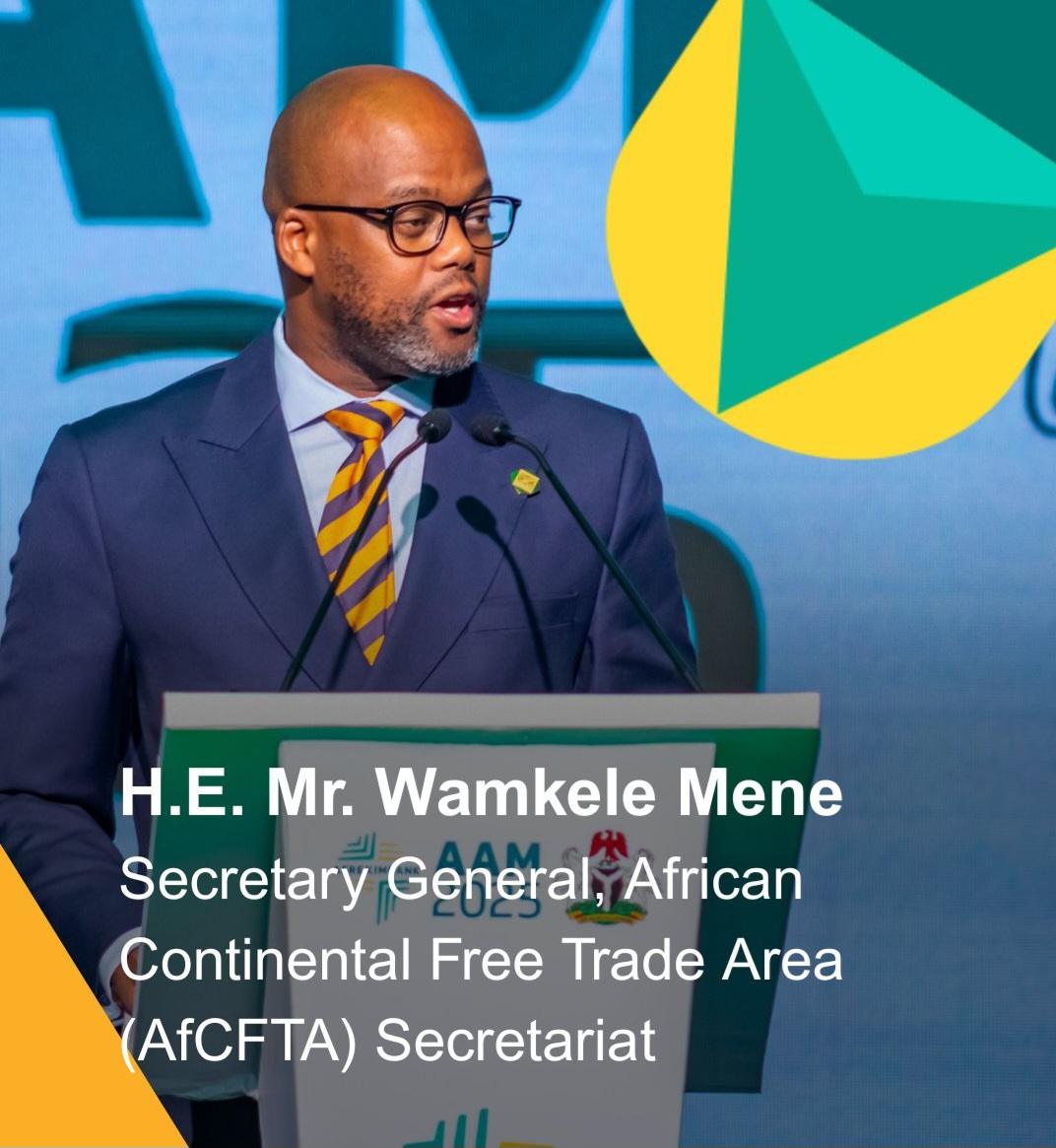
The African Continental Free Trade Area (AfCFTA) has called for the urgent development of a continent-wide digital identity system to accelerate cross-border trade, deepen financial inclusion, and strengthen regional integration.
The Secretary General, African Continental Free Trade Area (AfCFTA), Mr Wamkele Mene, made the appeal on Thursday in Abuja at a special side event at the ongoing 32nd Annual Meetings of Afreximbank (25-28 June 2025).
Mene made a strong call for political will and institutional cooperation to dismantle digital and regulatory barriers hampering intra-African commerce.
“We are not a supranational institution, but we are committed to removing barriers that hinder trade, particularly in sectors like pharmaceuticals.
There must be a continental mechanism for regulatory recognition that allows a product manufactured in Nigeria to be accepted in all 54 member countries without passing through 54 regulators,” said Mene.
He argued that regulatory harmonisation is essential for scaling up trade in key sectors, such as agribusiness, pharmaceuticals, and services, while warning that Africa’s ambitions for digital commerce would falter without coherent rules and robust infrastructure.
“Digital trade cannot happen in a digital pothole.
Investors ask, ‘Why should we invest in Africa when India offers a unified set of rules for digital infrastructure?’ That’s why we’re working to establish a single set of rules for digital public infrastructure,” he affirmed.
According to him, one of the AfCFTA’s most ambitious proposals is a continent-wide digital pass—an identity and transaction platform tailored to small and informal businesses.
Mene explained that the platform would allow micro-enterprises to open bank accounts, track transactions, access credit, and conduct cross-border trade with fewer hurdles.
He said this will be modelled on India’s digital public infrastructure, which has integrated over 95% of its population; the African version is aimed at levelling the playing field for informal traders and smallholder farmers.
“We are seeing global tech companies showing real interest because regulatory burdens are being lifted. We are creating a framework that welcomes innovation,” said Mene, concluding with a rallying call: “AfCFTA is more than a legal framework. It’s Africa’s group project—and we must all show up, united in action.”