

By ‘Segun Adegoke, Osogbo
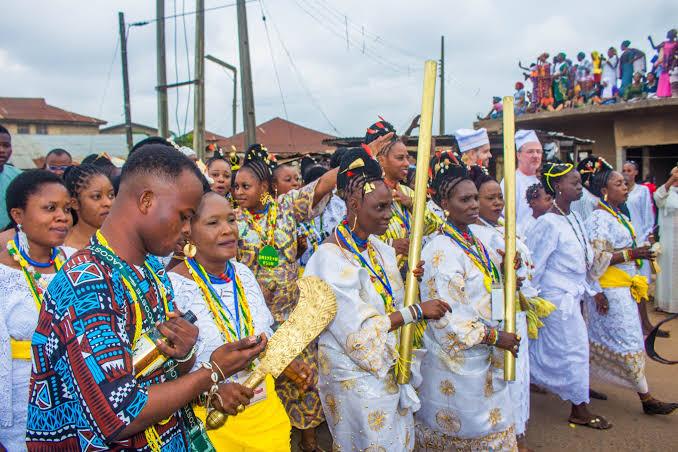
The annual Osun Osogbo festival that draws thousands of worshippers, devotees and tourists from across the world has ended with the culture and tradition of Yoruba people of southwest Nigeria taking centre stage.
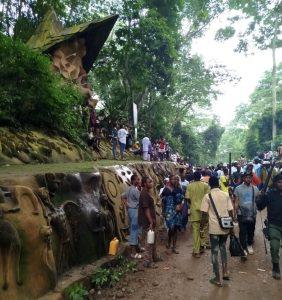
Several thousands of worshippers, traditionalists and tourists from across the globe on Friday converged on the Osun Osogbo grove for the finale, bearing gifts and wearing colourful attires.
The festival, a yearly event that honours the goddess of fertility, Osun Osogbo, also commemorates the founding of the town in a manner that celebrates the way of life of the people.
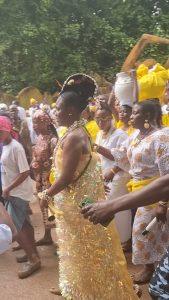
Singing, drumming and dancing were rife as devotees, worshippers and tourists alike took time out to bask in the joy of witnessing another year’s festival.
While some devotees went straight to the river to redeem their vows from previous years, others made fresh pledges in prayers, seeking divine intervention in their various life situations at the same location.
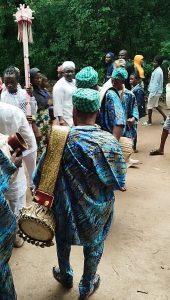
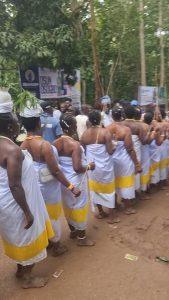
Many of the worshippers formed rings of faithful adherents, joyfully partaking in the communal display of faith built on years of devotion and trust in a deity they said never disappoints.
Osunfunke Oyebanji, a devotee of more than nine years told Voice of Nigeria that she came from Lagos to worship Osun and that ever since she became an adherent, she had found inner peace and joy.
“I have been a yearly pilgrim to this sacred grove for about nine years. I visit regularly to renew the peace and joy I found after discovering Osun Osogbo, the sacred mother who gives without holding back,” she said.
Another devotee, Barbara Ferreira, from Brazil dressed entirely in white iro and buba, the traditional Yoruba women’s attire, said she spiritually connected with Osun Osogbo in a way she herself could not explain.
She said: “I don’t know why I like Osun Osogbo so much. It’s as if she (the goddess) keeps calling to me.”
The story of Akinwole Ariwoola, a playwright, is a bit different. According to him, he attends the festival on a yearly basis to find fresh inspiration for his artistic works which dwell largely on Yoruba culture and tradition.
He explained that he had never missed any edition since he started attending some seven years back because the festival always provided the opportunity to meet new people and bond with them.
He said: “I’ve been attending the festival for about seven years now and my report, if you ask me about the festival itself and its essence, is positive in a decolonising and liberating way.
“As a writer, I find events like this inspiring and fulfilling, particularly in ways that inspire new stories from old ones for people like me to tell the world about how the cookie crumbles in this part of the world.
“I tell you, we are who we are as Yoruba and Africans; and there’s no shame about it. We are good, we are welcoming, we are liberal in our approach to things. We are authentically Africans,” he reiterated.
At the entrance to the sacred Osun Osogbo grove was a procession of an all women Osun worshippers, dressed in white wrappers, telling stories about the goddess and wooing visitors to join their train.
Their stories and songs were poetic in rendition, reminiscent of the old African griots and reflecting other aspects of Yoruba culture that are expressive and didactic in nature such as the oriki (panegyrics), folktales, folksongs and communal history.
Voice of Nigeria also met Kenneth Onuoha, a Nigerian of southeast extraction, who came to visit his relatives living in Osogbo. He took time out to also visit the Osun Osogbo sacred grove and he had this to say about it:
“I’m not a regular visitor here. I only came to visit my relatives in Osogbo and decided to see the Osun Osogbo grove. I’ve heard a lot about the place and I really like the vibe, culture and the various arts decorating the grove.”
For fifty-five year old Sikiru Ayelaagbe, a woodcarver selling figurines to interested tourists and visitors, Osun Osogbo was a time to showcase his own talent and to make some money off his craft.
“I thank God for a day like this. At least I’ve made some money from selling some of my sculptures”,he said smiling broadly.
Baba Adigun Olosun, an Ifa priest and Osun devotee, who also spoke to Voice of Nigeria, said the festival was a renewal of the contract of devotion and honour between humans and the divine.
He said the yearly re-enactment of that contract translates to keeping the faith and vow between a community and its guardian deity.
He stated: “We are a loyal people in Osogbo. Osun Osogbo is our patron goddess, who did wondrously for our forefathers.
“She gave them protection and a home when they were in need. She also promised to bless them and their offsprings if they worshipped her yearly. Our forefathers did that and we’re also keeping the faith today.”
A Professor of African History at the Missouri State University USA, Oyeniyi Bukola, whose yearly visit to Nigeria coincided with the festival this year said organisers and the government still have a lot to do in terms of standards.
According to him, both the state and the federal government need to do a lot more for the sacred grove, especially as it serves as some sort of tourist attraction for both governments.
“This is a beautiful festival that connects us to our roots. It reminds us of our history and ties us back to our culture and tradition. Much as I like the reenactment of this festival yearly, I think the organisers and government need to do a lot more in terms of crowd management and control.
“A mammoth crowd visits this place every year. It behoves them to protect the people by putting in some crowd management and control measures.
“The measures save lives and will certainly save us the regret of learning from our mistakes in retrospect. I also think the road leading to the grove should be upgraded,” the Professor advised.
Osun Osogbo 2025 in many ways lived up to its billing by bringing people of different tribes, tongues and views together and by adequately showcasing authentic African culture in an unassuming and unabashed way.
The festival which began two weeks ago climaxed with the bearing of a sacred calabash to the Osun river for sacrifice and prayers for the town, its people and Nigeria as a whole.
The Osun Osogbo Grove itself was designated a world heritage site in 2005 by UNESCO and the space is regarded as the last of its type within Nigeria, sacred to all traditionalists worldwide.