


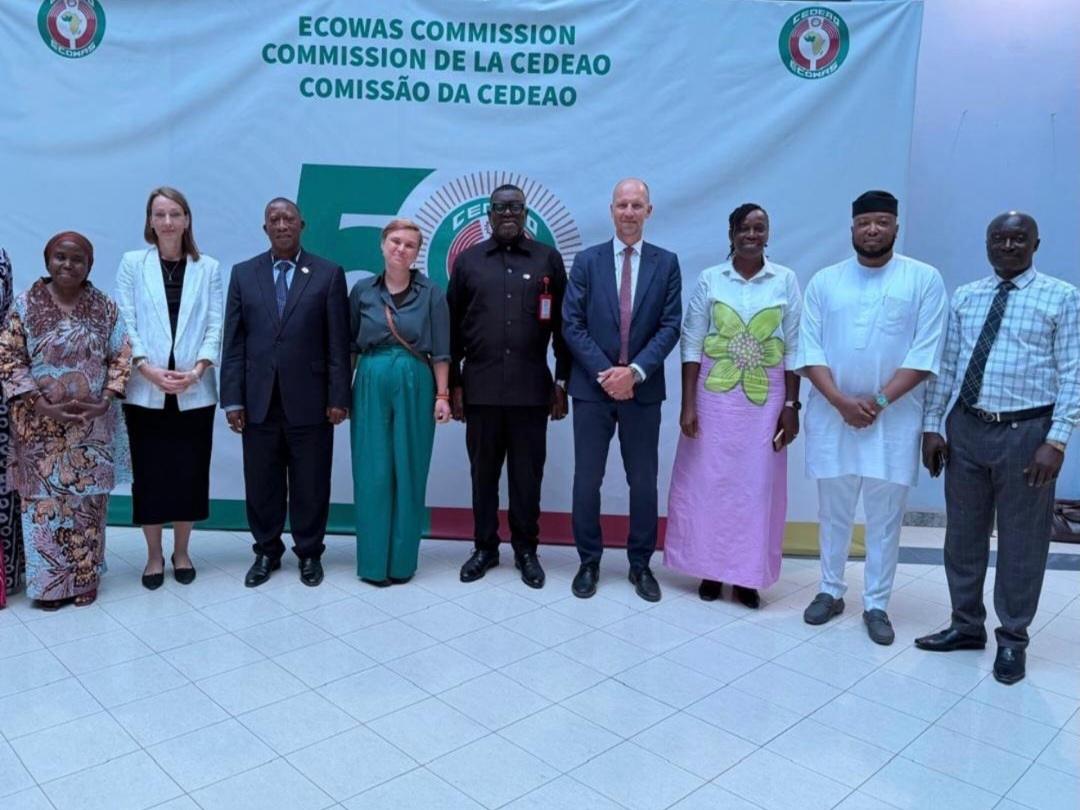
The ECOWAS Commission has met with a delegation from the Embassy of Sweden to discuss regional labour migration governance and the ECOWAS free movement regime.
The meeting in Abuja, Nigeria’s capital, provided an opportunity to exchange views on ongoing and planned regional initiatives aimed at strengthening labour migration governance, enhancing safe, orderly and regular migration as well as supporting the effective implementation of the ECOWAS free movement protocols.
The Swedish delegation was led by the Head of Regional Development Cooperation in Africa at the Embassy of Sweden in Addis Ababa, Ethiopia, Mr. Joachim Beijmo, and accompanied by the Programme Manager at the Embassy of Sweden responsible for Migration and Development within SIDA’s Regional Strategy, Ms. Agnes Geijer-Farah, and the Programme Manager for Peace, Security and Resilience at the Embassy of Sweden in Dakar, Senegal, Ms. Ann Sofie Fofana Rahmqvist.
The discussions were anchored on recent developments in the Joint Labour Migration Programme following the approval of the third phase of the Programme by the Swedish International Development Cooperation Agency, SIDA and the Swiss Agency for Development and Cooperation, SADC.
“Both parties highlighted the importance of regional cooperation, policy coherence and institutional coordination in advancing labour mobility as a driver of development, peace and stability in West Africa.
“The Swedish delegation reaffirmed Sweden’s commitment to supporting ECOWAS-led efforts in migration governance and free movement through strategic partnerships and programme-based cooperation.”
The meeting also brought together senior officials from the ECOWAS Commission’s Directorate of Free Movement and Directorate of Humanitarian Affairs, underscoring the Commission’s integrated approach to migration governance, mobility and regional development.
The meeting concluded with a shared commitment to sustain dialogue and collaboration in the implementation of the JLMP Phase III and related regional frameworks.
ECOWAS is implementing critical and strategic programmes that will deepen cohesion and progressively eliminate identified barriers to full integration. In this way, the estimated 300 million citizens of the community can ultimately take ownership for the realization of the new vision of moving from an ECOWAS of States to an “ECOWAS of the People: Peace and Prosperity to All” by 2050.