


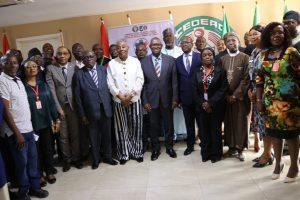
The ECOWAS Community Court of Justice has joined the global community in observing International Human Rights Day 2025, reaffirming its commitment to protecting the rights of all individuals across the region.
Speaking at the event under the theme ‘Human Rights, Everyday Essentials, the ECOWAS Court of Justice President, Justice Ricardo Goncalves, reminds the community countries that human rights are not abstract ideals but are necessities for all individuals to live a
dignified existence.
Justice Goncalves said, “Across our community, many of our people still struggle to have the necessities of life such as adequate food and clean water, security, healthcare and education, a healthy environment, housing, access to justice and other fundamental freedoms.
“It was for the purpose of protecting individual enjoyment of these
necessities that the ECOWAS Authority of Heads of State and Government decided to adopt the 2005 Supplementary Protocol, which expanded the jurisdiction of the Community Court of Justice to accommodate cases concerning the violation of human rights in the territory of Member States,” he added.
According to him, the Court is concerned that ECOWAS Member States have yet to implement most of its judgements. Without effective and total implementation of the Court’s judgments, the promise of human rights protection offered by the 2005 Supplementary Protocol becomes a mirage.
The President of the ECOWAS Court of Justice said the Court is also concerned about certain instances of retrogression in the enjoyment of human rights within the Community. ‘Across the community, we see military takeover or attempted takeover of governance, the narrowing or closing of civic spaces, terrorist insurgency, under-resourced justice systems and the effects of climate change, among other challenges.’
Justice Goncalves believed that the ECOWAS Member States have a duty to respond to these challenges and work with other stakeholders in the region to ensure that everyone in the Community can enjoy their human rights freely and without any discrimination.
He re-emphasised that the Court highlights that rights must be real and effective, not just ideas on paper, adding that victims should have genuine access to justice, without obstacles like cost, distance, language barriers, or complex procedures.
He called on Member States to fully and sincerely implement the Court’s judgments, ensuring that the remedies bring meaningful improvements to people’s lives. National bodies such as courts, human rights commissions, and ombudsmen should collaborate with the Court, building a unified protection system.
“Civil society, the media, and human rights defenders must be respected and safeguarded, as they play a vital role in exposing abuses, supporting victims, and bringing cases to the Court.” He added.
The Court recognises that its credibility rests on independence, impartiality, and strict adherence to the law.
He therefore called on all Member States to renew their dedication to the ECOWAS legal framework, the African Charter on Human and Peoples’ Rights, and all the international human rights agreements they have ratified.
He urged full cooperation with the Court and the effective enforcement of its decisions, showing respect for the rule of law and the people’s rights across West Africa and encouraging more investment in legal and human rights education, especially for young people, to empower them to understand and defend their rights and those of others.
The Court reaffirms its firm commitment to protect human rights, uphold justice, and strengthen the rule of law across our Community.
The ECOWAS Court of Justice remains committed to interpreting, applying and enforcing these rights, guided by the international human rights instruments, their jurisprudence and the values shared across our Member States.