

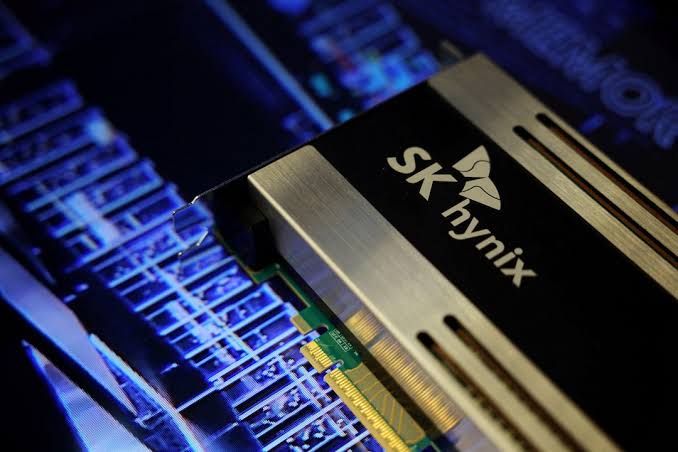
The global market for high-bandwidth memory (HBM) chips, a specialized type of memory used in artificial intelligence, is expected to expand by 30% annually through 2030, according to SK Hynix.
READ ALSO: Trump Says US To Levy 100% Tariff On Imported Chips
Choi Joon-yong, head of HBM business planning at the South Korean chipmaker, told Reuters that robust AI demand from end users remains strong despite concerns over rising prices in a sector long treated like a commodity market, similar to oil or coal.
Choi added that major cloud providers including Amazon (AMZN.O), Microsoft (MSFT.O), and Google (GOOGL.O) are projected to invest billions of dollars in AI infrastructure. He expects those spending forecasts to increase in the coming years, which he said would be a positive driver for the HBM market.
The relationship between AI build-outs and HBM purchases is “very straightforward” and there is a correlation between the two, Choi said. SK Hynix’s projections are conservative and include constraints such as available energy, he said.
But the memory business is undergoing a significant strategic change during this period as well. HBM – a type of dynamic random access memory or DRAM standard first produced in 2013 – involves stacking chips vertically to save space and reduce power consumption, helping to process the large volumes of data generated by complex AI applications.
SK Hynix expects the market for custom high-bandwidth memory (HBM) chips to grow into the tens of billions of dollars by 2030, driven by rising demand for artificial intelligence applications and increasing product customization.
Choi Joon-yong, head of HBM business planning at the South Korean chipmaker, told Reuters that next-generation HBM4 products developed by SK Hynix, Micron Technology (MU.O), and Samsung Electronics (005930.KS) now feature a customer-specific logic die, or “base die,” to manage memory. This shift makes it more difficult to replace a rival’s chip with a near-identical alternative, potentially locking in customers for longer periods.
Currently, major clients such as Nvidia (NVDA.O) receive individually tailored HBM solutions, while smaller customers typically get standardized products. Choi said he expects demand for customization to grow across the industry, noting that “each customer has different taste,” with varying needs for performance or power efficiency.
SK Hynix is Nvidia’s primary HBM supplier, though Samsung and Micron also supply the U.S. chipmaker in smaller volumes. However, Samsung cautioned during its recent earnings call that supply of current-generation HBM3E could outpace demand growth in the near term, a development that could weigh on prices.
Despite that warning, Choi voiced confidence in SK Hynix’s competitive edge, saying the company is well-positioned “to provide the right competitive product to customers” as the AI-driven chip market expands.
100% TARIFFS
U.S. President Donald Trump on Wednesday said the United States would impose a tariff of about 100% on semiconductor chips imported from countries not producing in America or planning to do so.
Choi declined to comment on the tariffs.
Trump told reporters in the Oval Office the new tariff rate would apply to “all chips and semiconductors coming into the United States,” but would not apply to companies that were already manufacturing in the United States or had made a commitment to do so.
Trump’s comments were not a formal tariff announcement, and the president offered no further specifics.
South Korea’s top trade envoy Yeo Han-koo said on Thursday that Samsung Electronics and SK Hynix would not be subject to the 100% tariffs on chips if they were implemented.
Samsung has invested in two chip fabrication plants in Austin and Taylor, Texas, and SK Hynix has announced plans to build an advanced chip packaging plant and an artificial intelligence research and development facility in Indiana.
South Korea’s chip exports to the United States were valued at $10.7 billion last year, accounting for 7.5% of its total chip exports.
Some HBM chips are exported to Taiwan for packaging, accounting for 18% of South Korea’s chip exports in 2024, a 127% increase from the previous year.
Shares of SK Hynix closed up 4.1% on Monday after rising as much as 4.3%, versus a 0.1% drop in the benchmark KOSPI (.KS11), opens new tab.
Shares of SK Hynix so far this year are up 53.5%, outpacing KOSPI’s 33.6% gain. Shares of Samsung Electronics are up 33.5% and Micron has climbed 41.3%.