

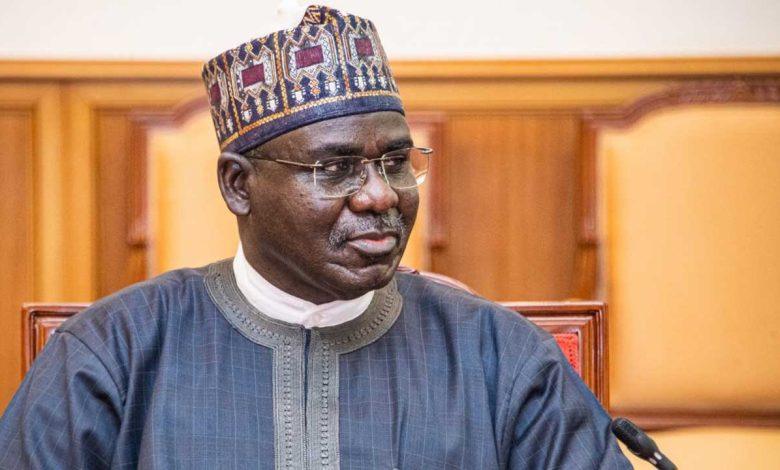
Nigeria’s former Chief of Army Staff, Lieutenant General Tukur Yusuf Buratai (Retired), has declared that the fight against insurgency cannot be completed without active citizen participation, warning that insurgents could be embedded within communities.
Speaking at the 18th Annual International Security Conference of the Institute of Security, Nigeria, held at the University of Lagos, Gen. Buratai reframed the national security challenge.
“What most people fail to understand is that insurgency is the people’s war. It’s not only the military’s war,” Buratai stated.
“You’d be surprised that amongst us here, there may be one or two bandits, terrorists or Boko Haram members.”
The former military head, who commanded counter-terrorism operations during the peak of the Boko Haram crisis, emphasised that the threat is societal and cannot be eradicated by kinetic military action alone.
Also Read: General Buratai Proposes Dual-Track Strategy To Counter Insurgency
While acknowledging measurable security improvements between 2015 and 2021, including the recovery of territories once under insurgent control and the “substantial degrading” of Boko Haram, Buratai stressed that sustained progress requires a holistic strategy.
“The military is still what it used to be, ‘ professional’,” he asserted, defending the institution’s capabilities.
“The government has all the documentation… the defence policy, the Anti-Terrorism Prevention Act. They are all there to deal with this situation. But it must be comprehensive, consistent, and sustained.”
Delivering a keynote address titled “Leadership, Strategy, and National Security Management”, Gen. Buratai, drawing from his published works on leadership, argued that even the best strategies fail without competent execution.
“A well-developed strategy is essential, but it is nothing without leaders who can implement it.”
“Leaders at all levels must promote transparency, encourage citizen participation, and be rational enough to anticipate future challenges.”
The retired general outlined a multi-layered approach for lasting security, including:
-
Strengthening local government administrations and building community resilience.
-
Fostering public awareness and cooperation with security agencies.
-
Ensuring continuous training, retraining, and recruitment across the military, police, and intelligence services.
The conference also featured the induction of new fellows and members into the Institute of Security Nigeria, highlighting the growing professionalisation of the country’s security sector.