

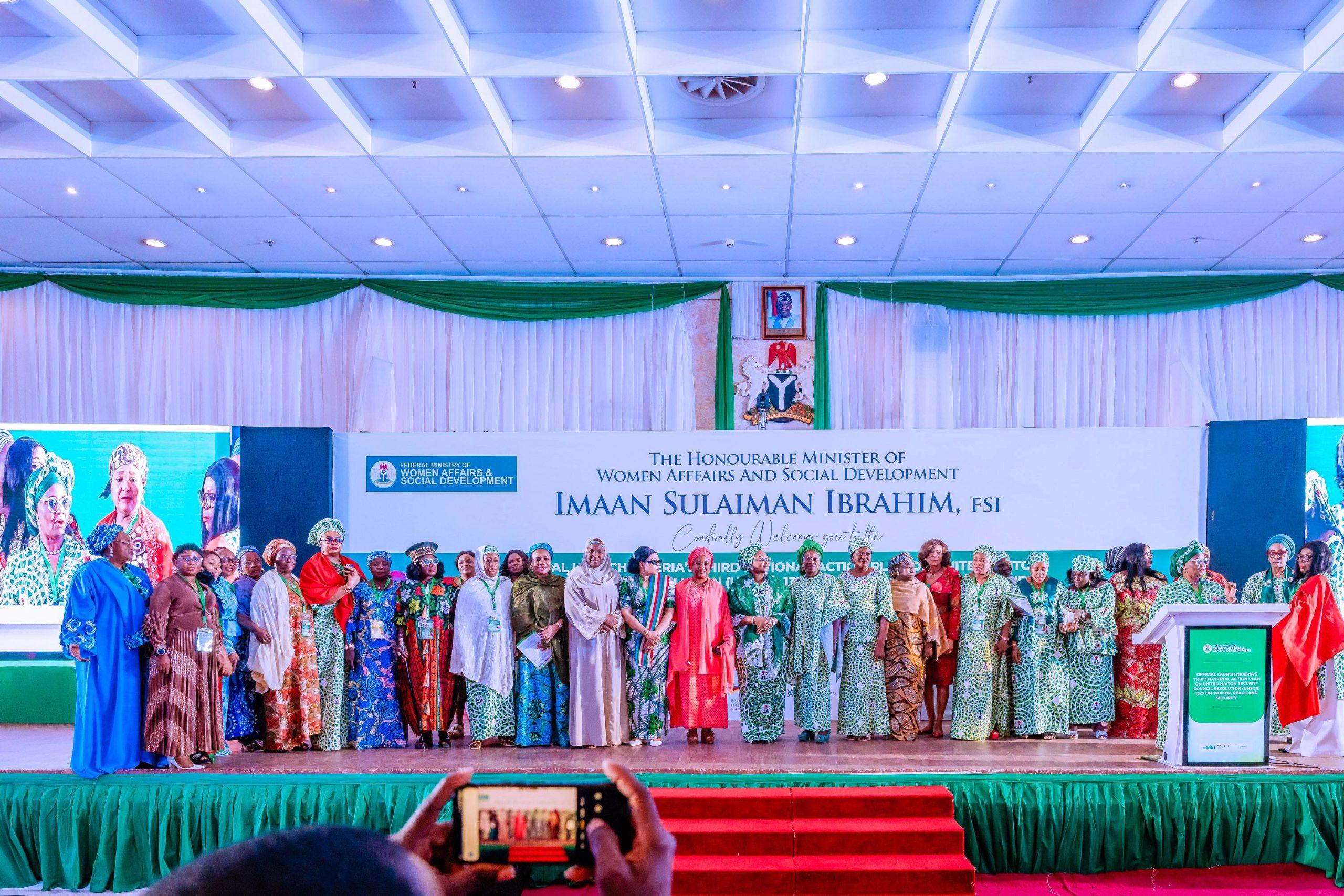
Policy administrators and political office holders have reaffirmed their commitment to the effective implementation of the Third National Action Plan (3rd NAP) on the United Nations Security Council Resolution 1325, aimed at protecting, empowering, and promoting the participation of women in peace and security processes.
Delivering the welcome address, the Permanent Secretary of the Federal Ministry of Women Affairs, Mrs Nko Asanye Esuabana, described the launch as a significant milestone for the country, underscoring national dedication to a “priority that safeguards the rights, dignity, and security of countless women and girls across our nation.”
Mrs Esuabana recalled Nigeria’s progress since adopting the resolution in 2013, noting the impact of collaboration among government institutions, civil society, and development partners.
“Since Nigeria adopted the UN Security Council’s landmark resolution on Women, Peace, and Security in 2013, we have witnessed remarkable progress through the combined efforts of government, civil society, and development partners,” she stated.
She highlighted achievements, including the localisation of the National Action Plan, the establishment of Women Mediation Networks, the recruitment of male gender champions, and legislative advances protecting women and girls, while also acknowledging persistent challenges such as insecurity, limited funding, and coordination gaps.
She stated that the 3rd NAP framework, anchored on the pillars of participation, protection, prevention, relief, and recovery, “offers Nigeria a renewed pathway for scaling up Women, Peace, and Security initiatives aligned with both our national priorities and global frameworks.”
Also speaking, the Director-General of the Maryam Babangida National Centre for Development, Dr Asabe Vilita Bashir, expressed appreciation to the Ministry of Women Affairs and development partners.
“Today is a great day for us in the Ministry of Women’s Affairs. We are so grateful that this time around we have a very, very dynamic leader who is committed to ensuring that all the changes and all the resolutions are not just on paper but are implemented to the letter,” Dr Bashir said.
She further gave assurance of institutional support for the Minister, adding, “…we are always ready to support you in whatever way, with our strength, with our capacity, whatever we have, to promote and support you in the implementation of your programmes.”
Former Minister of Women Affairs Dame Pauline Tallen emphasised the critical role of women in peace and security governance.
“This is a very, very important council because the role of women in the Security Council is critical, and it stands out. Women have played a very, very critical role in the National Security Council, and the United Nations has acknowledged this, and Nigeria is doing well,” she said.
Commending the Minister of Women Affairs, Iman Suleiman, Dame Tallen added, “Well done for the good work you are doing. We are proud of you.” She also called on state-level actors to ensure effective implementation:
“The Commissioners, their Permanent Secretaries, please make sure you work closely with the Ministry so that whatever is being done at the national level translates to the state and subnational levels.”
In her remarks, the Chairman of the House Committee on Women Affairs and Social Development, Kafilat Ogbara, described the launch as a decisive political statement.
“This launch is not merely ceremonial. It is a decisive political statement, one that affirms Nigeria’s obligation to move beyond commitments on paper and translate international resolutions into concrete national action that protects lives, strengthens peace, and upholds justice, particularly for our women and girls,” she said.
Ogbara stressed that women must be recognised as central actors in peace and security: “Women are not passive victims of conflict. They are critical actors in conflict prevention, peacebuilding, and post-conflict recovery. Any peace or security framework that excludes women is incomplete, unsustainable, and unjust.”
She acknowledged progress under previous National Action Plans but decried worsening security challenges: “Insecurity has taken on more brutal dimensions. Children are now deliberate targets. Communities are fractured. And women and girls bear a disproportionate burden of violence, displacement, exploitation, and exclusion.”
Reaffirming legislative commitment, she said, “As Chairman of the House Committee on Women Affairs and Social Development, I reaffirm the National Assembly’s commitment to its oversight role. We will continue to advocate for enabling legislation, adequate budgetary allocation, and strict monitoring to ensure that this plan delivers real impact where it matters most, at the community level.”
She concluded with a call to action for all stakeholders: “Let us ensure that this Third National Action Plan becomes a living instrument, one that saves lives, restores dignity, and builds a safer, more inclusive Nigeria.”
The positions expressed in the 3rd NAP underscore the importance of synergy in Nigeria’s renewed commitment to advancing the Women, Peace, and Security agenda through coordinated policy action, political will, and accountable implementation by all stakeholders.
The event, held in Abuja, brought together policymakers, political office holders, senior administrators, development partners, and civil society stakeholders.
PIAK