

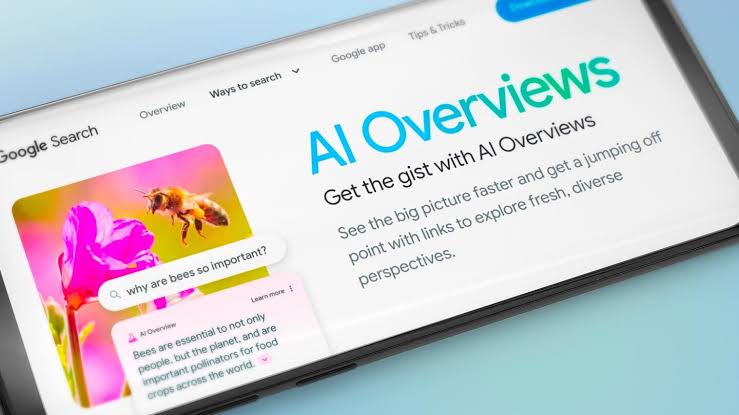
Over the past year, Google quietly changed its search results. Instead of the usual list of blue links, users now often see AI-generated answers what Google calls “AI Overviews.” While sometimes helpful, these summaries have also produced bizarre errors, like suggesting people eat rocks and glue.
READ ALSO: Google’s AI Overviews Hit By EU Antitrust Complaint
According to new Pew Research, AI Overviews affect user behavior. In a study tracking 900 Americans’ browsing habits, users were nearly twice as likely not to click any links when shown an AI summary and 26% ended their session altogether. Pew’s Aaron Smith notes these results suggest AI Overviews may be reshaping how people engage with search.
This is, by all standards, a major shift. Google Search handles five trillion queries a year and serves as the starting point for most online activity.
Many websites especially those focused on content rather than sales rely heavily on ad revenue. Their survival depends on traffic volume, which is largely dictated by Google’s algorithm. A single change to that algorithm can drastically reduce visibility and, in some cases, effectively shut down an entire business overnight.
“Most websites rely on Google traffic to stay afloat,” says Lily Ray, VP of SEO strategy and research at marketing firm Amsive. “But AI Overviews are slashing that traffic so severely that many sites are seeing revenue drop by 20%, 30%, even 40%. It’s devastating and it’s killing the motivation to produce quality content.”
And things may get worse. Google has introduced a new feature called AI Mode, which replaces traditional search results entirely. According to Ray and other experts, this shift could be catastrophic some even warn it may fundamentally break the web.
Google, however, says that’s all nonsense. “We consistently direct billions of clicks to websites daily and have not observed significant drops in aggregate web traffic as is being suggested,” a spokesperson for the company says. “This study uses a flawed methodology and skewed query set that is not representative of Search traffic.”
Pew says it’s confident in its research. “Our findings are broadly consistent with independent studies conducted by web analytics firms,” Smith says. Dozens of reports show AI Overviews cut search traffic as much as 30% to 70% depending on what people are Googling. Ray says she’s personally seen this in data from hundreds of websites.
But Google tells the BBC you should disregard this, because it’s bad research, biased data and meaningless anecdotes. The company says web traffic fluctuates for many reasons, and AI Overviews link to a wider variety of sources and create new ways to discover websites. Google’s spokesperson says the clicks from AI answers are also higher quality because people spend more time on the sites they visit.
Ironically, Google’s own AI disagrees with its PR department. If you ask Google Gemini, it says AI Overviews hurt websites. And according to Ray, the evidence is clear. “Google is trying to spin information and hide the truth because people will freak out,” she says. The company says it’s committed to transparency.
There’s another question though. Is this just what we all want? That’s what Google thinks, at least. “People are gravitating to AI-powered experiences, and AI features in Search enable people to ask even more questions, creating new opportunities for people to connect with websites,” Google’s spokesperson says.
But Ray says that’s missing the point. “Google can say, ‘Oh well, nobody wants to click anymore,’ but they’re benefiting from the hard work everyone else is doing. They’re taking the clicks away from the people who created the content Google’s AI pulled from in the first place,” she says. Forget the websites, though, Ray says AI’s propensity to hallucinate means it’s worse for you, too.