


The Inspector-General of Police (IGP), Kayode Egbetokun, represented at the event by Deputy Inspector-General of Police (DIG) Kenechukwu Onwuemelie, has called for stronger collaboration between security agencies, communities, traditional institutions and other stakeholders to effectively combat insecurity across Nigeria.
Speaking at a strategic stakeholders’ engagement on security in Awka, Anambra State, Onwuemelie said sustainable peace and public safety could only be achieved through mutual trust, intelligence sharing and active community participation.
The meeting, held on the directive of the IGP as part of a nationwide security engagement initiative, brought together traditional rulers, government officials, heads of security agencies, vigilante groups, civil society organisations, transport unions, media practitioners and community leaders to deliberate on prevailing security challenges and practical solutions.
READ ALSO: NPA, Police Move Against Illegal Port Checkpoints in Lagos

According to the DIG, the Inspector-General directed all six Deputy Inspectors-General of Police across the country’s geopolitical zones to engage stakeholders in their respective areas to identify strategies for addressing security threats and strengthening public confidence in law enforcement.
“Security is a collective responsibility. No individual or agency can tackle insecurity alone. The police and other security agencies require the support and cooperation of traditional institutions, community leaders and residents to reduce crime and criminality,” he stated.
He identified cult-related violence, armed robbery, kidnapping, targeted killings and drug trafficking as major drivers of insecurity, stressing that timely intelligence from members of the public remains critical to preventing criminal activities.
Onwuemelie lamented what he described as a culture of silence in many communities, noting that reluctance to share information often enables criminals to operate unchecked.
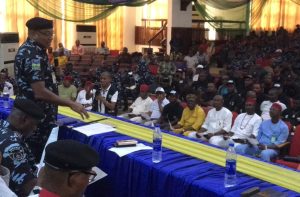
“The people need to trust the police, and the police also need to trust the people. It is only when there is mutual trust between the police and communities that information can flow freely. We need genuine partnership,” he revealed.
The DIG outlined four key pillars for improving security nationwide, listening, collaboration, crime prevention and trust-building, and urged stakeholders to work closely with security agencies and legally recognised vigilante groups to enhance safety at the grassroots level.
He also commended the Anambra State Government for establishing the Agunechemba security outfit, which he said has strengthened collaboration between local security structures and conventional security agencies in the fight against crime.
Addressing concerns over the proposed establishment of state police, Onwuemelie dismissed claims that the Nigeria Police Force was obstructing the process, explaining that the creation of state police requires constitutional amendments by the National Assembly and State Houses of Assembly.
“The power to create state police does not reside with the Nigeria Police Force. It is a constitutional matter that requires legislative action at both the federal and state levels,” he emphasised.
Speaking on behalf of the Anambra State Commissioner of Police, Ikioye Orutugu, the Deputy Commissioner of Police in charge of Operations, Ibrahim Ezekiel, described security as the foundation of economic growth and social development. He urged residents to support security agencies through vigilance and information sharing.
Also speaking, the Secretary-General of the Anambra State Traditional Rulers Council and Traditional Ruler of Uke, Igwe Charles Agballah, called for improved police responsiveness to distress calls and faster prosecution of criminal cases. He commended Governor Chukwuma Soludo’s administration for strengthening security architecture in the state through the Agunechemba initiative.
In his contribution, Alhaji Gidado Siddiki, Sarkin Fulani of Awka, Chairman of the Arewa Community in Anambra State and National Deputy Director-General of the Miyetti Allah Cattle Breeders Association of Nigeria (MACBAN), said Fulani communities are also victims of kidnapping, banditry and cattle rustling in different parts of the country. He urged Nigerians to avoid stereotyping entire ethnic groups based on the actions of a few individuals.
Siddiki also advocated increased government support for the transition from open grazing to ranching, noting that while ranching offers a sustainable solution to farmer-herder conflicts, many herders require sensitisation and training to successfully adopt the system.
The stakeholders’ forum forms part of ongoing efforts by the Nigeria Police Force to strengthen community policing, improve intelligence gathering and foster collaborative approaches to addressing evolving security challenges across the country.

