

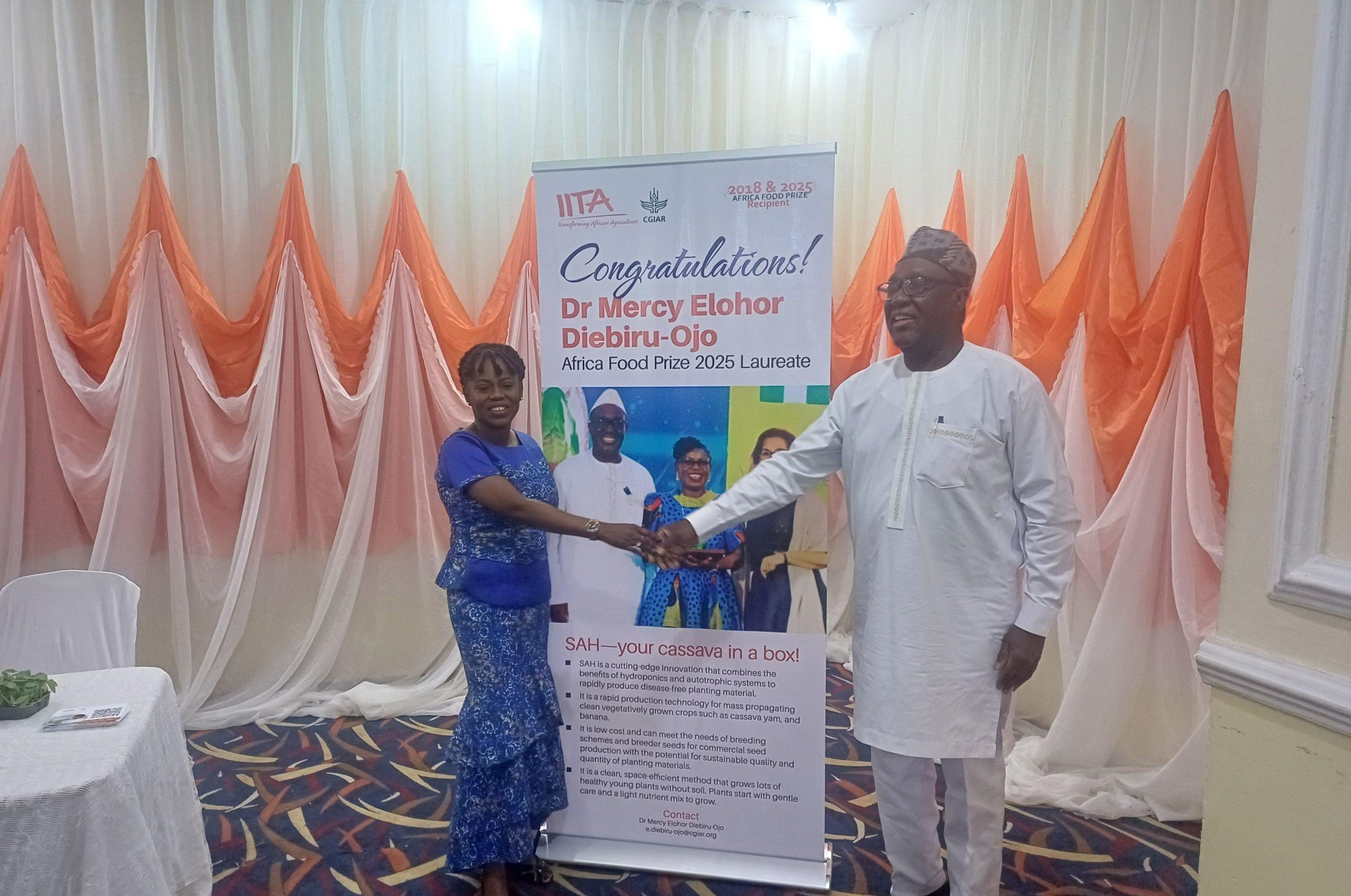
Ene Okwanihe, Abuja
The International Institute of Tropical Agriculture (IITA) has honoured Nigerian researcher, Dr Mercy Elohor Diebiru-Ojo, who won the 2025 Africa Food Prize for her groundbreaking application of Semi-Autotrophic Hydroponics (SAH) technology in the multiplication of cassava and yam seedlings.
The announcement was made earlier this month at the Africa Food Systems Forum in Dakar, Senegal, where Dr Diebiru-Ojo was named a laureate alongside Professor Mary Abukutsa-Onyango of Kenya.
The award, considered the continent’s most prestigious recognition for agricultural innovation, carries a cash prize of US$100,000, shared between the two recipients.
The SAH technology enables rapid multiplication of cassava and yam varieties, providing farmers with clean, disease-free, and vigorous planting materials.
It is suitable for all cassava and yam varieties, helping overcome long-standing challenges in seed systems.
Speaking at a press briefing in Abuja, the IITA Director General, Dr Simeon Ehui, described the achievement as a landmark moment for African agriculture.
“It is a proud day for our Institute and a significant moment for African agriculture. We are here to celebrate Dr Mercy Elohor Diebiru-Ojo, an IITA–CGIAR scientist whose work is transforming how Africa multiplies and delivers clean, vigorous planting materials to farmers.”
He added: “Dr Diebiru-Ojo’s leadership has been pivotal in advancing Semi-Autotrophic Hydroponics (SAH) node culture for cassava and yam, two of Africa’s most important staples. SAH is a clean, nursery-based method that rapidly multiplies disease-free plantlets at scale, lowering risk, shortening time to field, and strengthening seed systems end-to-end.”
Dr Ehui praised her scientific rigour and entrepreneurial drive, noting her role in championing early-generation seed enterprises and partnerships to make quality planting materials more accessible and affordable to farmers.
In her remarks, Dr Diebiru-Ojo acknowledged the support of IITA, CGIAR, the National Root Crops Research Institute (NRCRI), and other stakeholders in her research journey.
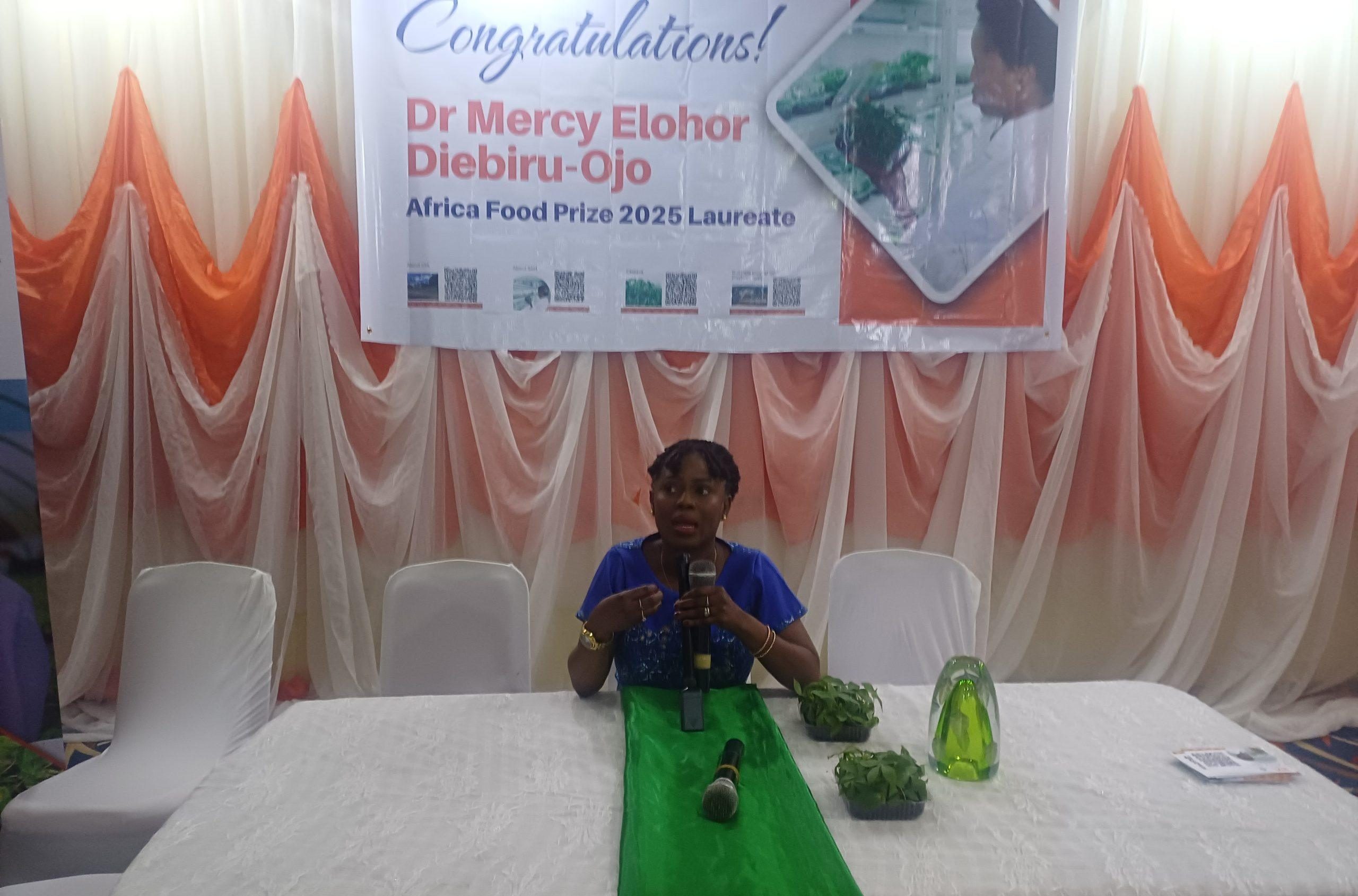
Explaining how the technology works, she said:
“We were the first to adapt it to our own crop, which is cassava. It was the first crop we adapted it to. And from there we moved to yam. So we started using it in a small room, a laboratory and all of that.
“And the essence of the technology was to provide planting materials for cassava. Cassava, as we all know, is a crop that, compared to the counterpart crop of maize and the others, the multiplication ratio is very low.”
She highlighted how the technology addresses a long-standing bottleneck in farmers’ access to improved varieties: “This has been a major, major challenge. And it has also impaired the way farmers access improved varieties, but these varieties are not getting to the farmers, just because the farmers cannot get access to the planting materials. So that is why it’s a major challenge. This technology, when we adopted it, that was what we had in mind.
Read Also: Lawmakers Inaugurate Committee on Naira-for-Crude Oil Policy
“And I’m glad to say today that it has actually solved that problem, and even more. So farmers are now having access to these improved varieties that are improving their productivity and their livelihood. They are no longer doing so much extensive farming.”
Dr Diebiru-Ojo further noted that farmers can now be assured of both the quality and the yield potential of the planting materials.
Showcasing samples of the SAH seedlings, she said:
“As we can see, we can call them cassava in the box, I don’t know if anyone would have seen cassava like this, but these are cassava plantlets. And when you take them to the field, you’ll be amazed what you get.
“Even in one month you’ll see them growing even better than your traditional cuttings. One major thing that made us attracted to the award, or the awardees for this, is the fact that it’s very, very scalable. It’s very replicable. So as we are talking, we don’t only have this technology in Nigeria, we have it in over 15 African countries.”
With her recognition as an Africa Food Prize laureate, Dr Diebiru-Ojo’s innovation is set to strengthen food systems, boost farmer productivity, and contribute significantly to agricultural transformation across the continent.