


 has commenced a nationwide sensitisation programme on Nigeria’s validated National Migration Policy (2025).)
The Nigeria Immigration Service (NIS) has commenced a nationwide sensitisation programme on Nigeria’s validated National Migration Policy (2025), aimed at enhancing migration governance, national security, and international cooperation.
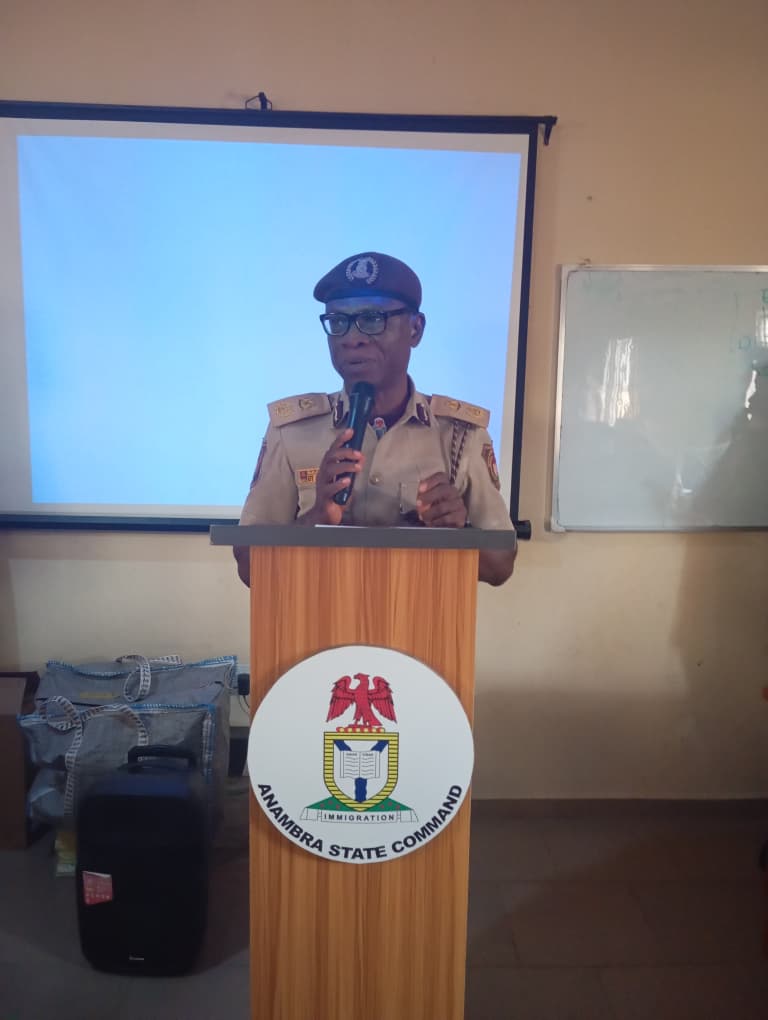
Speaking at the flag-off ceremony in Awka, Anambra State capital, the State Comptroller of Immigration, Umerah Timothy Nwanegbo, represented the Comptroller General of the NIS, Kemi Nandap.
In a keynote address delivered on behalf of the Comptroller General, Nwanegbo described the sensitisation workshop as a critical step in strengthening Nigeria’s migration framework in response to evolving global dynamics.

He noted that the Service has undertaken significant reforms in recent years, including the introduction of the e-Visa regime, Contactless Passport Application System, e-Border infrastructure, Passport Personalisation Centres, and the ECOWAS National Biometric Identity Card (ENBIC).
According to him, migration remains a key driver of national development, security, and international collaboration, requiring a balanced approach.
“Our borders serve as the first line of defence against transnational crimes such as human trafficking, migrant smuggling, and terrorism, while also functioning as gateways for legitimate trade, investment, and tourism,” he said.
He emphasised that the updated National Migration Policy (2025) builds on the 2015 framework, aligning Nigeria’s migration governance with global standards, including the Sustainable Development Goals (SDGs) and the Global Compact for Migration (GCM).
The Comptroller General stressed that the success of the policy will depend on effective implementation by officers across all commands, urging participants to fully engage with the sensitisation programme and apply its provisions in their duties.
In her opening remarks, the Command’s Public Relations Officer, Onyinye Anene, encouraged officers to actively participate and leverage the training to enhance professionalism and service delivery.
Also speaking, the facilitator, Greg Oluyole, highlighted the evolution of the policy, noting that the original document was adopted in 2015 and reviewed in 2025 to reflect emerging migration trends.
He explained that the updated policy was developed with technical support from the International Organization for Migration (IOM) and the European Union, positioning it as Nigeria’s most comprehensive migration governance framework to date.
Oluyole added that while awaiting formal presidential assent, the Service has commenced sensitisation efforts to ensure that immigration officers are adequately informed and prepared for implementation.
He further noted that the policy review process incorporated thematic working groups and addresses contemporary migration challenges, including irregular migration trends popularly referred to as “Japa.”
The event featured interactive question-and-answer sessions and concluded with a photo session among participants.