

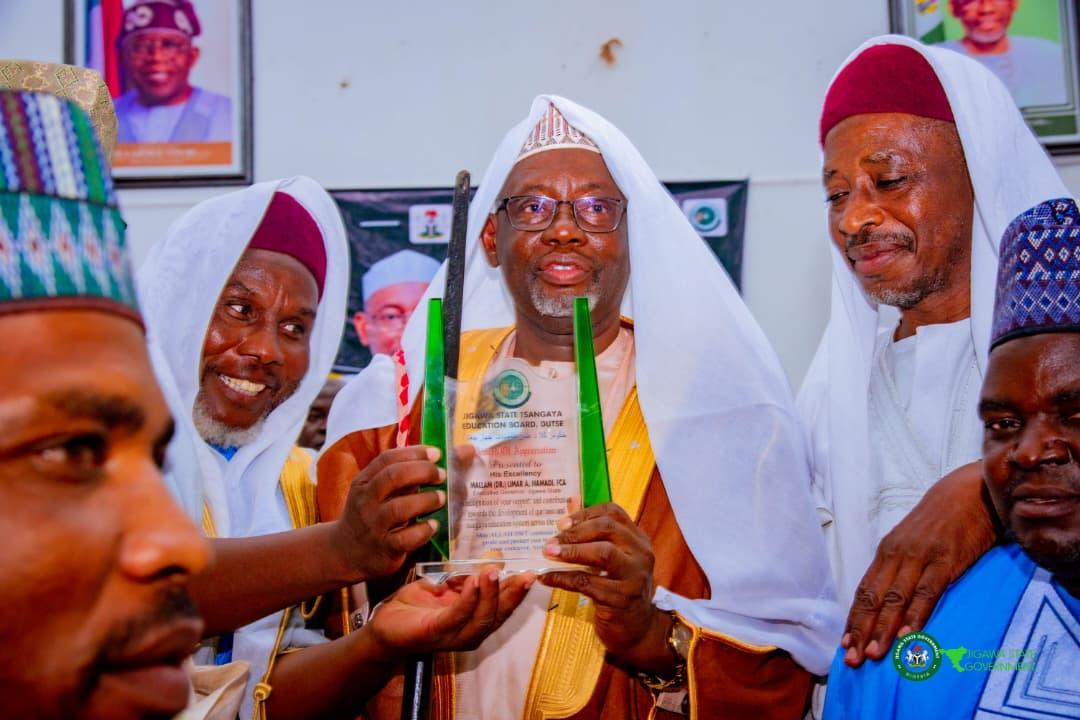
The Jigawa State Government in North West Nigeria has restated its commitment to reforming and modernising the almajiri education system, positioning the initiative as a model that could strengthen Qur’anic education across Nigeria.
Governor Umar Namadi made this known while presiding over a special interactive session with Tsangaya school teachers from across the state, under a programme tagged “Gwamnati Da Tsangaya” (Government Engagement with Tsangaya Schools).
The forum, organised by the Jigawa State Tsangaya Education Board, is designed to deepen collaboration between government and key stakeholders in Qur’anic education, while providing teachers with an opportunity to present their challenges, expectations, and proposals for improving the welfare and future prospects of almajiri pupils.
The event attracted prominent Qur’anic reciters from different parts of the country, underscoring the national relevance of Jigawa’s Tsangaya reform agenda amid growing calls for a holistic approach to almajiri education nationwide.
Governor Namadi described the engagement as historic, noting that it was the first time top government officials, including the governor, deputy governor, commissioners, and lawmakers, were jointly engaging Tsangaya teachers in a structured dialogue since the establishment of the Tsangaya Education Board.
He stressed that Qur’anic education must no longer be treated as peripheral, disclosing that Jigawa State has more than 4,000 Tsangaya and Qur’anic schools with over 1.3 million pupils, figures that surpass enrolment in conventional primary schools in the state.
According to him, neglecting such a large segment of learners would pose serious social and developmental risks, which informed the decision to institutionalise Tsangaya education and make it a permanent feature of the state’s annual budget.
“An almajiri is not an out-of-school child; an almajiri is a student. That is why we resolved to improve this system of education and restore dignity to this form of learning,” the governor said.
Governor Namadi explained that the state’s reforms aim to modernise almajiri education without eroding its religious and cultural foundations.
He said Tsangaya schools in Jigawa are being transformed into integrated institutions where Qur’anic memorisation, basic modern education, and vocational skills are taught concurrently.
He further disclosed that the state is working with the National Board for Arabic and Islamic Studies (NBAIS), under which nearly 100 Qur’anic teachers have already been trained and certified, in line with national education standards.
“Our goal is that at every stage of Qur’anic education, learners will receive recognised certification, just like in the conventional school system,” he added.
As part of future plans, the governor announced that the 2026 budget will provide for the recruitment of 500 Tsangaya teachers, alongside phased training programmes and increased funding for Qur’anic and Tsangaya schools.
Strengthening Education
Earlier, the Executive Secretary of the Jigawa State Tsangaya Education Board, Dr Abubakar Maje Hamisu, commended the governor’s leadership and outlined ongoing interventions, including the establishment of Mega Tsangaya Schools, renovation of model schools, integration of modern subjects, large-scale provision of learning materials, and expansion plans for 2026.
He said the state’s Almajiri Begging-Free Zone initiative had led to the enrolment of 2,000 almajiri children into government-owned Tsangaya schools across major towns and local government areas.
Dr Hamisu reaffirmed the Board’s commitment to working with teachers, communities, and development partners to align Tsangaya education with contemporary standards while preserving its moral and religious values.
A press statement by the Governor’s Chief Press Secretary, Hamisu Gumel, said Governor Namadi was recognised as Patron of the Qur’anic Reciters Association of Nigeria, in acknowledgement of his administration’s sustained support for Qur’anic education and Tsangaya institutions.