
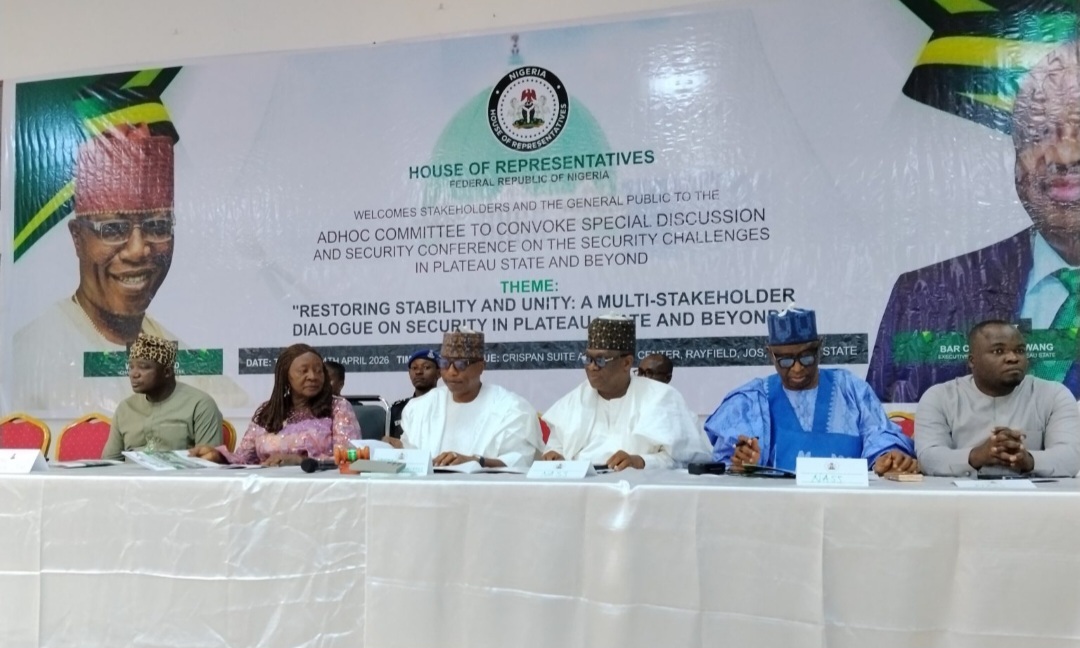
Lawmakers in the Federal House of Representatives, and other key stakeholders, have gathered for a landmark dialogue spearheaded by the House of Representatives Ad-Hoc Committee on Security Challenges in Plateau State and Beyond.
The one-day conference brought together traditional rulers, religious leaders, security agencies, and civil society actors under one roof.
Themed, “Restoring Stability and Unity,” the meeting underscored a shared determination, driven by the National Assembly, to chart a sustainable path toward peace in a region long troubled by recurring violence.
Declaring the conference open, Plateau State Governor Caleb Mutfwang described the gathering as both timely and necessary.
Represented by Deputy Governor Josephine Piyo, he emphasized that Plateau’s security challenges reflect a broader national concern requiring coordinated legislative and executive action.
“Plateau’s security situation is part of a broader national concern demanding collective action, strategic thinking, and sustained engagement. I recount that successive administrations had grappled with recurring cycles attacks despite concerted efforts by former governors including Senator Joshua Dariye, Senator Jonah Jang, and Senator Simon Lalong. My administration placed security of lives and property at the forefront of my priorities, revamping Operation Rainbow, recruiting personnel across the state, and establishing the Plateau Activity Centre equipped with drone surveillance to support coordinated operations,” he said.
The governor disclosed that over 300 operational vehicles belonging to security agencies had been refurbished, while motorcycles were procured to improve rapid response in rural and hard-to-reach communities.
“My Administration, has also reconstituted the Plateau State Inter-Faith Advisory Council to foster trust and promote understanding among diverse groups. These coordinated strategies had yielded relative peace until recent setbacks. Let me stress that security goes beyond deployment of personnel and encompasses justice, inclusion, economic opportunity, and assurance that every citizen has a stake in peace. The state is investing in peacebuilding initiatives that promote dialogue, reconciliation, and community ownership of security processes, while also addressing socio-economic drivers such as youth unemployment, rural vulnerability, and misinformation,” he said.
Read Also: President Tinubu Approves Measures to Prevent Jos Attack Recurrence
Plateau Unrest: Troops Launch Stop-and-Search Measures
Plateau Attack: Nigerian Government Reaffirms Security Commitment
The Speaker of the Federal House of Representatives, Abbas Tajudeen, who was represented by the Federal Lawmaker representing Shendam,/Mikan Constituency, John Dafa’an framed the conference as a decisive step by the House to confront insecurity head-on.
He cited the heavy human toll of past conflicts and recent attacks, stressing that the legislature is committed to backing policies and reforms that will prevent further loss of lives.
Dafa’an outlined key pathways for restoring stability, including institutionalizing inclusive peacebuilding platforms, strengthening intelligence and early warning systems with technology and community networks, reforming land governance, and enhancing community policing.
He reiterated the National Assembly’s support for President Bola Tinubu’s determination to establish state police, and urged the state to empower responsible vigilante groups and traditional institutions within the ambit of the law.
Peace Through Dialogue and Trust
The Chairman of the Ad-Hoc Committee, Honorable Wale Hammed, reinforced the leadership role of the House in seeking lasting solutions. He emphasized that peace cannot be enforced by force alone but must be built through inclusion, dialogue, and trust.
By offering even closed-door sessions for sensitive testimonies, the committee demonstrated its readiness to listen and translate concerns into concrete legislative action.
Participants at the Conference, emphasized the importance of intelligence sharing, community policing, and land reforms, aligning with the National Assembly’s push for structural solutions with the backing of Nigeria’s President Bola Ahmed Tinubu as critical to ensuring that legislative efforts are matched with executive action.

