

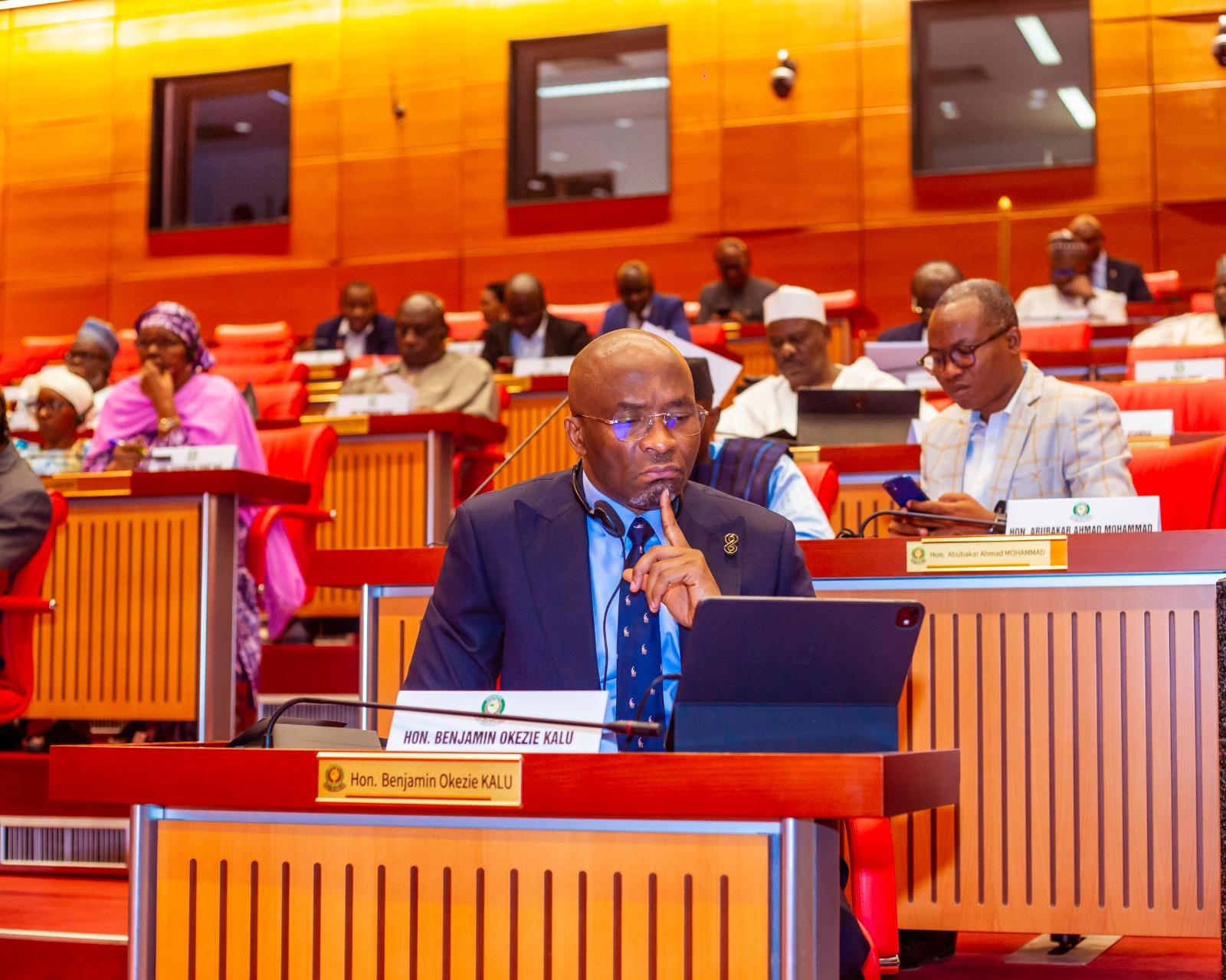
The Deputy Speaker of Nigeria’s House of Representatives, Benjamin Kalu, has called on West African leaders to embrace digital payment platforms as a practical step toward deepening trade within the Economic Community of West African States (ECOWAS).
Kalu said the region must move beyond prolonged debates over a common currency.
Speaking on the sidelines of regional economic discussions, Kalu said intra-African trade within ECOWAS remains significantly lower than expected, despite years of integration efforts.
According to him, while Africa’s trade with other parts of the world has seen about a 16 per cent increase in 2025, trade among ECOWAS member states stands at roughly 11 percent.
This, he said ought not to be so, attributing the weak performance to poor infrastructure and bureaucratic bottlenecks at border points.
He decried what he described as “rate tapism,” a situation where cargo trucks spend long hours at borders after already enduring extended travel time.
“After 14 hours on the road, trucks stay another 14 hours before they are cleared. It is affecting trade. The 2time you will use to get your goods into Europe, you are in Africa and you are being delayed,” he stated.
Kalu noted that while ECOWAS has long pursued the idea of a single currency, disagreements and economic disparities among member states have slowed progress.
Rather than remain stuck on the issue, he proposed a shift toward digital currency and regional digital payment platforms.
He said, “While we struggle with whose head will be on the currency, I think it is about time we begin to think about digital payment platforms. That which we could not do with paper notes, we can do through digital platforms.”
He explained that such a system would significantly cut costs associated with dollar-denominated transactions, which he said currently cost the ECOWAS region about $5 billion in charges.
By enabling transactions in local currencies through digital platforms, member states could retain more value within the region.
The Deputy Speaker argued that strengthening payment systems alongside fixing infrastructure would transform regional trade from what he called “paper diplomacy” into tangible economic benefits under the African Continental Free Trade framework.
Addressing concerns that digital currency could sidestep the issue of high inflation across West Africa, a key condition for monetary convergence under a single currency regime, Kalu stressed that increased intra-regional trade would naturally help stabilise prices.
“Inflation is going to drop if there is more trade among ourselves,” kalu stated, noting that many goods consumed in the region are imported from outside Africa.
He advocated for a strategy of nearshoring, where technology and capital are brought closer to raw material sources within Africa to boost local production.
Using cocoa as an example, he said Nigeria and Ghana should focus less on trading raw cocoa among themselves and more on developing processing industries.
“If we convert cocoa farms into chocolate factories, we increase productivity, reduce unemployment and export finished products instead of raw materials,” he explained,” he said.
He made a similar case for lithium, suggesting that instead of exporting raw lithium abroad and re-importing finished batteries, African countries should develop battery manufacturing capacity within the region.
“When these economic activities are stimulated, the ripple effect is that inflation goes down. There is a lot to gain if we trade more among ourselves, reduce importation and encourage production,” Kalu said.
He is optimistic that ongoing deliberations among regional leaders would address infrastructure gaps, border inefficiencies and payment systems.
The Deputy Speaker added that improved movement of goods and services would ultimately strengthen ECOWAS integration and economic growth.