

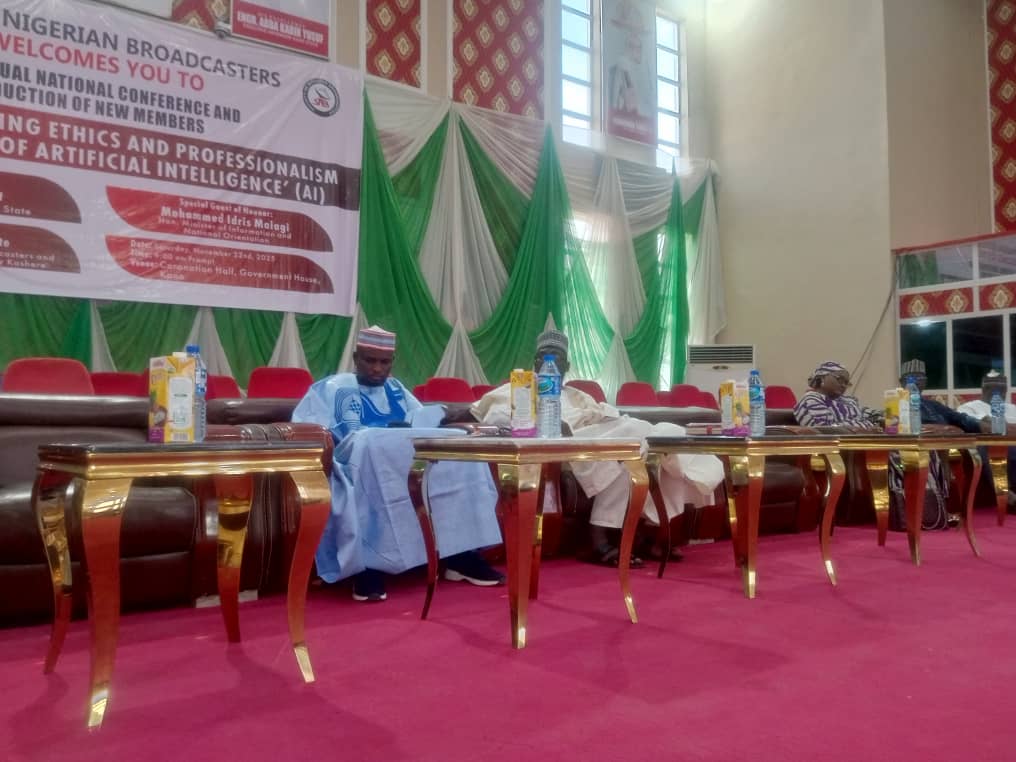
The Kano State Governor Abba Kabir Yusuf has formally prepared a policy memorandum for submission to the Senate Committee on Information, positioning his administration at the centre of Nigeria’s ongoing national debate on strengthening broadcast regulation and professional standards.
The memorandum, developed after wide-ranging consultations with media experts, legal practitioners, and civil society groups, is part of the ongoing review of the National Broadcasting Commission (NBC) Act by the National Assembly.
The Governor announced this during the 2nd Annual National Conference and Induction Ceremony of the Society of Nigerian Broadcasters (SNB) held in Kano, North West Nigeria.
The conference, themed “Broadcasting Ethics and Professionalism in the Age of Artificial Intelligence (AI),” drew national stakeholders who discussed the fast-changing media environment and the growing concerns over misinformation, digital manipulation, and ethical lapses in modern broadcasting.
Represented by his spokesperson, Sanusi Bature, Governor Yusuf said; “the document outlines critical policy reforms needed to strengthen Nigeria’s media ecosystem particularly as the influence of online content, political messaging, and religious broadcasting continues to expand.”
He noted that he had earlier, at the 2025 Africa Summit in Lagos, challenged the NBC to review and enforce stricter standards on digital content, especially materials that could inflame social tensions.
According to Governor Yusuf, the memorandum submitted to the Senate highlights several priority areas requiring legislative attention, including regulation of digital broadcasting and online media platforms, stronger ethical standards for political and religious programming, protection and welfare of journalists and media workers, adoption of global best practices in the era of artificial intelligence and stronger penalties for harmful or unprofessional broadcasting.
The interventions he said, “demonstrates his commitment to contributing to national reforms aimed at improving media accountability and professionalism.”
National Reforms
Speaking at the conference, President of the Nigerian Society of Broadcasters (NSB), Professor Umaru Pate emphasised the need for improved competence, ethics, and safety for journalists working in an increasingly challenging environment shaped by insecurity, disinformation, and political tension.
He said; “the SNB is focused on strengthening content quality, credibility, and technological adaptation to ensure Nigerian broadcasters remain relevant globally.”
“Our happiness will be for our members to be respected and to work anywhere based on their competence,” he said.
VON Position
The Director General of Voice of Nigeria (VON), Malam Jibrin Baba Ndace, represented by Deputy Director IT, Sani Balarabe Yusuf reaffirmed the organisation’s commitment to projecting Nigeria positively on the global stage.
Similarly, the Director General of the National Broadcasting Commission (NBC), Charles Ebuebu described the conference as ‘timely,’ noting that “artificial intelligence is rapidly transforming news production, audience analytics, and content distribution.”
However, he warned that AI also introduces significant risks, including misinformation, deepfakes, job displacement, and automated content manipulation.
NBC Proposes Solutions
To address AI-related threats, the NBC DG recommended; Strengthening verification and editorial standards, Using deepfake-detection and voice-cloning identification tools, Establishing crisis-response protocols and Improving collaboration among media organisations as well as Developing internal AI-usage policies for broadcasters and Enhancing staff training and digital literacy.
The conference agreed on a renewed national call for responsible, ethical, and technologically adaptive broadcasting to safeguard Nigeria’s democracy, unity, and social stability.
Olusola Akintonde