

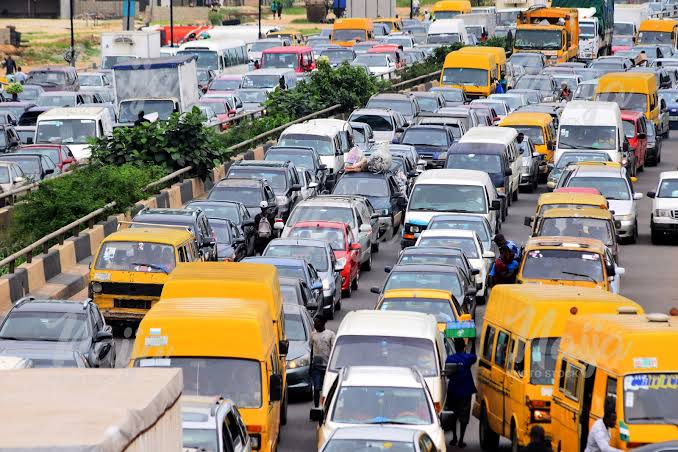
The Lagos State Government has said that Lagosians lose an average of four hours daily due to traffic congestion, resulting in an estimated N4trillion in annual economic losses.
Special Adviser to the Governor on Transportation, Mr. Sola Giwa disclosed that to enhance logistics coordination, ease traffic congestion, and improve road safety, the Lagos State Government has announced the enforcement of an Electronic Call-Up (E-Call-Up) system, with effect from Monday, June 16, 2025, for all tankers and articulated vehicles operating along the Lekki-Epe corridor.
Mr. Giwa explained that all tanker and articulated vehicle drivers entering Lagos to load or offload goods must now register and schedule their movement through the E-call-up platform saying the digital system is designed to coordinate truck movements, reduce indiscriminate roadside parking, and minimise disruptions to other road users.
He noted that Lagosians lose an average of four hours daily due to traffic congestion, resulting in an estimated N4trillion in annual economic losses.
The Special Adviser attributed much of this gridlock to unregulated parking, disorderly loading and unloading activities along major logistics routes.
According to him, “Under the new system, tanker operators will be required to upload their Authority to Load (ATL) and pre-book assigned parking slots before arriving in Lagos.
He said the E-call-up platform will also collect vital travel and cargo information, enabling efficient allocation of designated parking spaces noting that the facilities will be equipped with basic amenities such as rest-rooms, kitchens, and electricity to ensure the comfort and safety of drivers.
Mr. Giwa further disclosed that the government has approved seven dedicated truck parks along the Lekki-Epe axis to support the system’s implementation.
He emphasised that the policy is the outcome of over two years of extensive stakeholder engagement and forms a critical part of the State’s broader transportation reform agenda aimed at transforming Lagos into a smart, resilient, and Iivable city.
Hauwa Abu