


The Founder of the Medicaid Cancer Foundation, Dr Zainab Shinkafi-Bagudu, has advocated for renewed national collaboration to tackle cancer in Nigeria, stressing that defeating the disease requires a united front across all sectors of society.
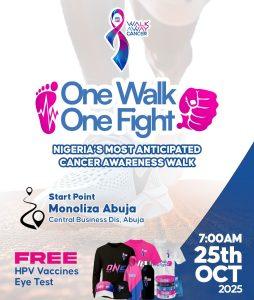
In an exclusive interview with Voice of Nigeria ahead of the 11th edition of the Medicaid Cancer Walk, Dr Bagudu said the event, themed “One Walk, One Fight, One Mission”, aims to deepen public awareness, strengthen partnerships, and amplify both government and citizen action against cancer nationwide.
“Whether you are a doctor, a market woman, a pharmacist, a banker, or a chief in his village— we all have one mission, which is to beat cancer,” she said.
Advocacy and Impact Report
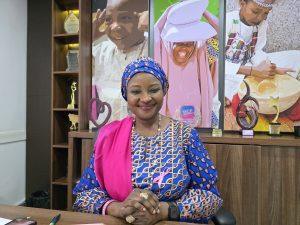
Dr Bagudu described herself as a paediatrician turned cancer advocate, who has spent the last two decades leading awareness, treatment access, and policy reform efforts through the Medicaid Cancer Foundation and affiliated international bodies like the Union for International Cancer Control.
“Through the Medicaid Cancer Foundation and other organisations like the Union for International Cancer Control, we work to improve cancer control in low- and middle-income countries, first of all in Nigeria, and beyond,” she said.
She elucidated that the Foundation promotes awareness, influences policy, and provides palliative and treatment support for patients.
“We might not be able to afford full treatment for all, but we try to impact their welfare as much as we can,” she added.
Building Awareness Through Action
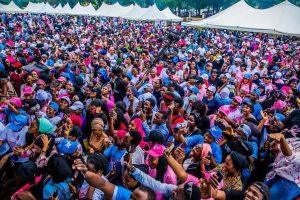
Dr Bagudu explained that the Medicaid Cancer Walk, now in its 11th year, has evolved into a major public health mobilisation platform drawing thousands from across Nigeria, triggering curiosity and conversation, often prompting individuals to seek information or screening.
“Each year, we take over the streets of Abuja, and that spectacle alone triggers curiosity and questions. Someone along the route always stops to ask what it’s about, and that spark can save a life,” she said.
She emphasised that the walk goes beyond exercise: it’s “a movement of empathy, education, and empowerment,” offering free and discounted screenings, palliative aid, and community engagement.
Nigeria’s Cancer Burden
According to the World Health Organisation (WHO) and the International Agency for Research on Cancer (IARC), Nigeria recorded about 127,763 new cancer cases and 79,542 cancer-related deaths in 2022, as reported by the Global Cancer Observatory.
Data from the CanScreen5/IARC country fact sheet indicate an age-standardised incidence rate of 113.6 per 100,000 persons per year and a mortality rate of 74.6 per 100,000 persons per year. Among women, breast cancer remains the most common cancer by incidence and mortality, while prostate cancer leads among men.
The World Health Organisation (WHO) notes that limited diagnostic capacity and uneven registry coverage continue to affect accurate cancer data collection across the country.
The Renewed Hope Agenda Alignment
Dr Bagudu, who also serves as Senior Advisor to the Coordinating Minister of Health and the President Elect (2024-2026), Union for International Cancer Control (UICC), highlighted ongoing government efforts under the Renewed Hope Agenda to expand cancer care infrastructure and access nationwide.
She said six new cancer treatment centres are being established; three already commissioned and functional, and three more nearing completion, managed and maintained through public-private partnerships.
“Under the Renewed Hope Agenda, we are witnessing remarkable improvements in cancer treatment facilities. The difference now is that they are managed with sustainability in mind,” she explained.
She further disclosed that the National Cancer Health Fund now supports patients in six tertiary hospitals, offering subsidised or free treatment through digital e-wallet systems.
“We have over a hundred patients currently benefitting from the Cancer Health Fund. It exists, and it works,” Dr Bagudu affirmed.
Harnessing Innovation and Youth Power
The 2025 edition of the walk, she noted, is being driven largely by young people and enhanced by technology.
“We start planning every December, and this year I’ve taken a step back because I love to see young people lead. They bring creativity, new tools, and energy— even integrating artificial intelligence into our outreach,” she said.
Dr Bagudu expressed concern that artificial intelligence and genomic research are reshaping global cancer care, yet Africa remains underrepresented in data.
“Only two per cent of genomic data used in developing new cancer drugs comes from Africa. So, how do we expect these drugs to be fully effective for our people? We are advocating for local participation in AI and research,” she emphasised.
Global Engagement and National Recognition
Dr Bagudu said Nigeria’s visibility on the global stage is increasing, citing her recent participation at the United Nations General Assembly alongside Nigeria’s Minister of State for Health.
“On the global stage, Nigeria is really out there. We’re identifying our gaps and receiving support to close them,” she stated.
She added that the National Cancer Control Plan, which she helped develop as Chair of its Finance and Advocacy Committee, continues to guide national policy actions.
Partnerships, Support and Public Engagement
She acknowledged the long-term support of partners, including the UBA Foundation, Wacot Rice-Kebbi, MedSERVE, NSIE, and numerous high-net-worth individuals and donors.
“We’ve raised about ₦3 billion to date — not a huge sum, but for civil society, that’s impact. Most of it goes directly to patients and early-career researchers,” she said.
She added that the Foundation works with influencers and celebrities from across Nigeria to promote awareness. “We have northern and southern artists, sports stars, and social media influencers joining us. It’s corporate social responsibility with real impact,” she said.
Rising Cancer Burden and Data Necessity
According to Dr Bagudu, cancer incidence documentation in Nigeria continues to improve due to increasing awareness and diagnostic capacity.
She noted that Nigeria’s reported cases, about 120,000 annually, remain lower than comparable nations like Brazil, where over 400,000 cases are recorded, largely due to stronger registry systems.
“We need to strengthen our health system from the grassroots, from primary healthcare to tertiary centres. Early detection starts at the primary care level,” she said.
She lamented that most Nigerian patients are still diagnosed at late stages III and IV, leading to low survival rates.
“In developed countries, breast cancer survival after five years is 95 per cent. Here, it’s closer to 25 per cent,” she noted.
Dr Bagudu added that the National Institute for Cancer Research and Treatment (NICRAT), which she advocated into existence, is now coordinating registries, disbursing research grants, and implementing the National Cancer Control Plan.
Challenges and Insurance Coverage Advocacy
Dr Bagudu identified late diagnosis, myths, misinformation, and inadequate insurance coverage as major barriers to effective cancer control, emphasising the need for homegrown awareness models, engaging traditional and religious leaders, sports icons, and celebrities to demystify cancer and encourage early action.
“Many people still believe cancer cannot be treated. Myths and low awareness are killing people. We need homegrown education using traditional rulers, religious leaders, and sports figures,” she urged.
She advocated for universal health coverage that fully integrates cancer care.
“Until every Nigerian has insurance coverage that includes diagnosis, chemotherapy, and radiotherapy, cancer will keep bankrupting families,” she advocated.
Future Vision
Sharing her dream project, Dr Bagudu said she plans to establish a dedicated indigent cancer centre that would provide full diagnostic and treatment services at minimal cost.
“We were allocated land for it, but funding has been difficult. I don’t want a centre charging millions per cycle. I want a place where the poor can walk in with dignity and receive treatment without despair,” she added.
Call to Action
As Nigeria marks the 11th Medicaid Cancer Walk, Dr Bagudu urges Nigerians to take personal responsibility for early detection and prevention.
“For women, monthly self-breast examination is essential. Tell your daughters and sisters — it doesn’t cost anything. If you find something abnormal, seek care,” she advised.
She also reaffirmed that the Cancer Health Fund is operational, with “over a hundred patients benefiting currently. Cancer is a tough disease, but we are tougher. Together, we can beat it.”
She encouraged citizens to participate in the upcoming Medicaid Cancer Walk as a symbolic step in the fight against cancer.
“You don’t have to be rich to make an impact. Buy a t-shirt, our slogan says it best — This t-shirt saves lives! Spread the word, or just walk. It’s a family event, a fun event, and a networking event. Some people call it their annual family holiday,” she said.
Dr Bagudu further shared her long-term vision:
“My dream is a Nigeria where cancer is no longer a death sentence. We may not reach it in my lifetime, but the journey has begun, and every step we take together brings that dream closer. We must detect it early, treat it boldly, and never give up hope,” she said.
Renewed Hope Agenda Commitment
In a show of commitment to addressing challenges in the Nigerian cancer sphere, the Renewed Hope Agenda of President Bola Ahmed Tinubu has strengthened health infrastructure to improve cancer care.
Six new oncology and radiotherapy centres in Ibadan, Abeokuta, Katsina, Enugu, Benin, and Abuja have been established or upgraded to expand access to treatment.
The National Health Insurance Authority (NHIA) has also partnered with Roche to make essential cancer medications more affordable through a cost-sharing arrangement.
These initiatives reinforce the government’s continuing commitment to expanding access and improving quality in cancer management across Nigeria.