
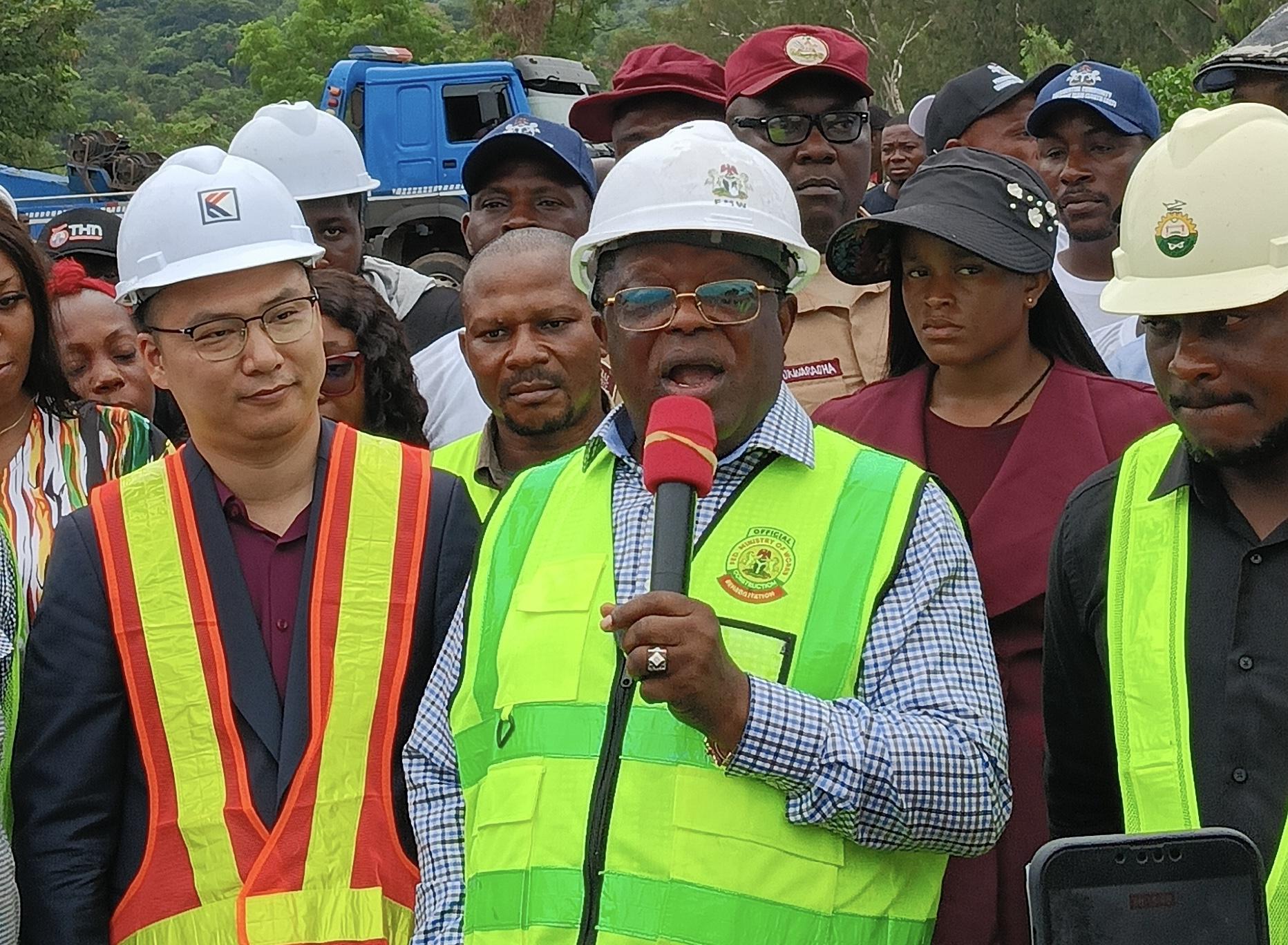
Nigeria’s Minister of Works, David Umahi, has commissioned completed sections of the Enugu–Onitsha Expressway, underscoring the project’s strategic importance to economic growth and regional connectivity in the Southeast.
Speaking during the inauguration on Thursday, Umahi described the development as a major turning point for transportation and commerce along one of the region’s busiest corridors.
He recalled that before the intervention of the current administration, commuters and freight operators spent over seven hours traveling between Enugu and Onitsha, resulting in high transportation costs, delays in goods delivery, and reduced economic productivity.
Read also: Enugu-Onitsha Road Nears Completion, Opens By March 31
“This is the most important route in the Southeast,” the minister said, noting that although the contract was awarded years before 2023, the project remained largely abandoned for nearly eight years with minimal progress.
Umahi explained that the road was initially executed under a tax credit scheme involving MTN and construction firm RCC, but suffered prolonged setbacks until President Bola Tinubu directed its acceleration and redesign.
According to him, the Federal Government reviewed the original ₦202 billion contract, retaining part of it while designating a 72-kilometre section for reconstruction using reinforced concrete pavement.
The redesigned section, valued at about ₦150 billion, is being constructed to higher durability standards similar to those adopted for the Lagos–Calabar Coastal Highway.
Umahi disclosed that the total reconstruction cost of the Enugu–Onitsha road has now exceeded ₦350 billion, reflecting both the scale of work and the government’s renewed commitment to infrastructure delivery.
Providing an update, the minister said the first 15 kilometres of the concrete section are 97 percent completed and have been opened to traffic to ease movement during the Easter period.
Umehi stated that an additional 18-kilometre stretch is under construction towards Anambra State, while work is ongoing on a separate 39-kilometre segment from the Niger Bridge axis.
He further directed contractors handling asphalt portions to adopt reinforced concrete for the remaining 23 kilometres, citing its longer lifespan and lower maintenance costs.
“Asphalt fails over time, but concrete can last between 50 and 100 years with little or no maintenance,” Umahi stated.
He emphasised that, upon completion, at least 50 percent of the highway would be constructed with reinforced concrete, a move expected to significantly reduce lifecycle costs and ensure sustainability.
Enhance Trade Flow
Beyond improving travel time, the Minister noted that the upgraded highway would enhance trade flows between key commercial hubs, reduce vehicle operating costs, and boost small and medium-scale enterprises that depend on efficient logistics across the Southeast.
He also highlighted ongoing federal infrastructure projects in the region, including sections of the Enugu–Port Harcourt Expressway nearing completion, the dualisation of the Enugu–Abakaliki road, and the reconstruction of the Afikpo–Abia–Okigwe corridor under a tax credit scheme.
Additional works include upgrades to the Aba–Port Harcourt road, construction of access roads and bypasses linked to the Second Niger Bridge, as well as multiple flyovers and interchanges aimed at easing congestion and improving urban mobility.
The Minister further noted that previously collapsed bridges along the Enugu–Onitsha corridor have been rebuilt and fitted with solar-powered lighting systems, aligning with the government’s broader highway illumination initiative to improve safety and security.

