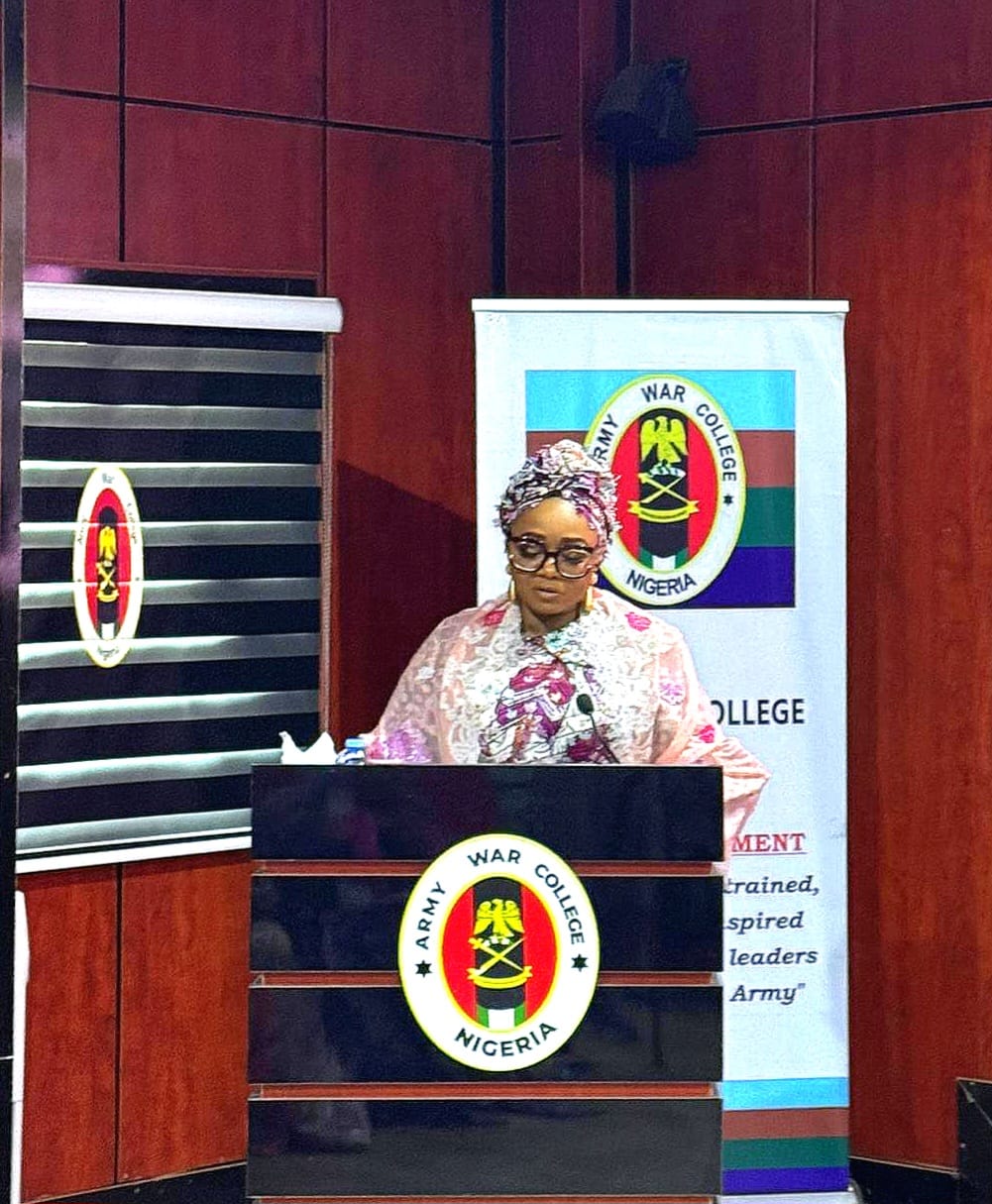
The Minister of Women Affairs and Social Development, Hajiya Imaan Sulaiman-Ibrahim, has called for the institutional integration of gender-responsive leadership frameworks within Nigeria’s security architecture to strengthen operational effectiveness, national cohesion, and sustainable development.
Delivering a lecture titled “Gender Dimension in Leadership” at the Army War College Nigeria to participants of the Higher Military Strategy and Management Course 10/2026 in Abuja, the Minister charged senior officers to embrace inclusive leadership models capable of strengthening operational effectiveness, institutional resilience, and national security.
Addressing military officers from Nigeria and allied nations, Sulaiman-Ibrahim emphasised that gender inclusion should be treated as a strategic governance and policy imperative rather than a symbolic social intervention.
“This lecture is not primarily about victimhood. It is about the nature of leadership itself and about how our assumptions around gender distort our understanding of what good leadership looks like,” she stated.
Leadership Beyond Gender Stereotypes
Drawing extensively from leadership theories and operational experience, the Minister explained that contemporary security environments require leadership models built on adaptability, collaboration, empathy, accountability, strategic influence, and strategic thinking qualities historically undervalued because they were often associated with women.
Referencing global studies validating that transformational and servant leadership approaches have produced stronger institutional outcomes in both military and civilian settings, she quoted leadership scholar Peter Northouse, noting that leadership is fundamentally about influence and the ability to inspire collective action toward shared goals.
“When gender norms constrain who can occupy positions of influence and how those in authority are expected to behave, we narrow the range of leadership styles available to an institution,” she said.
According to the Minister, institutions that fail to harness diverse leadership approaches risk becoming “more rigid, less adaptive, and ultimately less effective.”
Gender Inclusion And Military Operations
The Minister stressed that gender-sensitive leadership remains critical in modern military operations, particularly in counterinsurgency, peacekeeping, and community engagement missions.
She noted that evidence from global peace support operations shows that women personnel improve intelligence gathering, community access, and responses to gender-based violence in conflict environments.
“In those environments, the capacity to listen, to build relationships, and to demonstrate empathy without projecting weakness are not soft skills. They are strategic competencies,” the Minister said.
Institutional Reforms And Accountability
The Minister identified unconscious bias, structural exclusion, exclusionary institutional cultures, and limited mentorship opportunities as persistent barriers confronting women within leadership institutions globally.
She observed that Nigeria’s low representation of women in political and military leadership positions reflects broader structural inequalities requiring deliberate policy reforms.
Hon. Sulaiman-Ibrahim stressed the need for institutional measures focused on recruitment, retention, career progression, and gender-sensitive operational planning within the Armed Forces.
She also underscored the importance of implementing the United Nations Security Council Resolution 1325 on Women, Peace and Security through measurable accountability mechanisms.
According to her, Nigeria’s Third National Action Plan on UNSCR 1325, supported by a digital monitoring framework, represents a major step toward institutionalising gender-responsive security governance.
“The responsibility for setting the tone, for making clear through consistent action that the dignity of every person is non-negotiable, rests with commanders,” she said.
Call For Courageous Leadership
The Minister urged military leaders to deliberately mentor women officers and create inclusive command structures capable of maximising talent across gender lines.
She further challenged Course Participants to confront cultural biases that undermine fairness, professionalism, and institutional effectiveness.
“Leadership, at its best, is an act of courage. It is the courage to hold a vision when others cannot see it,” she stated.
Minister Sulaiman-Ibrahim maintained that building equitable institutions would enhance professionalism, operational resilience, and public trust within Nigeria’s security sector, ultimately producing “smarter, more adaptive, more resilient, and more effective” organisations.
The lecture forms part of the Army War College, Nigeria, Higher Military Strategy and Management Course designed to prepare senior officers for strategic leadership responsibilities within Nigeria’s security architecture.