

Nigeria’s fight against Technology-Facilitated Gender-Based Violence (TFGBV) gained renewed momentum on Tuesday as government leaders, development partners, prosecutors, and civil society actors convened at the 11th Network Conference of Sexual Assault Referral Centres (SARCs), held during the 2025 16 Days of Activism Against GBV.
Delivering her goodwill message, the Minister of Women Affairs and Social Development, Haji Imaan Sulaiman-Ibrahim, said the convening comes “at a critical moment as we collectively confront the rapidly growing threat of Technology-Facilitated Gender-Based Violence (TFGBV); a new dimension of harm shaped by the speed and reach of modern digital technology.”
She reaffirmed that the Ministry, under the Renewed Hope Agenda, is strengthening national and sub-national GBV protection systems, including through the Renewed Hope Social Impact Intervention (RHSII–774). She highlighted Nigeria’s progress with legislation, noting that all 36 States have now passed the Child Rights Act while 35 States have domesticated the VAPP Act.
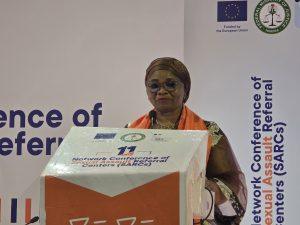
Represented by Princess Jummai Idonijie, the Minister also stressed the urgency of expanding Sexual Assault Referral Centres nationwide. “Today, Nigeria has 50 SARCs across 24 States, collectively assisting 58,134 clients. While commendable, these centres are not yet enough to respond to the scale, complexity, and emerging nature of GBV.”
She confirmed ongoing plans to establish an Emergency GBV Response Fund, describing it as a “dedicated, ring-fenced financial mechanism critically needed to bridge the funding gap and guarantee the operational stability of crucial safe spaces.”
International partners also shared concerns and expectations for Nigeria’s digital safety response.
Dr. Roba Sharamo, Regional Director for International Institute for Democracy and Electoral Assistance (IDEA), praised Nigeria’s multi-sectoral efforts.
“We are very grateful, for the various interventions, the various practises that the state, federal institutions, the civil society, the research institutions, the tech companies, and also CSOs are taking to combat, technologically driven sexual and gender-based violence.
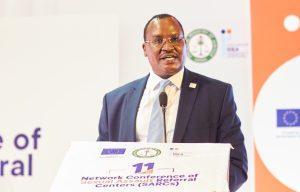
He emphasised the need for modernised legislation, saying he hopes to see “how can we make the laws of Nigeria,to be responsive, to be able to deal with this evolving, very fast-moving technologically driven sexual and gender-based violence…”
Also speaking, Ambassador Gautier Mignot, Head of the EU Delegation to Nigeria and ECOWAS, warned that digital attacks are increasingly weaponised against women in public life.
“Online and technology facilitated violence disproportionately affects women in public life… Digital attacks and disinformation are being weaponised to intimidate, silence, and discredit women.”
He noted gaps in global legal frameworks but acknowledged Nigeria’s efforts, including the passage of the Cybercrime Prohibition Prevention Act 2024.
He further disclosed that the EU is working with the Ministry of Justice to strengthen Nigeria’s legal protections against Technologically FGBV.
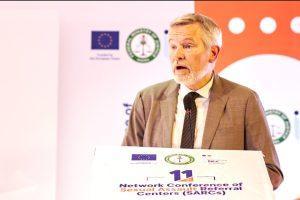
In an interview, Ambassador Mignot said the conference has provided “very practical advices on how to support victims and survivor, through prevention, criminal response, prosecution… all stakeholders must be .”
He noted that the EU is partnering with Nigeria’s Federal Ministry of Justice to strengthen the legal framework, adding: “TFGBV will also be a focus area under a new €18 million EU-funded SGBV programme recently signed with International IDEA.”
Speaking on next steps, Ambassador Mignot emphasised that real solutions require coordinated action across institutions.
“It’s really a whole-of-society approach, and all stakeholders must be mobilised,” he said, adding that the conference offered “very practical advice on how to support victims and survivors.”
The 11th Network Conference of Sexual Assault Referral Centres, themed “A Call to Action Against Technology-Facilitated Gender-Based Violence (TFGBV),” was organised by the Rule of Law and Anti-Corruption (RoLAC) Programme in collaboration with the Federal Ministry of Justice, in Partnership with other organisations, and funded by the European Union.