

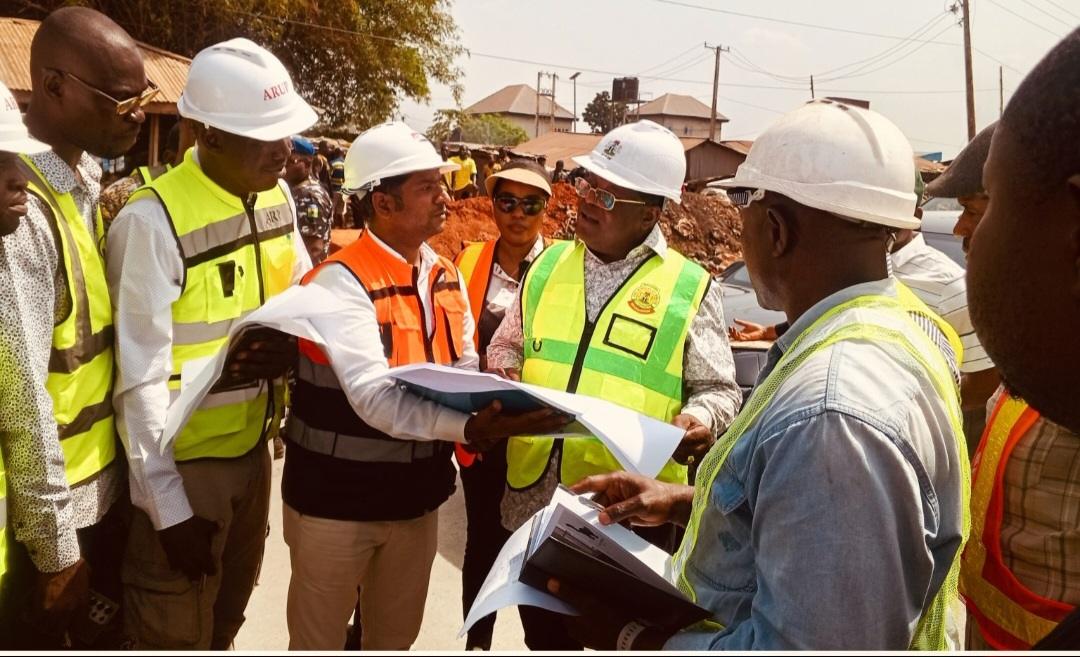
The Minister of Works, David Umahi, has pledged that roads constructed or rehabilitated under the administration of Bola Ahmed Tinubu will be built to last up to a century, signalling a major policy shift in Africa’s largest economy toward reinforced concrete highways.
Speaking during an inspection of the 107-kilometre dual-carriageway project along the Enugu–Awka–Onitsha corridor in southeastern Nigeria, Umahi said the federal government has begun converting major highways from asphalt to concrete pavement in a bid to improve durability and reduce long-term maintenance costs.
“No one guarantees asphalt roads in this country for more than 15 years.
“Under this administration, we are constructing concrete roads we expect to last up to 100 years,” he added.
The Enugu–Awka–Onitsha Expressway has for decades been regarded as one of the region’s most problematic federal roads, linking commercial hubs in the Southeast. Umahi described it as a nightmare that successive administrations failed to rehabilitate meaningfully.
He attributed the renewed momentum on the project to Tinubu’s commitment to addressing what many in the Southeast have viewed as historic underinvestment in federal infrastructure.
Construction of the highway is being financed under Nigeria’s tax credit scheme by telecoms giant MTN Nigeria, at a total cost of about ₦202 billion (approximately $125 million at current exchange rates). Portions of the project had been initiated before the current administration took office, with roughly ₦50 billion worth of work already completed.
Engineering firm Reynolds Construction Company (RCC) is leading the construction, with NigerCat serving as a subcontractor on sections of the road.
According to the minister, “Around 20 kilometres of reinforced concrete pavement have already been completed, with additional sections under active construction. Two of the most critical stretches, measuring 15 kilometres and 18 kilometres, are being built entirely with reinforced concrete.”
The current phase of the project is scheduled for completion by the end of May 2026, slightly revised from an earlier April target to mitigate potential damage during the peak rainy season.
Umahi defended the shift to concrete by citing comparative costs and longevity. He said asphalt pavement layers cost approximately ₦94,000 per square metre, compared with about ₦92,000 per square metre for concrete, which he argued provides significantly longer service life.
The ministry has also converted additional stretches initially designed for asphalt into reinforced concrete, including strengthened shoulders to ensure structural consistency.
Industry experts note that while concrete roads often require higher initial technical precision and quality control, they can offer lower life-cycle costs in heavy-traffic and high-temperature environments.
The inspection came amid controversy surrounding allegations of misconduct against Umahi circulating on social media, claims he said are already before the courts. The minister dismissed the accusations as distractions and insisted they would not derail ongoing reforms.
“If you make allegations, you must prove them in court.
“We will not bend the rules. Contracting in Nigeria is no longer business as usual,” he added.
Beyond the Southeast corridor, Umahi pointed to other flagship projects, including sections of the East–West Road and the Lagos–Calabar Coastal Highway, as examples of what he described as a new construction standard under Tinubu’s “Renewed Hope” development agenda.
He also urged residents of the Southeast to support the president politically, arguing that visible infrastructure improvements mark a turning point for a region that has often voiced dissatisfaction over federal project allocation.
For the Tinubu administration, the high-profile road programme forms part of a broader effort to combine fiscal reforms with visible capital projects aimed at stimulating economic growth and restoring public confidence in infrastructure delivery.
Whether the promise of 100-year highways can withstand Nigeria’s climate, traffic loads and long-term maintenance realities remains to be seen. For now, the Enugu–Awka–Onitsha corridor stands as a test case for the government’s ambitious engineering gamble