

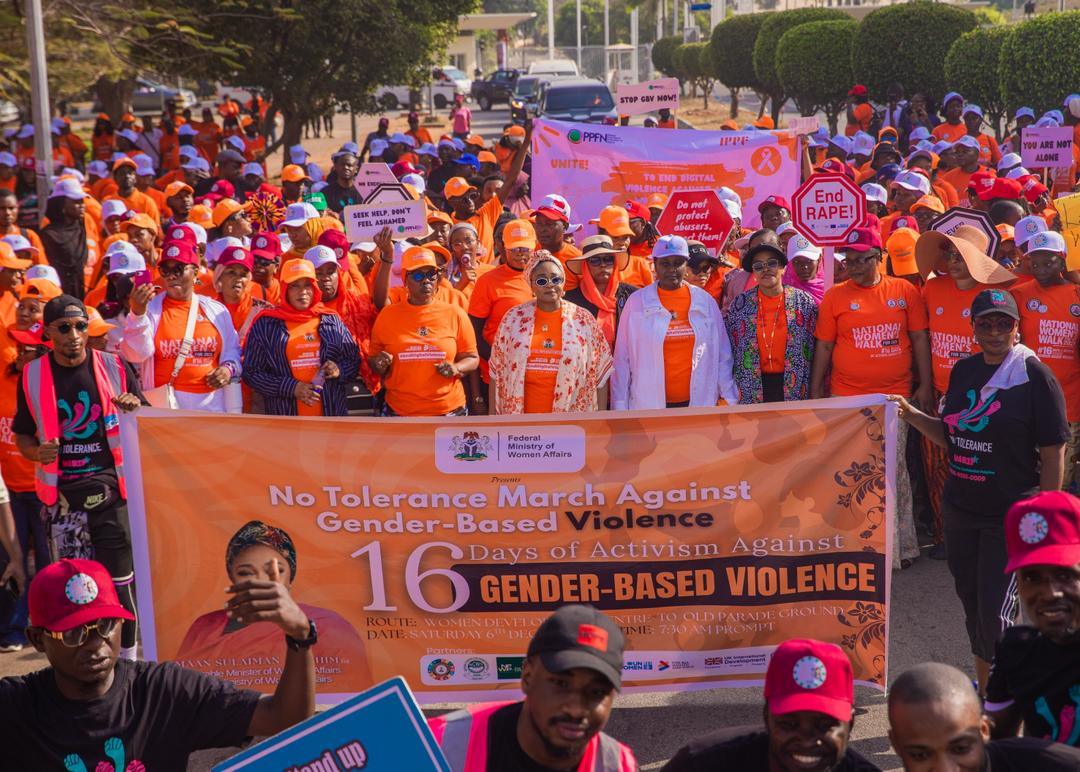
The Minister of Women Affairs and Social Development led a massive “No Tolerance Walk” in Abuja, drawing national figures, development partners, and civil society leaders who delivered strong messages against gender-based violence, particularly its fast-growing digital dimensions.
Addressing participants, the Minister of Women Affairs and Social Development, Hajiya Imaan Sulaiman-Ibrahim, said violence in all its forms remained pervasive:
“Violence is real… emotional violence, sexual violence, and financial violence. Nobody is prone to violence. It can happen to anybody.”
She reaffirmed President Bola Tinubu’s “zero tolerance stance to violence”, announcing ongoing reforms: “Our VAPP Act is undergoing a total overhaul so that there’s no more slap on the wrist.”
She warned that digital harm was expanding rapidly: “Digital violence is another form… from extortion to bullying, sextortion, and online grooming. Our VAPP Act is 10 years old… the reforms will capture the protective measures of the digital dimensions.”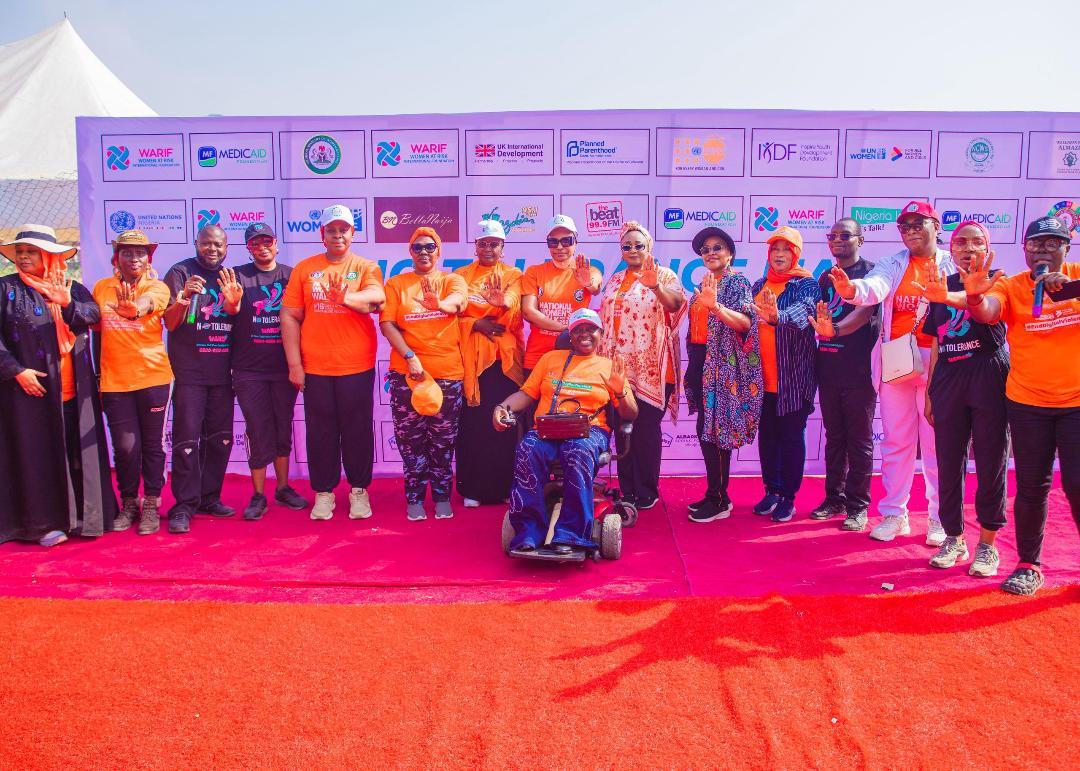
In an interview, she raised alarm over daily cases: “Every day… we receive about 10 cases on GBV, and 8 out of those 10 are minors.” She urged Nigerians to “give violence no place in our societies.”
Similarly, Chairman of the Senate Committee on Women Affairs, Senator Ireti Kingibe, saluted participants: “We, the women of Nigeria, have to stand together. We have to stand strong to end gender-based violence… Gender-based violence is one of the things that deters women. But that must stop, and it can only stop when we all demand and insist that it must stop.”
Earlier, the founder of the Medicaid Cancer Foundation, Dr Zainab Shinkafi Bagudu, applauded partners, including the Women At Risk Foundation (WARIF), UN Women and the Ministry of Women Affairs.
“The theme for this year is speaking out against digital violence. We’re going to send a very strong statement, and we are going to stand against gender-based violence…”
Former Minister of Women Affairs Salamatu Suleiman delivered a resounding message:“… sing it loud and clear around the country and around the world that not only women, but men also say a very, very big no to any form of gender-based violence.”
Human rights advocate Hajiya Maryam Uwais appealed for vigilance: “People are dying, people are suffering… We should be diligent to protect women, girls, boys and men from sexual and gender-based violence.”
Reaffirming law-enforcement commitment, AIG Aishatu Abubakar Baju, Force Gender Advisor, said, “The Nigerian police has zero tolerance for gender-based violence in any form, be it digital or physical. We understand that ‘no’ means “no”.
She noted the launch of the police GBV training manual and Standard Operating Procedure, adding that gender desks had been expanded “to all divisions”.
Executive Director, Project for the North Central Development Commission, Princess Atika Ajana, urged male allies to step forward: “We are begging our fathers, our brothers to please join us in saying no to gender-based violence of any form.”
Disability rights advocate Lois Auta emphasised inclusion: “Disability rights are human rights. This is a walk for inclusion, a walk for accessibility… End gender-based violence against all women and girls.”
Founder of WARIF, Dr Kemi Da Silva Ibru, highlighted the global spread of the march: “Gender-based violence is not one community’s problem or even one continent’s, but it is a global crisis that demands collective action.”
Closing, WARIF Programmes Lead, Adeola Potts-Johnson, called for action: “Please let us stop the culture of silence. Rape is never the fault of the survivor.”