


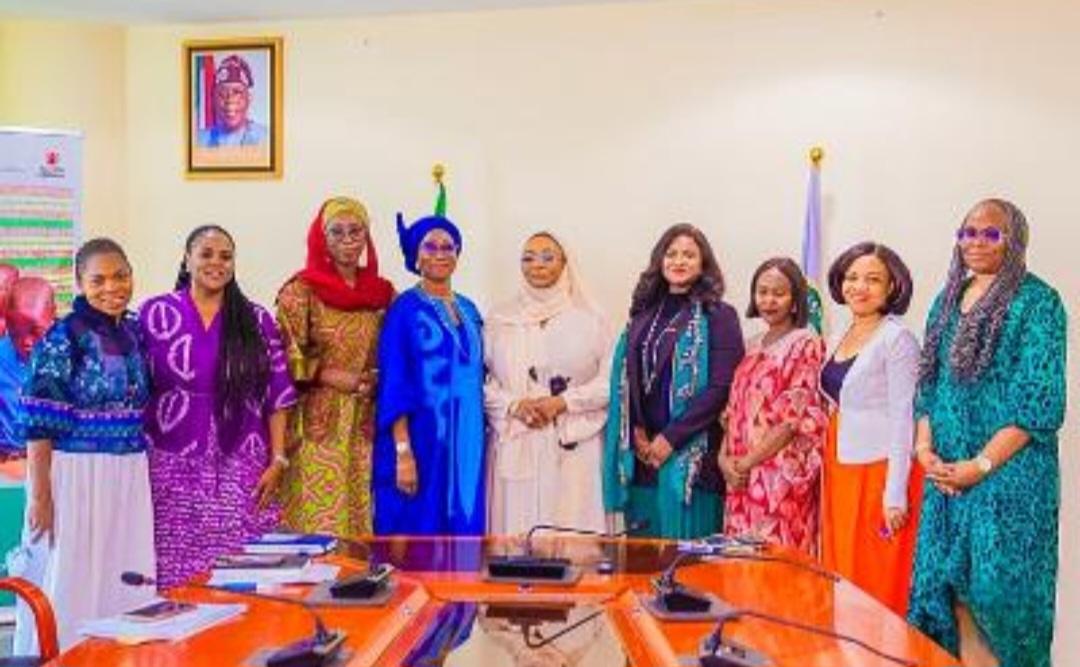
Nigeria’s Minister of Women Affairs and Social Development, Hajiya Iman Sulaiman-Ibrahim, has reaffirmed the Ministry’s commitment to championing reforms that align not only with federal and state actions, but also mobilise private sector participation and translate policy ambition into measurable national outcomes.
The Minister made the commitment while receiving the Women in Leadership (WiL) Coalition, comprising the Women in Leadership Advancement Network (WILAN), Women in Management, Business and Public Service (WIMBIZ), Women in Successful Careers (WISCAR), the Nigeria Governors’ Forum, and Caring Africa, during a high-level courtesy strategic dialogue.
The dialogue focused mainly on strengthening Nigeria’s female leadership pipeline and advancing structural reforms under the declaration of 2026 as the Year of Families and Social Development.
The Coalition, led by Mrs Amina Oyagbola, expressed support for the government reforms and families Agenda, commending the Honourable Minister’s leadership which led to the declaration of 2026 as the Year of Social Development and Family, and presented global and domestic data reframing women’s economic participation as a macroeconomic imperative.
“We have followed your vision, They are very very bold visions, we know the constraints that you are grappling with relations to resources but we really appreciate your laser focus on the empowerment of women and girls.
“The declaration of Mr President, coming out boldly to declare 2026 the year of families and social development, that has never been done before,” Oyegbola said.
The engagement assessed Nigeria’s strong societal readiness for female leadership, the enforcement gaps identified in the World Bank Women, Business and the Law 2026 report, and the economic implications of inconsistent parental leave standards and workplace protections across sectors.
Citing the World Bank Women, Business and the Law 2026 report which gives Nigeria 50/100 on gender equality laws, but only 22/100 on enforcement frameworks, Oyagbola linked it to the gap actively dragging down GDP, foreign investment, and mid-level female retention.
Under the Parenthood indicator, she urged for the Strengthening of federal institutionalisation mandates for fully paid maternity leave, paternity leave, and childcare infrastructure.
Possible Collaboration
The Coalition opened conversation for possible collaboration to achieve the Ministry’s mandate in the care economy to serve as macroeconomic infrastructure and governance infrastructure to channel productivity of women and girls.
According to the Coalition, “It is no longer a social awareness issue as there is sufficient evidence to show that it is no longer culture but the system holding women back. As partners in progress, we will do what we can to get you know we are there for you and we are here to enable and support you in whatever manner we can to achieve your strategic goals.”
Discussions also centred on the urgent need to move women’s economic empowerment beyond awareness and firmly position it within national productivity, workforce retention, and GDP growth strategies.
The strategic dialogue further highlighted the opportunity for Nigeria to lead on care systems, parental policy reform, and institutional safeguards that protect women’s participation in leadership and the workforce.
With 2026 designated as the Year of Families and Social Development, this engagement marks another decisive step towards strengthening families, protecting talent pipelines, and advancing inclusive economic growth, in line with the Renewed Hope Agenda of Bola Tinubu, which prioritises social development, institutional reform, and broad-based national prosperity.