

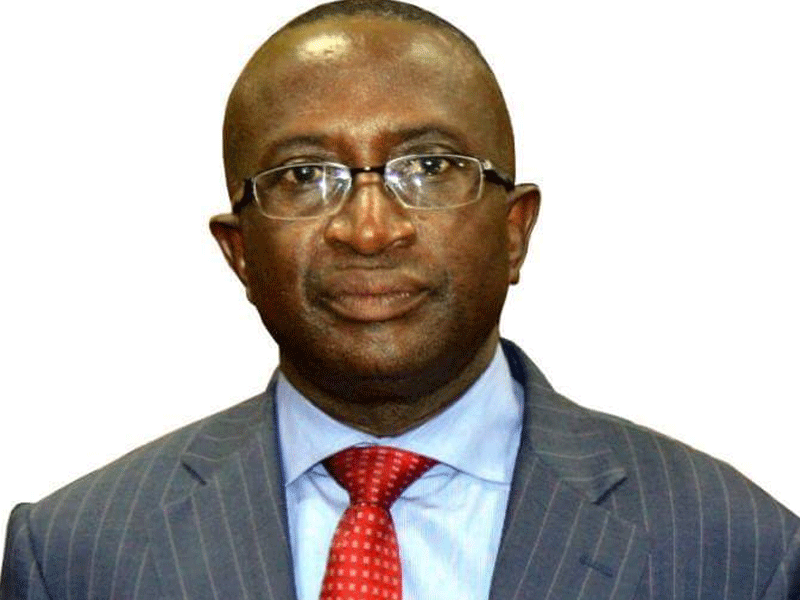
A former lawmaker, Victor Ndoma-Egba has commended the resilience and versatility of Nigerians as the country prepares to celebrate its 65th Independence Anniversary.
Ndoma-Egba, who is the Pro-Chancellor and Chairman of Council, Federal University, Oye-Ekiti, South-West Nigeria, said the nation’s strength is a product of the experiences gained since independence.
Ndoma-Egba, during an interview with Voice of Nigeria on the nation’s political development since independence in 1960, also stated that despite decades of challenges and trials, Nigerians have continued to adapt, thrive and stand tall on the global stage, showing courage and ingenuity in the face of adversity.
He said “we have shown resilience, we have shown versatility because of the experiences we have had as a nation are experiences other nations have across generations. In one generation, we have seen independence; we have seen movement from regionalism to 12 states to 19 to 21 to 36.
”At one point in our history, our economy was the fastest growing in the world. We have seen oil boom and the reverse; and moved from a population of 35 million at independence to 236 million today. The most significant takeaway from our independence is our resilience and versatility; and we also survived the civil war and unitedly embraced our diversity,” he explained.
Work-in-progress
On the growth of the legislature, Ndoma-Egba, who served as leader of Nigeria’s 7th senate and held prior executive positions in his home state, Cross River, reasoned that 26 years was not enough to adjudge the legislature as an institution.
He explained, “we have had several episodes of military rule in our post independence history, which had terminated a number of democratically elected governments. The significance of the military rule was that it removed the third arm of government, which is the legislature. Incidentally, the legislature is the symbol of democracy.”
According to him, “military rule affected the growth of our legislature. But, in the last 26 years, we have had unbroken democracy and the legislature has grown as much as it can. However, 26 years is a very short time for an institution like the legislature to develop a culture and relevant history that would provide the precedent for it to keep acting. So, it is a work in progress.”
Biggest Challenge
The former senate majority leader averred that Nigeria’s journey was a testimony to the strength and determination of its citizens, whose ability to overcome setbacks has kept the country moving forward.
Ndoma-Egba pointed out that the biggest challenge, which every Nigerian must strive to overcome was the “immediate effect” mindset acquired by a generality of Nigerians and rooted in the years of military rule.
The former lawmaker said, “during the years of military rule, we developed a military mentality, which was ‘with immediate effect’. So, our mindset remains rooted in our years of military governance – immediate effect.”
“Democracy is a tedious process at decisions. We always say in democracy outcomes are irrelevant, it is the process to arrive at the outcome is critical.
”Democracy is not just a process, it is an attitude. That has been a major impediment to our democracy. We need a complete change of mindset to a democratic ethic,” he added.
Victor Ndoma-Egba is a Nigerian lawyer, politician, and Senior Advocate of Nigeria (SAN).
He represented Cross River Central Senatorial District in the Nigerian Senate from 2003 to 2015.
In the Senate, he rose to become the Majority Leader (2011–2015).
Hauwa Abu