

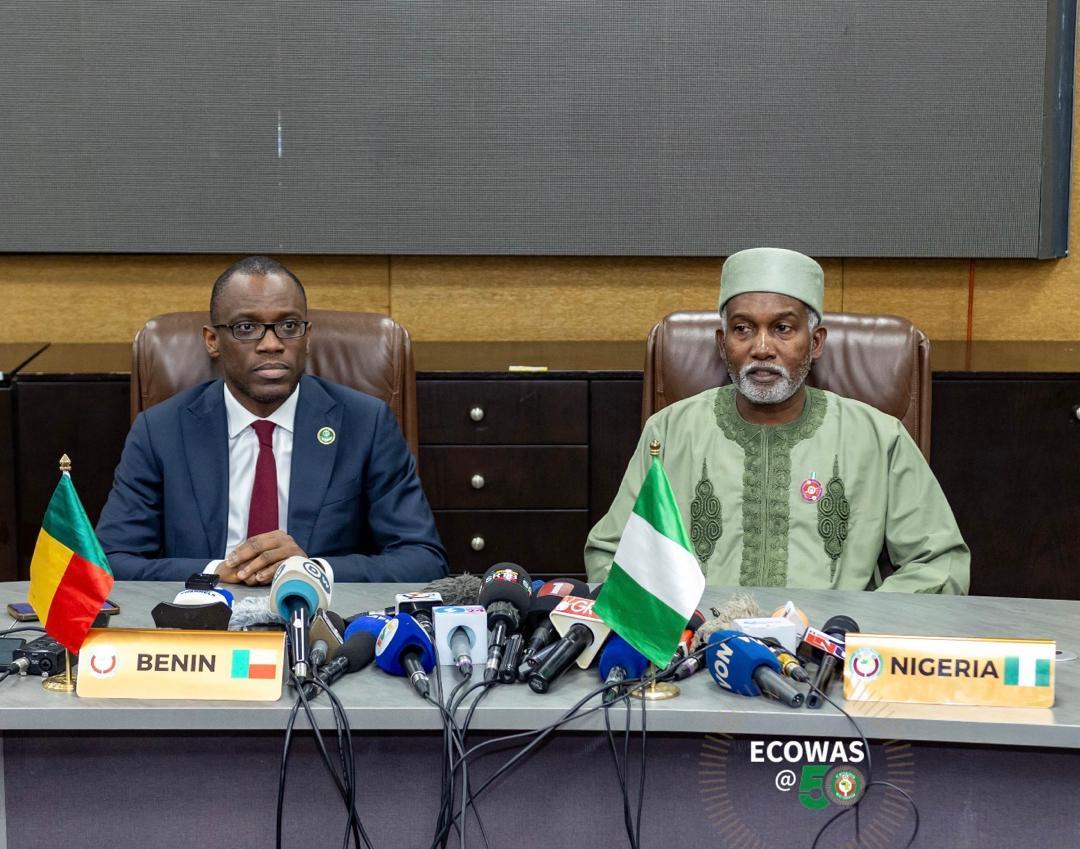
The Nigerian and Benin Republic foreign ministers have reiterated their countries’ commitment to safeguarding democratic governance and strengthening regional security mechanisms in West Africa.
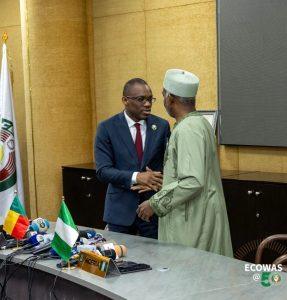
Nigeria’s Minister of Foreign Affairs, Ambassador Yusuf Tuggar, and the Minister of Foreign Affairs and Cooperation of the Republic of Benin, Mr Olushegun Bakari, addressed journalists during a joint press briefing on the sidelines of the ECOWAS Council of Ministers’ Meeting in Abuja, the nation’s capital.
Ambassador Tuggar praised the swift and coordinated regional response that helped avert an attempted unconstitutional change of government in the Republic of Benin, describing it as a model for collective action whenever democracy is under threat in the region.
“The swift and coordinated regional response helped avert an attempted unconstitutional change of government in the Republic of Benin and should be an exemplar of what really should obtain whenever democracy is under threat in our region,” he said.
He emphasised that rapid communication and collaboration among West African governments were instrumental in preserving constitutional order, noting that instability in neighbouring countries has direct implications for Nigeria’s national security.
“Nigeria’s internal problems are inextricably linked to the external problems,” Ambassador Tuggar noted.
He reemphasised Nigeria’s resolve to support its neighbours in times of crisis.
“We would not be doing ourselves any good if the Republic of Benin has a problem and we don’t help in tackling it decisively,” he added.
The Foreign Affairs Minister highlighted that security challenges confronting the region, from the Sahel to the Lake Chad Basin, are driven by interconnected external factors.
“The insecurity problem we’re facing today is tied to the dysfunction of Libya, the fall of the Gaddafi regime, and the conflict in the Sahel, including the fight against terrorism in Mali, Burkina Faso, the Niger Republic and beyond,” he said.
On regional security cooperation, Ambassador Tuggar described the Niger Republic’s withdrawal from the Multinational Joint Task Force as a setback and stressed the need to prevent similar destabilising developments.
“We already have issues to the north and northeast. So why would we sit by and not act when our neighbour to the west faces a crisis?” The Foreign Affairs Minister asked.
He reaffirmed Nigeria’s readiness to support neighbouring countries, noting that President Bola Ahmed Tinubu’s administration has introduced the Regional Partnership for Democracy to strengthen democratic governance and support countries transitioning back to civilian rule.
For his part, Mr Bakari expressed appreciation to Nigeria and other ECOWAS member states, including Côte d’Ivoire, Sierra Leone and Ghana, for their solidarity and timely support during the attempted coup.
“ECOWAS remains an important tool that allows us to defend democracy and the values of democracy in our regional space,” he said.
Mr Bakari confirmed that although the Beninese armed forces repelled the coup attempt, the risk of significant casualties highlighted the need for coordinated regional action.
“That is why President Patrice Talon requested the support of the Federal Republic of Nigeria,” he explained.
Both ministers reaffirmed their countries’ commitment to strengthening ECOWAS mechanisms for conflict prevention, democratic consolidation and regional peacekeeping, stressing that only collective action can effectively address insecurity, terrorism and unconstitutional changes of government in West Africa.
PIAK