


The Attorney-General of the Federation and Minister of Justice, Lateef Fagbemi, says the Constitution of the Federal Republic of Nigeria guarantees the right to receive and impart information.
Delivering the keynote address on Wednesday at a high-level national conference commemorating the 2025 International Human Rights Day in Abuja, he stressed that freedom of expression is the “lifeblood of democracy,” warning that “in a democracy, silence is not golden; it is dangerous.”
Represented by Garba Godwin, the head of the freedom of information unit in the ministry, he noted that “this year’s theme, Our Everyday Essentials, reminds us that these two rights are not abstract ideals but practical necessities that empower citizens, strengthen institutions, and uphold the very fabric of democratic governance.”
Fagbemi added that while the government is committed to safeguarding free expression, “this freedom must be exercised with responsibility” in view of the rise of misinformation and hate speech.
On access to information, he described it as “the oxygen of transparency,” reaffirming the Federal Government’s commitment to fully implementing the Freedom of Information Act.
“We are working to strengthen institutional frameworks… and foster a culture of openness and accountability,” he said.
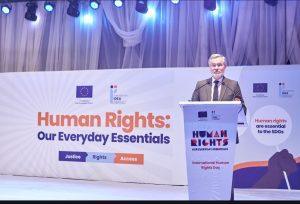
The EU Ambassador to Nigeria and ECOWAS, Gautier Mignot, in a goodwill message, linked the event to the end of the 16 Days of Activism and the 77th anniversary of the Universal Declaration of Human Rights.
He noted that freedom of expression and access to information “underpin democracy, accountability, and social progress,” stating that they are “not a privilege granted by the state – but an inherent right essential for every person to live freely and safely.”
Mignot said acts of threats against journalists are “a clear assault on freedom of expression and on democracy.”
He urged the government to strengthen the legal system for prosecuting crimes against journalists.
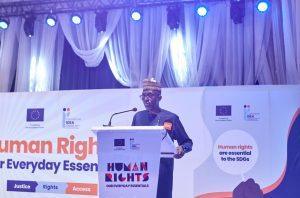
Earlier in his welcome remarks, Mr Danladi Plang, Head of Programmes, International Institute for Democracy and Electoral Assistance (IIDEA), said the organisation adapted the 2025 theme to “Our Everyday Essentials: Freedom Of Expression And Of Information”, emphasising how free expression and access to information enable other rights.
Citing UNESCO data, he noted that countries with higher levels of free expression enjoy “a significantly higher level of protection of civil, political, economic and social rights.”
“While the digital age should make easy access to information, it comes with its many challenges, including the misuse of digital platforms and the restrictive laws enacted by governments to curb such abuses,” he added.
Speaking on “A Decade of Access to Information,” Dr Emmanuel Uche, Project Manager, Anti-Corruption, Rule of Law and Anti-Corruption Programme (RoLAC), said the FOI Act is “the oxygen of democracy,” adding that despite progress, “too many institutions still resist openness” and “too many FOI requests go unanswered.”
He urged stronger enforcement, digitalisation of public records, and broader public awareness.
“The right to information is the right that protects all other rights,” Uche concluded. “Let us defend it… Let the work begin.”
The National Conference, organised by the International Institute for Democracy and Electoral Assistance with support from the European Union, provided a platform for national dialogue on free expression, information, and access to law, identifying challenges, fostering collaboration, and producing actionable strategies for future reform.