

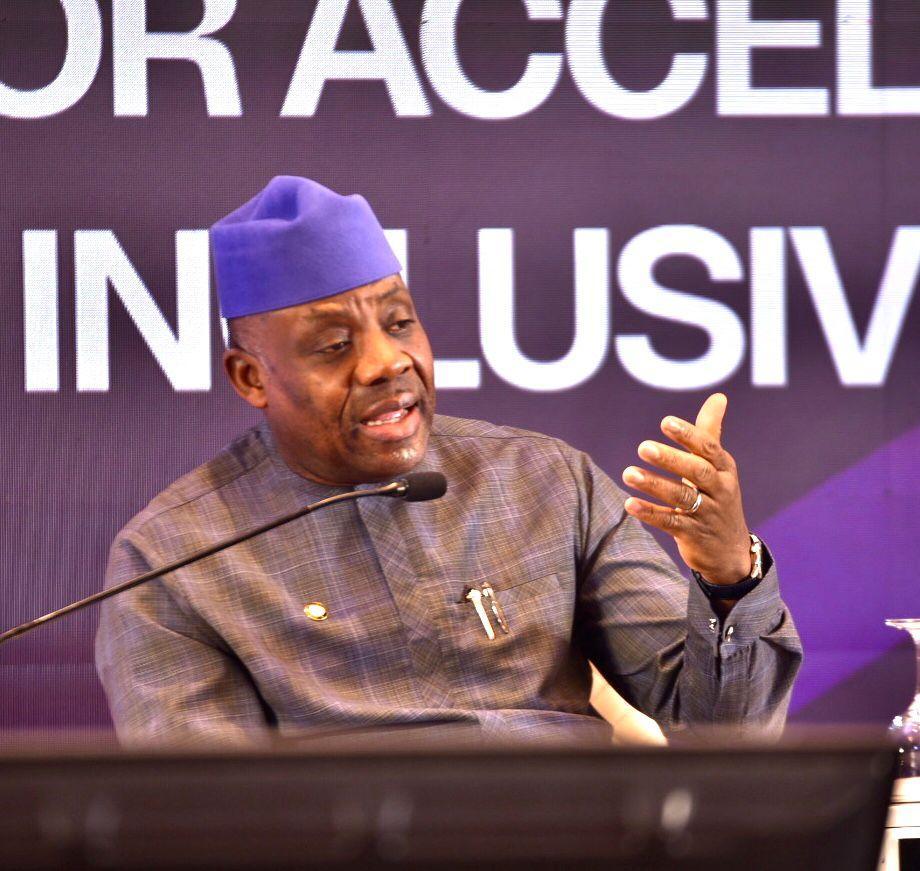
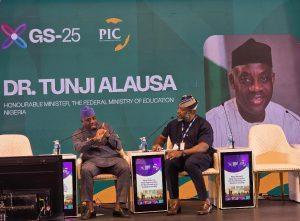
Nigeria’s Minister of Education, Tunji Alausa, says the Federal Government is implementing far-reaching reforms to ensure inclusivity, improve learning outcomes, and drastically reduce the number of out-of-school children.
Speaking during a fireside chat at the Gender and Inclusion Summit (GS-25) in Abuja, Alausa emphasised that the administration of President Bola Ahmed Tinubu is laying a solid foundation for national development by prioritising education as “the most logical investment.”
According to him, “The best investment we can make was that of the children, and that we are trying to go to schools where they can have better nutrition, better improvement in their education.”
The minister said that the government has completed an extensive review of the national curriculum to make learning competence-based, cognitive and functional.
He expressed concerns about the current overload of subjects, noting that “today, WAEC offers 74 subjects… and NECO, 76 subjects,” while primary school pupils face up to 21 subjects.
To correct this, he announced new subject caps across all levels, effective from September 2025.
Alausa said: “Today, I can report to you that we are reducing the number of subjects that are Primary 1 to Primary 3, taking to the minimum of 9, maximum of 12… For SS1 to SS3, minimum of 8, maximum of 9 and 11.”
He added that Nigerian history has been reintroduced into the curriculum from Primary 1 through Senior Secondary 3, while digital technologies such as coding, robotics, and augmented reality will now be part of the syllabus. “We have to educate Nigerian children for the future,” Alausa said.
The minister explained that Nigeria has one of the highest populations of out-of-school children in the world, with estimates ranging between 12 and 18 million. However, he stressed that the government is no longer relying on external figures.
Alausa said: “…Depending on the data, …some people are quoting 18 million, 15 million, 12 million. But where you get the midpoint data of 15 million, this is not acceptable. We also have to have what I call data sovereignty… If we let people continue to tell us their data, we’ll never improve.”
He added that through a new Out-of-School Commission and extensive digital mapping, the ministry is identifying each child by home, age, and reasons for being out of school, with findings showing poverty as the leading factor.
To address this, the government is piloting an upgraded school feeding and conditional cash transfer programme in partnership with the Ministry of Humanitarian Affairs, where cash will be given directly to mothers to ensure children remain in school.
Alausa explained: “This encourages the mother and the parents to get their kids to school. And this will help improve their stature, their ability, their cognitive functions, and it will help improve attendance.”
In addition, the government will provide uniforms, instructional materials, and scholarships. For the first time, the private sector is being engaged to support school attendance and retention, he added.
Women inclusion initiatives
The minister highlighted efforts to boost girls’ enrolment, particularly in rural areas, through the establishment of special schools with accelerated pathways to higher education.
He said: “We have a women’s programme, that’s a new chapter. Riding all of these aspects of education. That’s the launch to finalise the design. We’re opening up special schools for these girls who are in the rural areas. With focus, emphasis on numeracy, literacy, and educational skills. And we also created an accelerated pathway for them to continue to advance their education to a tertiary institution.”
Alausa drew attention to the barriers that force many girls out of classrooms, especially during their menstrual periods. He said this reality informed the launch of “Flow with Confidence”, an initiative spearheaded by Nigeria’s First Lady, Senator Oluremi Tinubu.
He explained: “Girls will not go to school during their menstrual period because they are ashamed. They don’t have things to use, the hygienic things they need for their menstruation. That means to them, dropping out of school, getting poor education.”
The initiative provides dignity pads and menstrual hygiene support to ensure girls can attend school consistently and pursue their education without shame or interruption.
Alausa further emphasised that inclusivity goes beyond gender, stating: “Inclusivity is not just about gender, it’s also about people with disabilities.”
The minister reaffirmed the current administration’s commitment to ensuring women play a central role in Nigeria’s governance and policy processes. He recalled President Bola Ahmed Tinubu’s track record as a former governor, saying:
“When he was governor… the cabinet then had the highest number of women in cabinet across all the 36 states today. And today, in Abuja, there is a council. This council has a higher number of women than we’ve ever seen before.”
He stressed that the Federal Government’s broader inclusion policy goes beyond education to women’s participation in leadership and governance.
According to him, “This government in totality has a clear agenda on how we want to include more women in Nigeria, to move this country forward.”
Responding to concerns about insecurity, Alausa assured that school safety remains a top government priority.
He said: “We’re working more with the National Security Advisor, the police, civil defence and also the army. We’ve built safety towers in some of these schools. Kids going to school is their constitutional right, and we as a government must ensure that these kids… are safe.”
He added that there had been no major breaches of school safety in recent months.
On the education of children living with disabilities, Alausa rejected proposals for a diluted curriculum.
He said: “Our strategy should not be to water the quality of education we give them, but to give them every resource they need, every support they need to improve, to get that kind of life out of them.”
He also acknowledged cultural barriers to education, noting that the ministry is working with communities, traditional leaders, and religious groups to ensure inclusion across Nigeria’s diverse regions.
In his final submission, the minister emphasised the Federal Government’s wider prioritisation of inclusivity, reflected in the high number of women in government and cabinet positions.
He said: “This government in totality has a clear agenda on how we want to include more women in Nigeria, to move this country forward.”
PIAK