The Federal Government has flagged off a free nationwide training programme aimed at equipping 10 million Nigerians with financial inclusion and literacy skills.
The initiative, being implemented through the Office of the Vice President and coordinated by the Presidential Committee on Economic and Financial Inclusion, is targeted at empowering women and youths with essential financial, investment, and digital competencies to drive sustainable wealth creation.
Vice President, Kashim Shettima, has said Nigeria can reap bountifully from its demographic dividend only if young Nigerians and women are equipped with the needed skills and ethical grounding required for a speedily progressing digital economy.
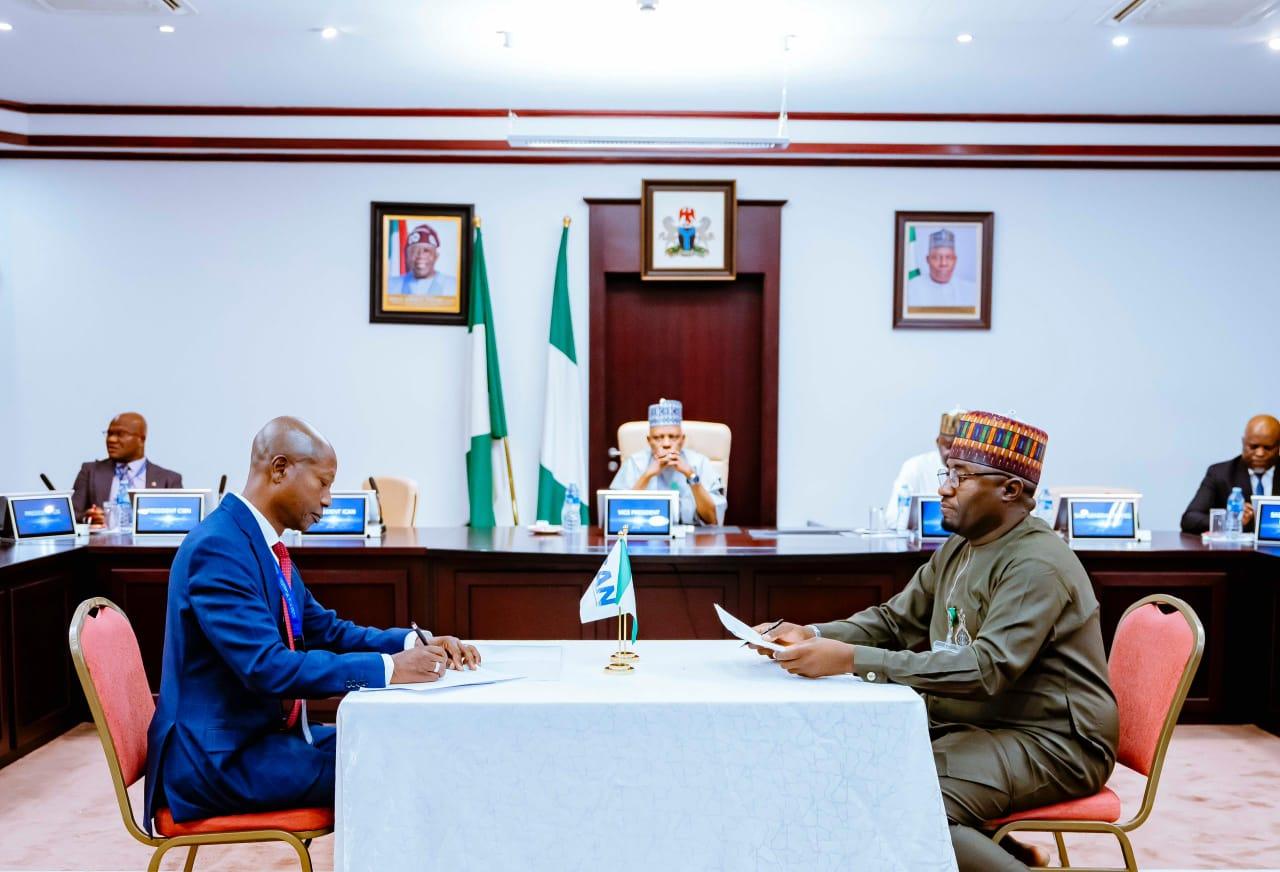
Accordingly, the Office of the Vice President, through the PCEFI, signed a Memorandum of Understanding (MOU) with six professional bodies to jointly design training programmes, certification pathways, digital skills initiatives, and mentorship platforms that would strengthen Nigeria’s financial and enterprise workforce.
The professional bodies include the Institute of Chartered Accountants of Nigeria (ICAN); Chartered Institute of Bankers of Nigeria (CIBN); Chartered Institute of Stockbrokers (CIS); National Institute of Credit Administration (NICA); Chartered Risk Management Institute (CRMI) and Nigeria Institute of Innovation and Entrepreneurship (NIIE).
Speaking when he officially flagged off the free nationwide training of 10 million Nigerians, on behalf of President Bola Tinubu, at the Presidential Villa, Abuja, the Vice President noted that the signing of the MoU between the Government and the six of Nigeria’s foremost professional bodies was more than a formal agreement.
“It is a strategic national investment in capacity as infrastructure which is the human, institutional, and ethical foundations upon which inclusive growth must rest,” he stated
VP Shettima noted that the Aso Accord on Economic and Financial Inclusion, which the PCEFI is mandated to implement, recognises the fact that “financial inclusion is not achieved by access alone, but by competence, trust, and capability.”
He added that the nation “cannot build a one-trillion-dollar economy on weak skills, fragmented standards, or disconnected professional ecosystems.
“This MoU therefore establishes a working framework to harness the collective expertise of ICAN, CIBN, CIS, CRMI, NICA, and NIIE to advance inclusion through capacity building, advocacy, digital transformation, youth empowerment, and support for small and medium practitioners.
“It establishes a structured mechanism for joint training programmes, policy dialogue, digital skills development, and professional standards that align market practice with national inclusion goals.”
VP Shettima pointed out that while capacity building is financial inclusion, “without accountants who understand MSME formalisation, credit administrators who can assess risk beyond collateral, bankers who embed consumer protection, risk professionals who anticipate digital threats, and innovators who translate ideas into enterprises, inclusion remains a slogan rather than a system.”
He maintained that the training programme must prioritise young Nigerians and women.
He charged the PCEFI and the professional bodies not to treat the MoU as a mere document, but as a living platform for execution.
The President of the Institute of Chartered Accountants of Nigeria (ICAN), Mallam Haruna Yahaya, applauded the administration of President Bola Ahmed Tinubu for its bold economic reforms that has culminated in the flag off of the financial inclusion free training programme for 10 million women and youths in Nigeria.
He said the decision to embark on the project was prompted by visible improvements in the economy as a result of the gains of the Federal Government’s policy reforms.
Yahaya assured the Vice President of their professional support in the realisation of set objectives, describing their involvement involvement in the project as an institutional honour.
The Chief Executive Officer of WAWU Africa – technical partners in the programme, Mr Emmanuel Lennox, assured of the company’s readiness to deliver on the project, particularly in providing the digital platform and overall enabling environment for its success.
Also, explaining why the training of 10 million Nigerians on financial inclusion had become necessary, the Technical Adviser to the President on Economic and Financial Inclusion, Dr. Nurudeen Zauro, said,
“Exclusion is not only by lack of access, but by limited skills, weak institutional capacity, and insufficient professional support.