

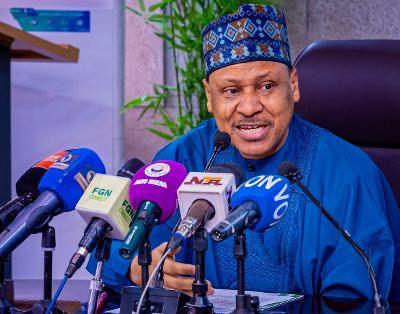
Nigeria’s Minister of Information and National Orientation, Mohammed Idris, has reaffirmed the Federal Government’s commitment to amplifying policies on economic reforms aimed at attracting stronger international trade engagements and investment into the country.
The Information Minister made this known when he received his counterpart, the Minister of Industry, Trade and Investment, Dr Jumoke Odunwole, on a courtesy visit to his office in Abuja, Nigeria, where discussions focused on amplifying Nigeria’s economic reform agenda and preparations for international trade engagements.
According to Idris, the Information Ministry will continue to support and publicise the government’s economic initiatives to ensure Nigerians and the global community understand the reforms being implemented by the administration of Bola Ahmed Tinubu.

“For us at the Federal Ministry of Information and National Orientation, it is always about servicing you, amplifying the work you do, and ensuring that Nigerians and people outside the country clearly understand the programmes and policies that you are implementing,” he said.
Idris explained that the administration’s economic reforms were already producing results, insisting that Nigeria had become an increasingly attractive destination for global investors.
He stressed that the Ministry of Industry, Trade and Investment plays a critical role in implementing policies that make Nigeria more attractive to investors and support economic growth.
Commending the Minister of Trade’s performance in office in improving Nigeria’s business climate and strengthening investor confidence, as well as her leadership and dedication since assuming office, he noted that her previous work in government had already demonstrated the vision and competence required to improve Nigeria’s business environment.

“I was not surprised at the kind of vision, commitment and dexterity she has shown since she became Minister of Industry, Trade and Investment. She has been working to ensure that the business environment for anyone who wants to invest in Nigeria is made easy and consistent with the policies of the Federal Government,” he noted.
The Information Minister reiterated that the Ministry would continue to support the trade and investment ministry by publicising its programmes and reforms to both domestic and international audiences.
“For us at the Federal Ministry of Information and National Orientation, it is always about servicing you and amplifying the work you do so that Nigerians and people outside Nigeria will really understand what it is that you are doing,” he stated.
Idris said the administration’s reforms under President Bola Tinubu were beginning to stabilise the economy and attract renewed investor interest.
He further pointed to improvements in key economic indicators, including rising foreign reserves, reduced inflation, growing GDP and improved global perception of Nigeria’s economy, saying the developments demonstrate that the government’s economic policies are working.

“All the economic reforms that the President has instituted are already bearing fruit. As the Minister of Finance has often said, the economy has turned the corner. We are seeing the tunnel and we are also seeing the light, meaning we know where the destination is. For the first time in many years, Nigeria’s foreign reserves have crossed the $50 billion mark,” he said. “Headline inflation and food inflation are going down, and GDP is improving. The numbers are showing that the reforms are working,” he added.
Idris noted that the administration is also taking steps to strengthen critical sectors such as electricity, noting that plans are underway to address weaknesses in power transmission infrastructure in order to support industrialisation and economic expansion.
He stressed that “stable energy supply is essential for Nigeria’s ambition to achieve large-scale industrial growth and become a $1 trillion economy,” he stressed.
He described the reforms as difficult but necessary decisions that previous administrations had avoided for decades.
“Everyone wanted to do these reforms, but for about 40 years no one dared to. The President understood that the only way Nigeria can achieve sustainable growth is to take those difficult but necessary decisions. It is like a woman in labour; the pain is intense at that moment. But when the baby arrives and you see the result, the joy makes the struggle worthwhile,” he said.
The minister also highlighted Nigeria’s removal from the monitoring list of the Financial Action Task Force as a major boost for investor confidence.
“That development sends a clear signal to investors around the world that Nigeria is ready for business. Countries and companies that once hesitated can now engage more confidently with Nigeria,” he said.
Idris also noted progress in other sectors, including health and energy, stressing that government intervention in the power sector was aimed at enabling large-scale industrialisation. He maintained that the government was also considering the creation of a National Grid Assets Management Company to improve electricity supply across the country.
“Massive industrialisation cannot happen without reliable energy. That is why the President is focusing attention on strengthening the transmission segment of the power sector,” he said.
The Information Minister added that reforms in the aviation and financial sectors had already resolved previous concerns about trapped funds belonging to foreign airlines.
“Today, investors know they can bring their money into Nigeria, do legitimate business and repatriate their profits without obstruction,” he said.
Speaking earlier, the Minister of Industry, Trade and Investment, Dr Jumoke Odunwole, said her visit to the Information Ministry was part of efforts to strengthen collaboration with the media in communicating the government’s economic agenda and outlining the ministry’s priorities for 2026.
“As the administration approaches the three-year mark, the journey has been an interesting one. We have achieved quite a bit in terms of reforms and stabilisation of the economy,” she said.
Dr Odunwole said the Ministry of Industry, Trade and Investment would focus on four major pillars in 2026 aimed at accelerating industrial growth and expanding trade opportunities. According to her, the ministry would also strengthen domestic industrial capacity to enable Nigerian companies to produce export-ready goods and services.
“The first pillar is unlocking global and regional demand to drive non-oil exports and industrial productivity at scale. The second pillar will be strengthening domestic industrial capacity and productivity so that Nigerian businesses can become major suppliers of export-ready goods and services,” she said.
She said that the government was also pursuing strategic investments to boost infrastructure, innovation and industrial transformation, noting that effective communication of government reforms would remain a priority.
“Mr President has given this ministry a mandate to push industrialisation, expand trade and ensure that Nigerian businesses and domestic investors are supported in every way possible. Telling our story is a responsibility for us as an administration. With all that has been done in the last three years, it is important to amplify the concrete evidence of the reforms we have implemented,” she said.
The Trade and Investment Minister noted that Nigeria had already begun actively engaging global trade platforms, including participation in the World Economic Forum in Davos and the signing of its first Comprehensive Economic Partnership Agreement with the United Arab Emirates.
“Nigeria will continue to leverage opportunities under the African Continental Free Trade Area to expand its trade footprint. One of the most important things we will continue to push this year is the African Continental Free Trade Area. Nigeria has been leading discussions on what Africa stands to gain from the 14th Ministerial Conference of the World Trade Organization scheduled to hold in Yaoundé, Cameroon,” she said.
According to her, the upcoming global trade meeting marks the next stage of Nigeria’s international economic engagement.
“This marks the official road to Yaoundé, and we wanted to begin that journey here,” she said. “It is important for Nigeria to clearly position itself and articulate what these global trade opportunities mean for our economy,” she added.
She added that the ministry would also embark on a nationwide sub-national tour to help states identify their competitive advantages and connect them to regional and global value chains.
“We will be moving across the country, engaging states and helping them understand what they have and how they can plug into regional and global markets,” she added.
Both Ministers outlined plans to attract more investment and expand Nigeria’s non-oil exports ahead of the forthcoming global trade discussions in Yaoundé, Cameroon.