

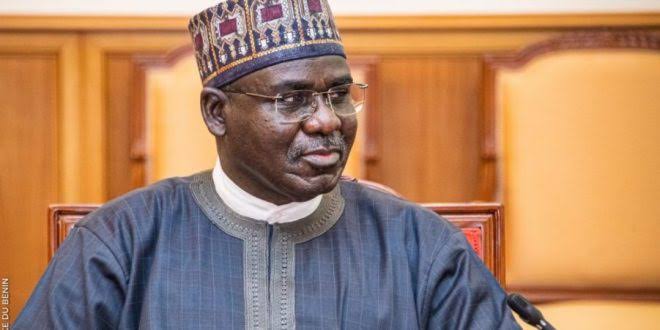
The former Chief of Army Staff, Lieutenant General Tukur Yusuf Buratai (Retired) has dismissed international and domestic assessments portraying Nigeria as a potential failed state, insisting the nation was rising through its challenges.
In a statement titled “Nigeria: An Unbreakable Nation Rising Through Challenges,” Buratai described such forecasts as inaccurate and disconnected from Nigeria’s history of endurance and institutional strength.
He cited past pessimistic analyses, including a 2011 U.S. report, arguing they consistently underestimated Nigeria’s leadership and the resolve of its citizens.
Buratai said “From independence to date, our leaders—civilian and military—have steered this country out of storms many nations would not survive.”
He added that “Nigeria cannot and will not fail, by the grace of God.”
He traced a tradition of national resilience from the foundational roles of Dr Nnamdi Azikiwe, Sir Ahmadu Bello and Chief Obafemi Awolowo to the stabilising leadership of Generals Yakubu Gowon and Murtala Mohammed.
He credited former President Olusegun Obasanjo with strengthening democratic transitions.
Buratai argued that contemporary leadership across government, civil society and the private sector was more accountable and digitally connected to citizens, making national collapse inconceivable.
While acknowledging ongoing economic pressures, he said it was shortsighted to define Nigeria solely by present difficulties.
He highlighted Nigeria’s status as Africa’s largest economy and its expanding global influence in fintech, telecommunications and entertainment, noting that human capital, agriculture, solid minerals, renewable energy and the creative industry remained anchors for future strength.
He expressed confidence that diversification efforts would secure a transition to a post-oil, knowledge-driven economy.
On insecurity, Buratai described the situation as a renewal phase, citing enhanced military capabilities and the significantly degraded strength of Boko Haram compared with a decade earlier.
He pointed to national infrastructure projects—including railway rehabilitation, major highway construction, airport upgrades and the Dangote Refinery—as evidence of long-term development.
Buratai criticised Western analysts for what he called doomsday projections, urging global partners to shift from predicting Nigeria’s failure to investing in its growth.
He recommended fairer trade terms, genuine technology transfer, collaborative security frameworks and reforms to global financial systems, calling for Western investment and green finance over aid.
Domestically, he urged Nigerian leaders to strengthen patriotism, accelerate economic reforms and decentralise security structures.
For Africa, he advocated deeper integration under the African Continental Free Trade Area and a unified continental voice in global governance.
He concluded that “Our people innovate, adapt and support one another in ways that defy every prediction.”
PIAK