


Nigeria has positioned itself at the forefront of global advocacy for data-powered social progress, declaring that “data is an instrument for justice and the heartbeat of inclusive governance.”
It urged World leaders to ensure that digital transformation becomes “a force for equity, not exclusion,” so that “no community, no woman, no child is left behind in the data revolution.”
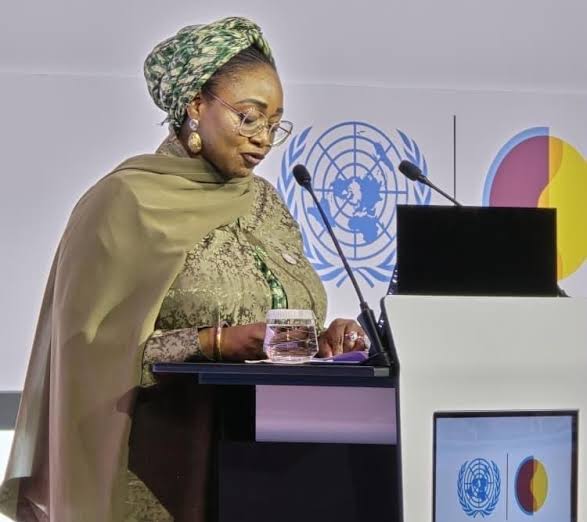
Delivering her opening remarks at the Solutions Session, a high-level event held on the sidelines of the Second World Summit for Social Development (WSSD) in Doha, Qatar, the Minister of Women Affairs and Social Development, Hajiya Imaan Sulaiman-Ibrahim, reaffirmed Nigeria’s commitment to harnessing data, innovation, and digital cooperation to drive inclusive growth.
The session, themed “Data-Driven Strategies to Address the Gaps in Social Development and Accelerate an Inclusive Digital Economy,” was co-hosted by Nigeria, the Digital Cooperation Organization (DCO), and the Kingdom of Belgium.
According to the Minister, the theme “resonates profoundly with Nigeria’s national vision and global aspirations.”
“In this era, data is an instrument for justice. It enables us to see who is left behind, why they are excluded, and what solutions work. It is the foundation of evidence-based policymaking and the heartbeat of inclusive governance,” she said.
Read Also: 2025 Lagos Trade Fair Opens with Call for Investment
Highlighting Nigeria’s flagship programme, the Renewed Hope Social Impact Interventions – 774 (RH-SII), Sulaiman-Ibrahim described it as “a unified social contract between government and citizens that leverages data, innovation, and partnerships to deliver measurable social progress across all 774 local government areas.”
She outlined transformative components of the initiative, including Digital Harmony, which aims to equip five million women and girls with ICT skills, smart devices, and entrepreneurship tools through Digital Empowerment Hubs, and PowerHer774, which provides clean energy access to 15 million households while creating 300,000 green jobs for women technicians.
Other interventions such as Women Agro Value Expansion (WAVE) and SheRuns promote market access for women farmers and prepare young women for civic leadership through mentorship and data-driven policy advocacy.
“When women participate fully in the digital economy, nations prosper. When data informs social policy, inequality narrows. When collaboration replaces competition, humanity advances,” she affirmed.
The Minister emphasised that Nigeria’s efforts align with the National Digital Economy Policy and Strategy (NDEPS 2020–2030), the National Gender Policy, and the Women’s Economic Empowerment Policy, positioning inclusion as “both a moral imperative and an economic strategy.”
She concluded by expressing Nigeria’s appreciation to the Digital Cooperation Organisation, the Kingdom of Belgium, and all global partners for “championing data-driven solutions for social progress.”