

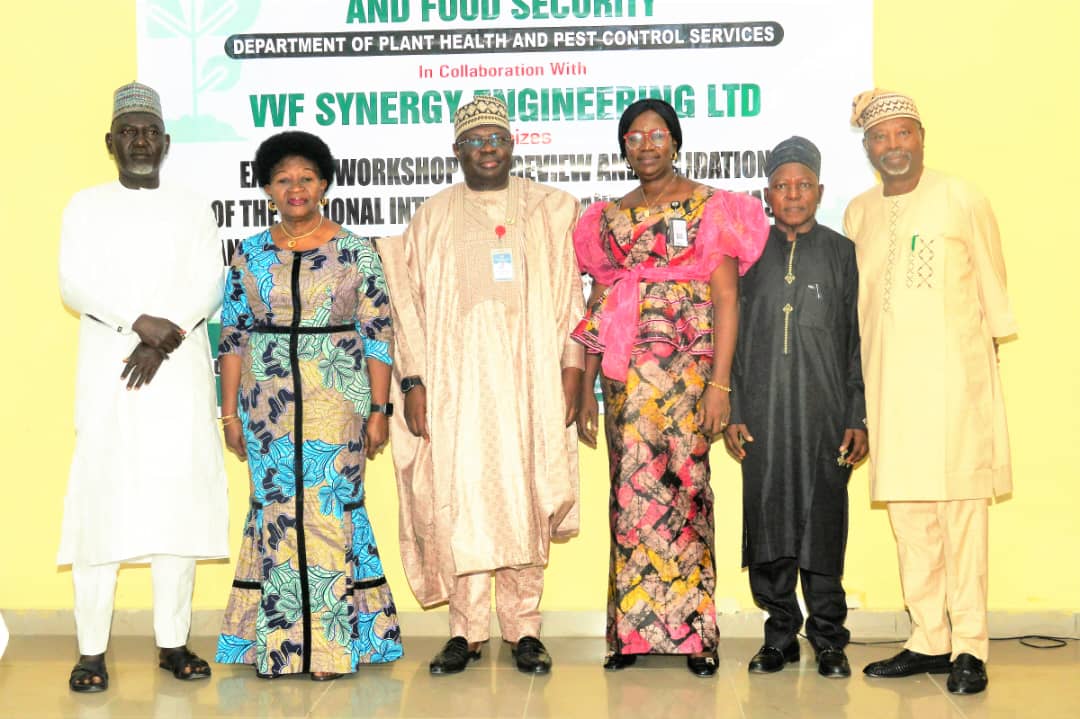
Nigeria has taken a major step to strengthen its capacity to combat transboundary and migratory agricultural pests as stakeholders gathered in Abuja for a workshop to review and validate the National Integrated Pest and Plant Disease Management Strategy.
The workshop, which held at the Agricultural and Rural Management Training Institute (ARMTI), Gudu, Abuja, brought together stakeholders from across the agricultural sector to harmonize scientific insights, field data, and global best practices aimed at addressing the growing threats posed by invasive pests and plant diseases.
Declaring the workshop open, the Permanent Secretary of the Federal Ministry of Agriculture and Food Security, Dr. Marcus Ogunbiyi, described the event as a significant milestone in the nation’s efforts to safeguard food security and strengthen resilience against pest-induced crop losses.

He emphasized that agriculture remains the backbone of Nigeria’s economy, supporting millions of livelihoods, but is increasingly threatened by recurring outbreaks of pests such as fall armyworm, tuta absoluta, ginger blight, and quelea birds.
These pests, he noted, have caused substantial productivity losses and economic setbacks, particularly for smallholder farmers.
“The impacts of these pest and disease outbreaks reach far beyond the farms, undermining food and nutrition security and threatening livelihoods.
“Addressing these challenges demands a coordinated, science-based and sustainable approach, which is precisely what the National Integrated Pest and Plant Diseases Management Strategy is designed to deliver.”
Dr. Ogunbiyi explained that the Strategy adopts the principles of Integrated Pest Management (IPM), combining biological, cultural, mechanical, and chemical methods in ways that protect human health, beneficial organisms, and the environment.
He noted that emerging pests, climate-driven migrations, and evolving farming systems make it necessary for Nigeria to continually update and strengthen its response systems.
He urged participants to rigorously review the strategy and propose enhancements that align with both national realities and international phytosanitary frameworks.

The Permanent Secretary also commended development partners particularly the Food and Agriculture Organization (FAO) for their consistent technical support.
Intensify Surveillance and Rapid Response Mechanisms
The Director, Plant Health and Pest Control Services Department, who delivered the welcome address, echoed similar concerns about the rising frequency and severity of pest invasions due to climate variability, ecological shifts, and increased movement of goods and people.
According to him, Nigeria must intensify its preparedness, surveillance, and rapid-response mechanisms to mitigate the threats posed by migratory pests such as locusts, quelea birds, armyworms, and other invasive species.
“This workshop provides a strategic platform to harmonize expert knowledge, field experience, global best practices, and national priorities,” he said.
“Our goal is to produce a dynamic, science-driven, and actionable national strategy capable of preventing, detecting, and managing pest incursions in a timely and coordinated manner.”
He praised the contributions of research institutions, regulatory agencies, extension bodies, and private-sector actors, noting that their inputs are essential to strengthening Nigeria’s crop protection architecture.
Throughout the workshop, participants were encouraged to take a practical approach identifying gaps, proposing workable solutions, and ensuring the Strategy is both comprehensive and implementable.
Both leaders affirmed the Ministry’s commitment to supporting implementation through strengthened extension services, capacity building for farmers, improved early warning systems, and adequate resource allocation for pest monitoring and rapid response.
With rising global concern about the spread of transboundary pests exacerbated by climate change the reviewed National Strategy is expected to play a crucial role in reinforcing Nigeria’s agricultural resilience and protecting national food security.
The workshop concluded with a shared resolve among stakeholders to build a pest-resilient agricultural sector capable of responding to current and future threats.
Olusola Akintonde