

Nigeria’s Minister of Solid Minerals Development, Dele Alake has assured foreign investors in the country’s mining sector of robust legal protections under the internationally recognised Cape Town Convention on International Interests in Mobile Equipment.
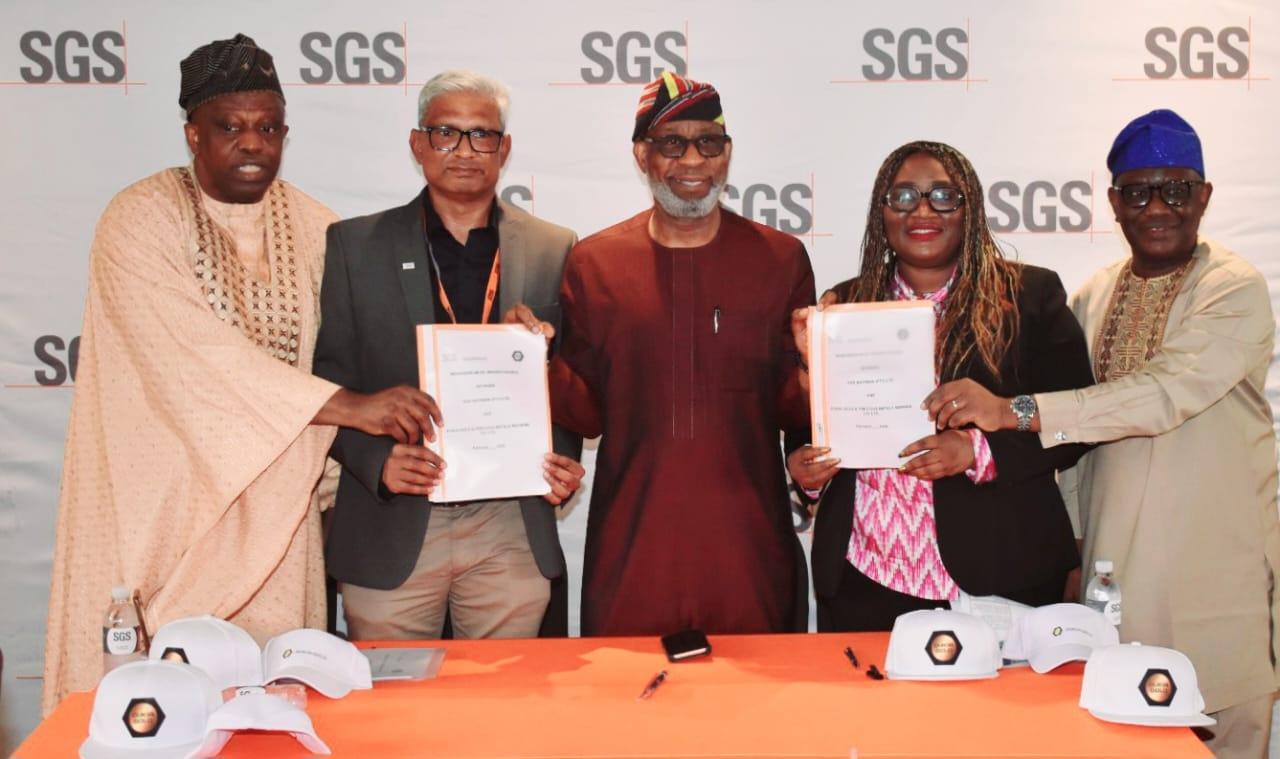
The Minister gave this assurance in Cape Town, South Africa, during the signing of a Memorandum of Understanding between Dukia Gold & Precious Metals Refining Company Limited and SGS Bateman.
The agreement was executed on the sidelines of the Investing in African Mining Indaba, one of the continent’s foremost mining investment gatherings.
Dr Alake emphasized that Nigeria’s status as a signatory to the Cape Town Convention provides international lenders, equipment financiers, leasing companies, and technical partners with clear legal safeguards.
He said; “It is important to note that Nigeria is a signatory to the Cape Town Convention on International Interests in Mobile Equipment. This provides a robust assurance framework for international financiers and service providers. It strengthens confidence that mining equipment and mobile assets deployed into Nigeria can enjoy internationally recognized protections, a key factor for project finance, asset leasing, and structured equipment procurement.”
The treaty standardizes transactions involving movable assets and offers strong protections, including asset registration, security interests, and repossession rights in cases of default.
According to the Minister, “this legal framework strengthens investor confidence in deploying high-value mining equipment and mobile assets into Nigeria, particularly for project financing and structured procurement arrangements.”
Describing the Dukia–Arinola Mineral Resources Development Project as a landmark initiative, Dr. Alake noted that it reflected Nigeria’s broader strategy of transforming the mining sector into a major driver of economic diversification.
He said; “the ongoing reforms including improved regulatory clarity, streamlined licensing, investor-friendly fiscal incentives, and infrastructure prioritization are already yielding measurable growth, with mining contributing more significantly to national GDP.’
The Dukia–Arinola project, located in Ose and Owo Local Government Areas of Ondo State within the Igarra Schist Belt, is structured as a scalable polymetallic Mine-to-Market initiative. It prioritizes local value addition, beneficiation, and phased industrial expansion.
The Minister highlighted that the private-sector-led project aligned with Nigeria’s ambition of building a one-trillion-dollar economy by 2036, noting that it is expected to stimulate economic activity, create jobs across skilled and semi-skilled levels, deepen local procurement, and strengthen mineral export competitiveness through improved connectivity by road, rail, air, and sea.
According to him, these measures are already yielding measurable results.
“These reforms include improved regulatory clarity, streamlined licensing processes, investor-friendly fiscal incentives, and prioritization of infrastructure to support mineral development and beneficiation. The sector has been recording growth, with mining contributing more significantly to GDP, reinforcing the momentum of the reforms and our commitment to sustained sector expansion,” he said.
Dr. Alake also invited world-class mining contractors, engineering firms, equipment manufacturers, and service providers to participate in upcoming Requests for Proposals and Expressions of Interest tied to the project’s execution phase.
He encouraged partnerships that incorporate capable Nigerian firms to enhance local content and domestic value retention.
Reaffirming Nigeria’s growing reputation as an emerging hub for critical and strategic minerals, the Minister stressed the importance of responsible sourcing, traceability, and global best practices.
Also speaking at the ceremony, the Chairman of Dukia Gold, Mr. Tunde Fagbemi, described the MoU as ‘a strategic step toward feasibility-driven execution and long-term mineral beneficiation.’
“This MoU marks the beginning of a structured EPCM partnership to advance the Dukia–Arinola Project toward feasibility and disciplined execution,” Fagbemi said.
The Dukia–Arinola project spans approximately 184 square kilometres and has undergone extensive geological mapping, geophysical surveys, trenching, and diamond drilling as part of its technical development.
The Nigerian Government continues to position the mining sector as a strategic pillar for foreign exchange earnings, industrial growth, and sustainable economic transformation