

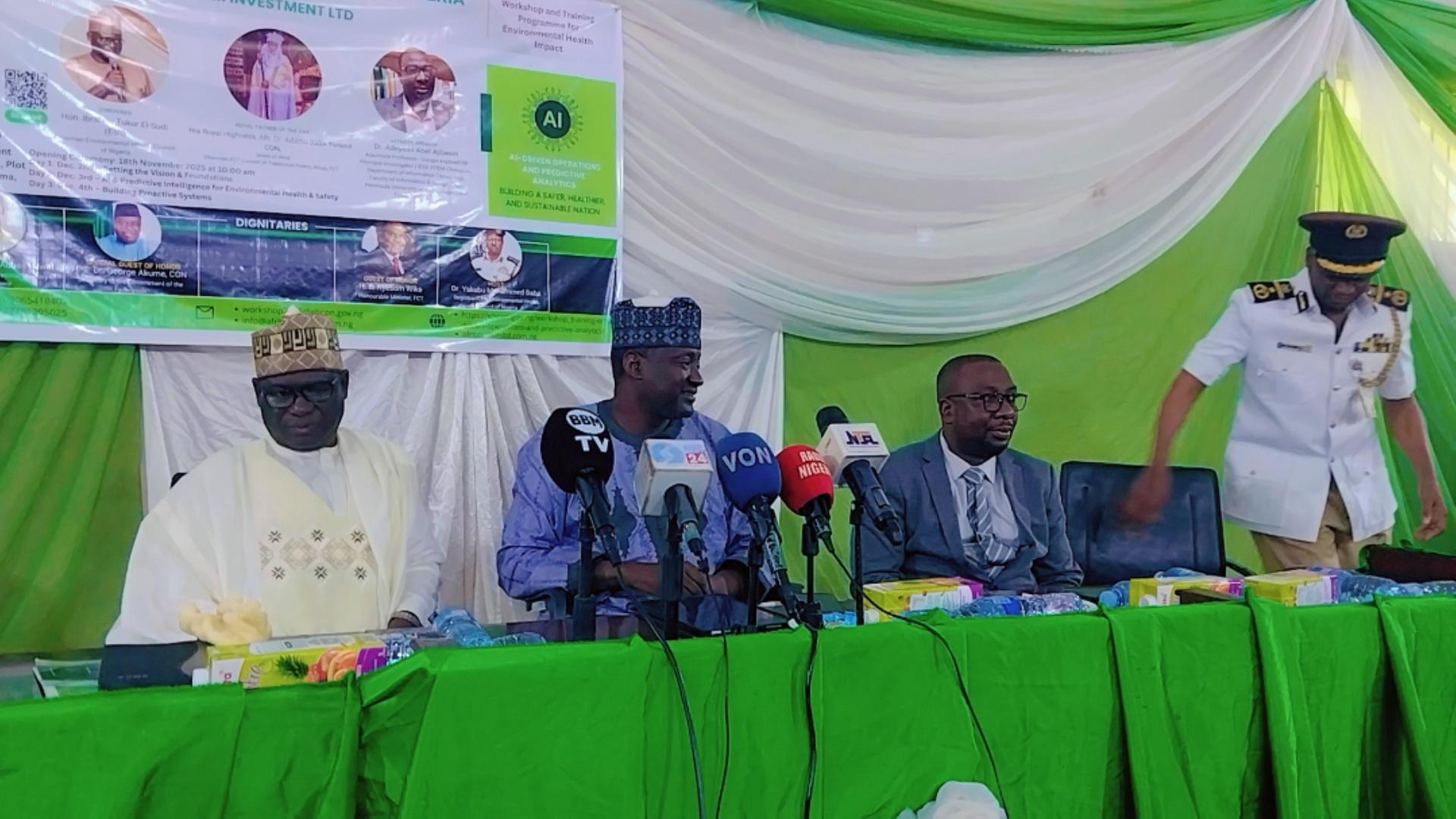
The Nigerian government has reiterated its commitment to fostering innovation, strengthening institutional capacity, and promoting cross-sectoral collaboration to ensure that environmental management aligns with the nation’s digital transformation goals.
Secretary to the Government of the Federation, Mr. George Akume, made this known at the Workshop and Training Programme for Environmental Health and Impact Assessment, held in Abuja..
The them for the workshop is; “Artificial Intelligence (AI)-Driven Operations and Predictive Analytics: Building a Safer, Healthier, and Sustainable Nation,”
He stated that the Office of the Secretary to the Government of the Federation (OSGF) would continue to coordinate policies that reinforce inter-agency synergy and ensuring that environmental health initiatives complement national strategies on public health, the digital economy, and sustainable development.

Mr. Akume represented by Director Political and Economy Affairs, Mr Ifiok Abio, emphasised that Artificial Intelligence was no longer a futuristic concept, but a present-day reality already shaping how societies monitor, manage, and improve their environments.
“Through predictive analytics, we can anticipate disease outbreaks, detect pollution patterns, optimize waste management, and enhance emergency responses to natural disasters,” he noted.
He added that by embracing AI, Nigeria was better positioned to achieve the Sustainable Development Goals (SDGs), particularly those relating to health (SDG 3), clean water and sanitation (SDG 6), and sustainable cities and communities (SDG 11).
He stressed that technology alone was not sufficient, explaining that the success of AI-driven environmental operations depends on human capacity, regulatory readiness, and ethical governance.
According to him, “the Renewed Hope Agenda of President Bola Ahmed Tinubu, GCFR, places premium on sustainable growth, human capital development, and public health security The agenda envisions a Nigeria where every citizen lives in a clean, healthy, and safe environment-one that promotes productivity and prosperity.”
Proactive Step
He described the training workshop as a proactive step toward national preparedness in the digital age.
He further noted that the Federal Government, through relevant Ministries and Agencies, would continue to support such initiatives—particularly those that build local expertise, encourage innovation, and promote the responsible use of emerging technologies.
Mr. Akume emphasised that building a safer, healthier, and more sustainable Nigeria requires the collective commitment of all stakeholders: government, academia, the private sector, civil society, and citizens.
“We must see environmental health not as a peripheral activity, but as central to our national safety and economic growth. The adoption of AI in this field should therefore be guided by inclusivity, transparency, and accountability, so that no community is left behind in the nation’s digital transformation journey,” he stated.
He urged all participants to approach the sessions with open minds and a spirit of innovation, expressing hope that the knowledge and ideas generated would translate into tangible outcomes—improved service delivery, stronger institutions, and healthier communities.
The SGF commended EHCON and its partners for taking the initiative to train professionals and build the competencies required to integrate modern technology into environmental health practice.
Convener of the workshop and Chairman of the Environmental Health Council of Nigeria, EHCON, Honourable Ibrahim Tukur El-Sudi, explained that the workshop was not just another meeting, but an investment in Nigeria’s future, one that would yield lasting benefits for both the nation and the participants.
“We are gathered today to explore a topic of monumental importance: ‘Artificial Intelligence (AI)-Driven Operations and Predictive Analytics: Building a Safer, Healthier, and Sustainable Nation.
“This assembly marks a pivotal moment in our collective mission. The caliber of expertise present here today—from both the public and private sectors—speaks to our shared commitment to strengthening health systems in Nigeria,” he said.
He noted that the training would provide practical, hands-on experience and equip Environmental Health Officers with the skills and confidence needed to effectively deploy AI tools in their work.
“It also offers a unique networking opportunity to connect with peers, experts, and policymakers, fostering collaborations that will drive innovation,” he added.
National impact
Speaking on the national impact, Honourable El-Sudi emphasised that the program would catalyze the adoption of cutting-edge technologies, leading to more efficient and accurate environmental and public health service delivery across the country.
“The policies and recommendations generated from the workshop will help create a roadmap for a more resilient, technology-driven environmental health sector nationwide,” he added.
The Registrar Environmental Health Council of Nigeria ECHON Dr Yakubu Baba says the integration of AI into environmental health was no longer a distant dream but an unfolding reality, one that promised a safer, healthier Nigeria.
“Plans were already underway to take the initiative across all six geopolitical zones, ensuring no community was left behind.
Nigeria must digitize and digitalize,” he often said, a phrase that echoed now like a mantra of progress.” he said.
According to him, at EHCON, we have taken this call to heart. We are committed to conducting our affairs in alignment with modern, digital standards, ensuring that every initiative we undertake reflects innovation, efficiency and forward thinking.
While delivering his address on “Building the Proactive Nation: Harnessing AI to Safeguard Nigeria’s Environmental Health and a Healthier Generation,” the keynote speaker, Dr. Adeyemi Ajibesin of the Department of Information and Design, Cape Peninsula University of Technology, Cape Town, South Africa, emphasised the need for Nigeria to fully embrace artificial intelligence.
He stressed that AI was a powerful and transformative technology capable of helping the nation plan, predict, and grow, ultimately enabling Nigeria to achieve the future it envisions.
The workshop was organised by the Environmental Health Council of Nigeria EHCON in collaboration with Afri Tourism Investment Ltd in partnership with West Africa Gas Pipeline Authority WAGPA.
Confidence Okwuchi