

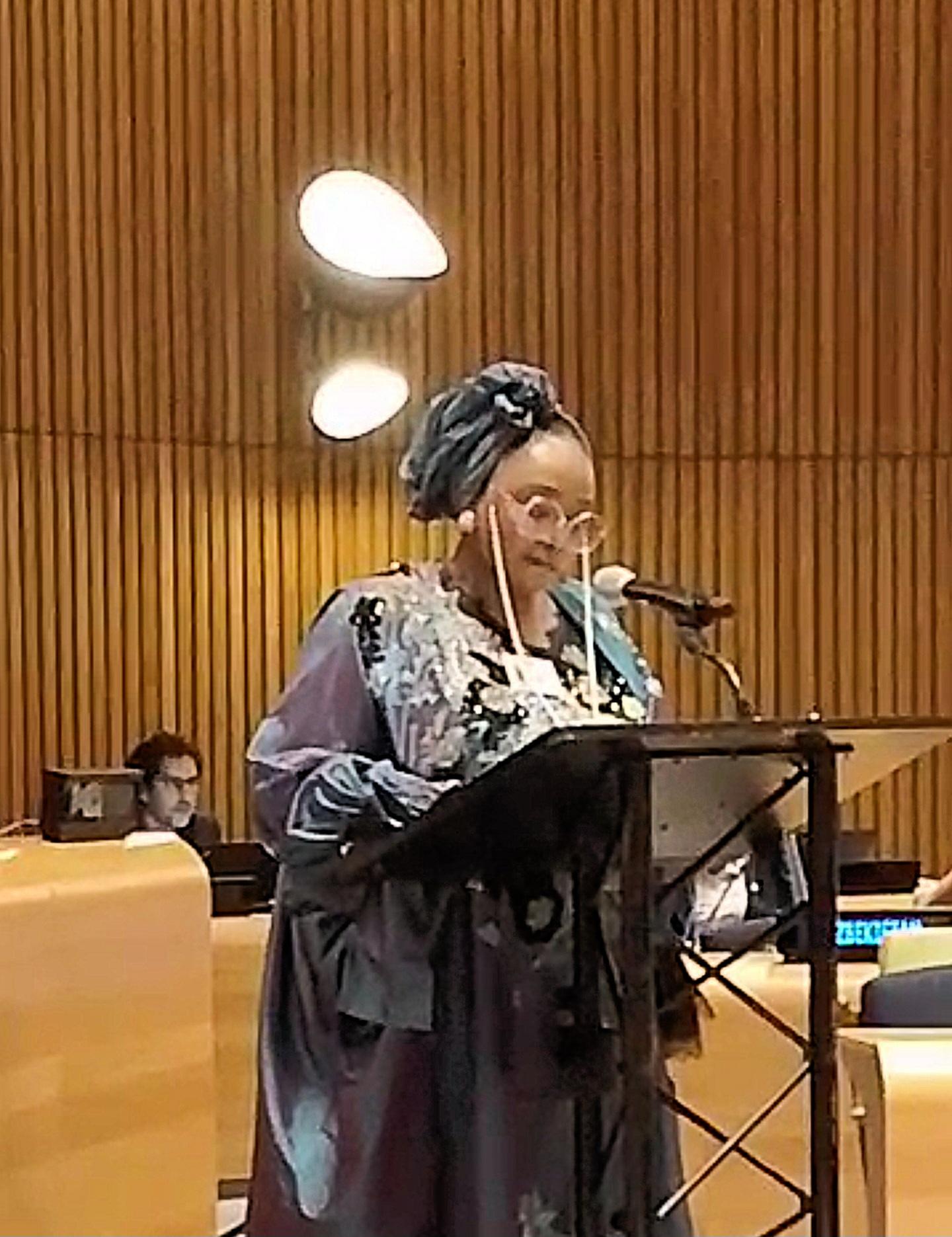
Nigeria’s Minister of Women Affairs, Hajiya Imaan Sulaiman-Ibrahim, has declared that the country remains steadfast in its commitment to advancing gender equality and empowering women, stressing that the time has come to turn global pledges into tangible results.
She made the declaration while delivering Nigeria’s Country Statement at the High-Level Meeting to Mark the 30th Anniversary of the Fourth World Conference on Women (Beijing +30), held on the sidelines of the 80th Session of the United Nations General Assembly in New York.
The Minister told world leaders that thirty years after the landmark Beijing Conference, Nigeria is determined to accelerate its transformative vision. “We gather here to commemorate history, but also to accelerate its transformative vision: a world where gender equality isn’t an aspiration but a lived reality for every woman and girl,” she affirmed.
Progress Journey
Sulaiman-Ibrahim highlighted the progress Nigeria has made, noting that “more girls are in school than ever before. Women are shattering barriers in leadership, business, science, and public life. Stronger laws are in place to combat violence and discrimination.”
However, she cautioned that global setbacks continue to slow momentum.“We must be honest with ourselves: the road ahead remains long. Millions of women and girls still face systemic inequality, violence, and exclusion. Global crises—from climate change to conflict and the digital divide—are deepening their vulnerability,” she said.
Nigeria’s Renewed Hope Agenda for Women
Outlining Nigeria’s fresh commitments, the Minister identified education as the foundation for long-term change. “Our first and most vital investment is in the education of our girls, which we see as the surest pathway out of poverty and the bedrock of our future,” she stated.
She pointed to the mainstreaming of climate resilience and digital inclusion into the school system, guided by the National Gender Policy and the Women’s Economic Empowerment Policy.
According to her, Nigeria is also prioritising economic empowerment, rolling out flagship programmes like the Renewed Hope Women Agro-Value Expansion, which will empower 10 million women in the agricultural value chain, in addition to other social impact interventions designed to advance women and children under Nigeria’s Agenda 2050.
Tackling Violence, Expanding Representation
The Minister restated Nigeria’s zero tolerance for gender-based violence. “We are enforcing stronger laws, expanding survivor support, and, most critically, driving a profound cultural shift where men and boys become active champions of change,” she said.
She also underscored deliberate actions to increase women’s representation in politics and governance. “We are deliberately increasing women’s representation in governance and decision-making through the Special Reserved Seats, because a nation is only as strong as the voices it empowers,” she declared.
Call for Collective Global Action
Hajiya Imaan Sulaiman-Ibrahim ended Nigeria’s statement with a strong appeal for global solidarity. “Nations that empower women are more prosperous, more peaceful, and more resilient. Gender equality is not just a human right; it is an economic imperative, a social necessity, and the very foundation of sustainable development and peace.”
She urged that the 80th General Assembly should be remembered for action, not rhetoric.
“Let this moment mark the time we turned pledges into progress and rhetoric into results. Nigeria stands ready to work with all nations, civil society, and the private sector to fulfil the promise of Beijing—for every woman, for every girl, everywhere,” she concluded.
Nigeria’s Domestic Commitment
Back home, Nigeria is backing its global pledges with bold policies and reforms. The government is driving the Reserved Seats Bill to expand women’s representation in parliament, scaling up the Renewed Hope Initiative for women’s economic empowerment, and strengthening the National Gender and Women’s Economic Empowerment Policies to close persistent gaps.
These interventions, according to the Minister, underline Nigeria’s position that women are not an afterthought in national planning, but central actors in shaping the country’s democratic and developmental future.