

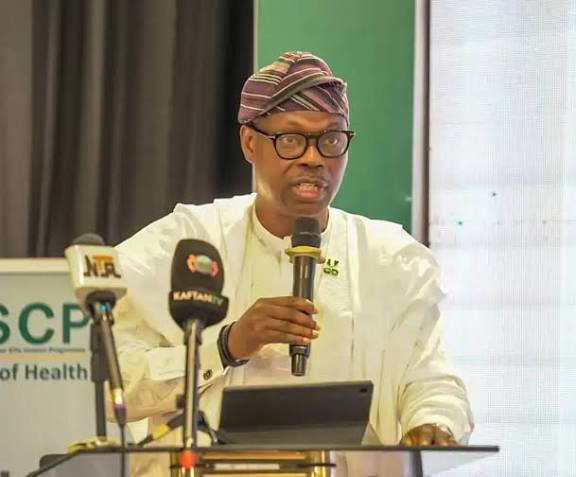
The Nigerian Government has reaffirmed its commitment to reversing medical tourism through strategic investment in the nation’s health system.
The Minister of State for Health and Social Welfare, Dr. Iziaq Adekunle Salako stated this at the 2025 NMA Healthcare and Medical Expo with the theme “Reversing Medical Tourism: Africans Investing in Africa.”
Dr. Salako noted that the Nigeria Government is taking deliberate steps to strengthen local healthcare delivery and boost public confidence in the system.
He identified oncology, orthopedics, nephrology, and cardiology as the major areas driving medical tourism, adding that oncology alone accounts for about 40 percent of cases.
According to him, six cancer centers of excellence have been developed while efforts are ongoing to upgrade tertiary hospitals to provide world-class treatment.
He also highlighted the Presidential Initiative on unlocking Healthcare Value Chain, aimed at positioning Nigeria as a hub for health products and technology manufacturing.
“We urged doctors to help maintain government investments for the benefit of all citizens”. Salako stated.
Read Also: Ebonyi State to Recruit 2,000 Doctors, Nurses
Nigerian Government Reaffirms Commitment to Health Promotion
The President of the Nigerian Medical Association (NMA), Dr.Bala Audu, called for greater investment in Nigeria’s healthcare sector to reverse the trend of medical tourism and position the country as a hub for world-class medical services.
Dr. Audu explained that many Nigerians travel abroad for medical treatment that is already available locally, noting that Nigerian-trained doctors are excelling globally with the same expertise obtained in Nigeria.
He stressed the need to raise awareness that high-quality, specialized healthcare services exist within the country.
According to him, the goal is not only to discourage Nigerians from seeking treatment overseas but also to attract foreign nationals to access advanced medical services in Nigeria.
Achieving this, he said, requires creating an enabling environment through improved health financing, infrastructure, and strong private sector participation.
Health sector industrialization
Responding to concerns about political leaders seeking care abroad, Dr. Audu noted that healthcare is a personal and confidential matter.
He, however, maintained that as Nigeria’s medical system becomes more competitive, even foreign doctors will begin referring patients back to Nigerian hospitals.
The NMA president projected that Nigeria could attract up to five billion dollars in foreign direct investment within the next five years if local and international investors channel resources into health sector industrialization.
He urged Africans to invest in Africa’s healthcare to transform the continent into a global destination for quality medical care.
Medical drain
The Chairman of the day and Chancellor of Ekiti State University, Dr. Tunji Olowolafe, while presenting his keynote address, lamented that Nigeria loses an estimated seven billion dollars annually to medical tourism.
Dr. Olowolafe described it as a major drain on national confidence and development.
He noted, however, that hospitals such as Evercare, Nisa Premier, Cedar crest, and St. Nicholas are already providing world-class medical care within Nigeria, proving that the country can achieve excellence in healthcare delivery.
He commended President Bola Tinubu’s Renewed Hope Initiative for driving reforms in the health sector, including the commissioning of new facilities and the training of 120,000 health workers nationwide.
“These actions reflect a clear commitment to achieving universal health coverage and strengthening the nation’s healthcare system”.
Dr. Olowolafe further emphasized the importance of collaboration among government, private sector players, and the Nigerian medical diaspora to invest in education, research, and technology-driven solutions.
He said such partnerships are essential to reversing brain drain and fostering home-grown medical innovation.
He appealed to health workers to embrace dialogue rather than strikes in resolving disputes, warning that every disruption affects lives and public trust.
“The time for lamentation is over,” he stated. “Let us build the bridges that turn medical tourism into medical excellence, made in Africa” he said.