

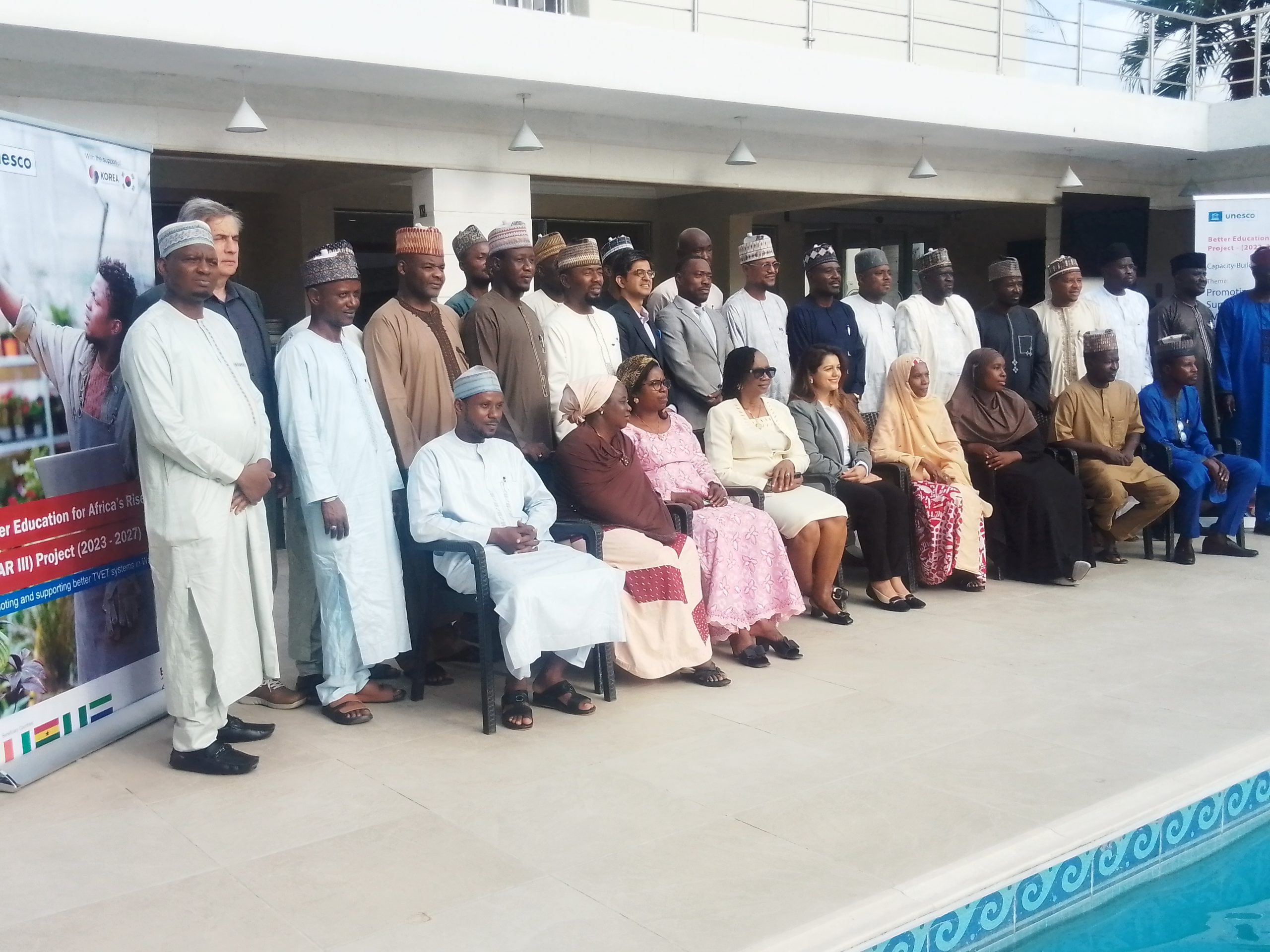
Nigeria’s Federal Ministry of Education and the Kano State government have partnered with the United Nations Educational, Scientific and Cultural Organisation (UNESCO) to train key stakeholders in Technical and Vocational Education and Training (TVET).
The two-day workshop, held under the Better Education for Africa’s Rise (BEAR) III Project, focused on strategic planning for TVET institutions and drew participants from education regulators, training providers, and private sector representatives.
The Head of the Abuja Office and UNESCO’s Representative to Nigeria, Mr Mendy Albert, represented by Mr Manish Joshi, said the programme builds on a 10-week online course completed in July, designed to enhance participants’ capacity to modernise vocational education.
He described TVET as a cornerstone of youth empowerment and economic growth in the region while acknowledging the Republic of Korea for funding the multi-country initiative.
The Director of Technology and Science Education, Federal Ministry of Education, Dr Muhibat Adeleke Olodo, reported that more than one million people have enrolled under a new TVET framework, with federal technical colleges welcoming 15,000 students this month.
She explained that the reforms aim to expand access, align curricula with labour market needs, and boost employability among young people.
Also speaking, the Executive Secretary of the National Board for Technical Education (NBTE), Professor Idris Bugaje, represented by Dr Babangida Abubakar, highlighted the Board’s regulatory role in curriculum development, accreditation, and quality assurance.
He described UNESCO as a reliable partner in strengthening Nigeria’s TVET system through training and international collaboration.
Similarly, the Provost of Audu Bako College of Agriculture, Danbatta, Kano, Associate Professor Dahiru Muhammad, represented by the Deputy Provost, Dr Hassan Ibrahim, said the goal is to ensure that trainees acquire the necessary skills to meet industry demands, thereby making them more employable.
“The college anticipates that this session will reshape their thinking and approaches, enabling them to effectively bridge the identified skills gap.
“This will ultimately allow the labour market to better utilise the trainees produced by various institutions within the state and the nation at large.”
The Kano workshop included peer-learning sessions, discussions on green and digital transitions in vocational training, and practical exercises in institutional planning.
Organisers say the outcomes are expected to strengthen West Africa’s workforce readiness and support the region’s push for sustainable economic development.