

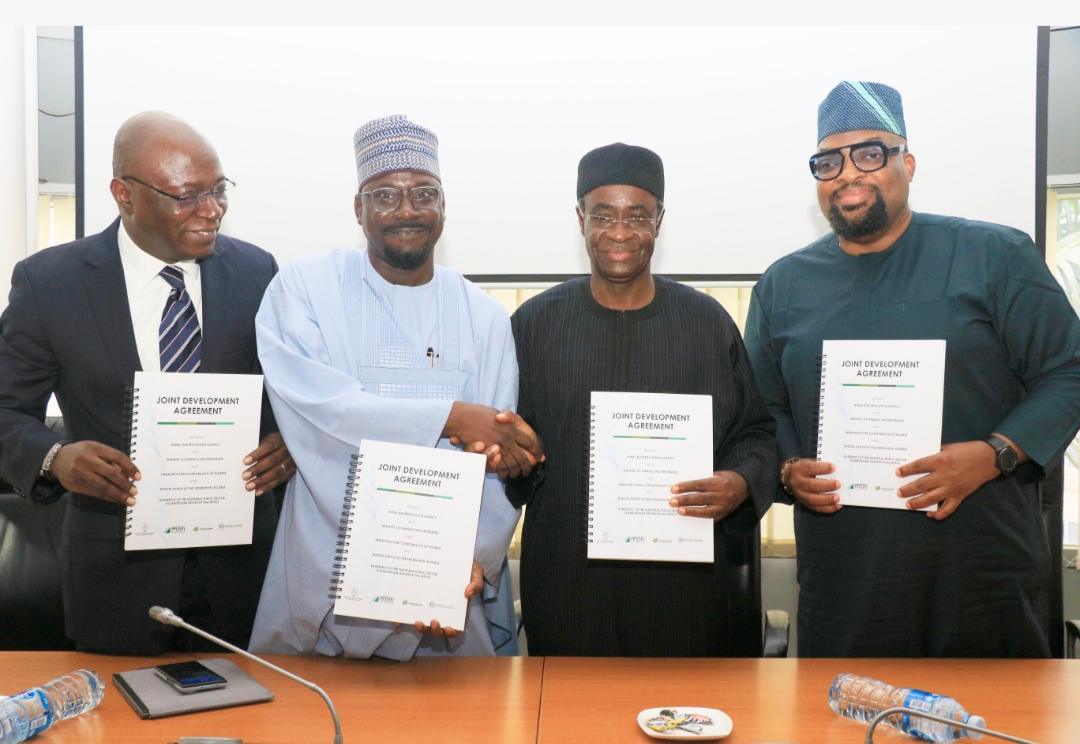
The Rural Electrification Agency (REA) has officially signed a Memorandum of Understanding with the Budget Office of the Federation, Infrastructure Corporation of Nigeria (InfraCorp) and the Ministry of Finance Incorporated (MOFI) to officially launch the National Public Sector Solarisation Initiative (NPSSI).
The solarisation initiative is a government led flagship programme designed to accelerate the deployment of distributed solar energy solutions across Nigeria’s public sector institutions, including schools, hospitals, security posts, government offices and more.
This initiative was birthed from a strategic national priority, the urgent need to power critical infrastructure with clean, reliable energy, while moving away from diesel dependence and reducing the public sector’s carbon footprint.
The Managing Director of the Rural Electrification Agency, Abba Abubakar Aliyu, at the joint agreement in Abuja Nigeria noted that the initiative was part of a broader strategy to position Nigeria as the renewable energy hub of Africa, while promoting innovation, local manufacturing, and sustainability in energy infrastructure financing in Nigeria.
“What makes this truly remarkable, he said, “is the collaborative spirit behind it. We are witnessing a new era of inter-agency synergy, driven by creativity, fiscal responsibility, and a shared determination to reduce the cost of governance while meeting our national energy transition goals.”
While providing an overview of the initiative, Abba-Aliyu explained that at its core, the initiative was birthed from a strategic national priority: the urgent need to power critical infrastructure with clean, reliable energy, while moving away from diesel dependence and reducing the public sector’s carbon footprint.
According to him, the Phase 0 of the NPSSI is fully funded by the Federal Government of Nigeria to the tune of ₦100 billion.
Subsequent phases will harness innovative and blended financing models, leveraging private capital from both local and international long-term funders, all under structures that eliminate sovereign guarantees and contingent liabilities.
The Director-General of the Budget Office of the Federation, Tanimu Yakubu emphasised on the significance of the initiative in addressing Nigeria’s long-standing energy gap and strengthening the fiscal efficiency of public sector operations.
He explained that solarisation has come of age as a necessity and NPSSI will provide an added opportunity to optimise the demonstrated ability of public institutions to pay for clean, sustainable energy, which is what the capital market needs to ensure bankability.
Future of infrastructure
Also, the Managing Director of InfraCorp, Lazarus Angbazo hailed the initiative as a model for the future of infrastructure financing in Nigeria.
He said that “for decades, the sector has relied solely on public financing and while government is indispensable, government is not enough to solve the energy challenge, hence the need to optimize the Federal Government’s NPSSI as a pathway to drive localization of energy capability and supply chain integration”
The Managing Director, of MOFI, Armstrong Takang who was represented by MOFI’s Chief Investment Office,
Femi Ogunseinde said a strategic perspective on the need for evolving funding models for Nigeria’s energy sector.
“Our energy mix has historically been unfairly weighted on fossil fuel, which is expensive to sustain. We must not underestimate the importance of creating business models that drive down the cost of power while expanding access.”
“We must now chart a new course, one that deemphasises the use of sovereign guarantees, domestically anchored and investment-ready, ” he said.
“With far-reaching objectives, the NPSSI is aimed at sustainably eliminating dependence on diesel generators and high electricity bills, while advancing energy access, sustainability culture and local job creation.”
The Rural Electrification Agency (REA) is the Implementing Agency of the Federal Government of Nigeria (FGN) under the Federal Ministry of Power tasked with the electrification of unserved and underserved communities to catalyse economic growth and improve quality of life for Nigerians.
The Agency was established under section 127 of the Electricity Act 2023.
The REA is currently implementing the Rural Electrification Fund (REF), Capital Projects, Nigeria Electrification Project (NEP), Distributed Access through Renewable Energy Scale-up (DARES), National Public Sector Solarization Initiative (NPSSI), Solar Power Naija (SPN), Energizing Education Programme (EEP), Energizing Economies Initiative (EEI), Energizing Agriculture Programme (EAP), Energy for All – Mass Rural Electrification,Research and Innovation Hub.
Projects
Africa Mini Grids Programme (AMP), Derisking Sustainable Off-Grid Lighting Solutions (DSOLS), the Korean Energy Project, Healthcare, Education, Agriculture, Rural Development And Transportation (e-HEART) and the Global Cleantech Innovation Programme (GCIP).
The Agency is responsible for creating an enabling environment for private sector-led projects, which includes conducting feasibility assessments, energy audits, enumeration, data analysis, identification of qualified private sector developers, and project stakeholder engagements.
Lateefah Ibrahim