


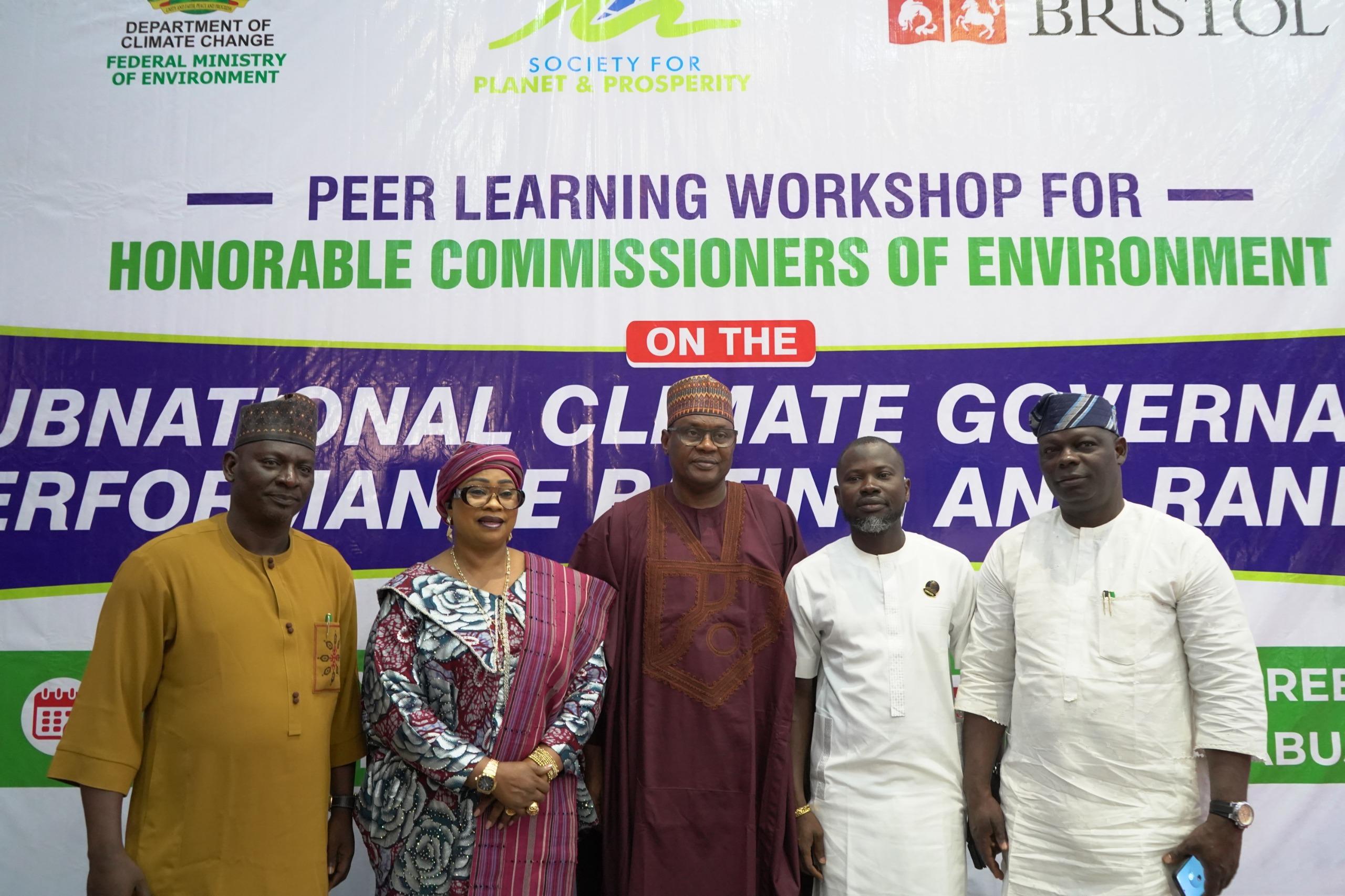
The Nigerian Government is committed to positioning States to access global climate finance mechanisms, carbon markets and blended finance by strengthening project preparation and establishing standardised Monitoring, Reporting and Verification (MRV) systems nationwide.
The government said the effort would ensure compliance with environmental and social safety while fostering stronger partnerships with the private sector and development institutions.
The Minister of Environment, Mr Balarabe Lawal stated this at the “Peer learning Impact and First Meeting of the Community of Practice (CoP) on Climate Change and Environmental Sustainability” held in Abuja the nation’s capital.”
Represented by the Director of the Department of Climate Change, Dr. Iniobong Abiola-Awe urged members to commit to regular technical engagements, transparent data sharing, alignment of State Action Plans with the national climate framework, stressing that “Nigeria cannot finance climate action through public resources alone.”
Intergovernmental Collaboration
Lawal described the establishment of the Community of Practice as ‘a new chapter in intergovernmental collaboration on climate and environmental governance.’
He said; “The CoP is envisioned as a technical knowledge hub, coordination platform for harmonising state climate action plans, pipeline incubator for bankable climate projects, and forum for tracking progress towards Nigeria’s climate commitments.
“Through this structure, we can aggregate subnational climate ambitions into a coherent national strategy that enhances our credibility internationally and strengthening our negotiating positioning globally.”
The Minister said that the ministry is committed to supporting states in unlocking these opportunities.
“Through our ongoing reforms including strengthening the national MRV framework, enhancing transparency systems, and improving environmental governance, we are laying the foundation for a more accountable and results-driven climate response,” Lawal said
The Minister emphasised that the Community of Practice is not merely ceremonial but a practical mechanism designed to strengthen coordination between federal and state institutions, facilitate peer learning and knowledge exchange.
Lawal said it would also promote evidence-based policymaking through impact evaluation, improve access to climate finance at the subnational level, and build institutional capacity for climate project implementation and MRV.
Frontline Exposure
Also speaking at the event, the President of the Society for Planet and Prosperity, Professor Chukwumerije Okereke noted that climate policy in Nigeria has historically focused on the national level, often overlooking states despite their frontline exposure to climate risks.
“To bridge this gap, the Society partnered with the Federal Ministry of Environment and its Department of Climate Change to launch a pioneering ranking of climate governance across the country’s 36 states.” Professor Okereke stated.
He said that the first ranking was released two years ago, followed by a second last year, with findings showing significant and growing climate action across nearly all states.
“The findings revealed an impressive and growing range of climate actions being undertaken across nearly all states of the Federation, “Professor Okereke stated.
He explained that the purpose of the ranking goes beyond scoring performance. It is designed to foster peer learning, collaboration, and collective ownership of climate governance at the state level.
“Commissioners are encouraged to share best practices, reflect on areas needing improvement, and contribute to refining the ranking methodology. By creating a platform for dialogue and co-creation, the initiative ensures that states not only understand the framework used to assess them but also actively participate in shaping it. This approach strengthens transparency, trust, and shared commitment to climate action,” he said.
The Chairman of the Commissioners Forum on Environment, Dr. Nura Ibrahim Kazaure, emphasised the importance of collaboration, inclusiveness, and constructive engagement in advancing climate action across the country.
Kazaure acknowledged that while there were concerns and differing opinions following previous meetings, “such reactions are natural in a process aimed at meaningful reform. Rather than viewing criticism negatively, he encouraged stakeholders to see it as motivation to strengthen institutional frameworks and improve performance in addressing environmental challenges.”
Equity and Inclusivity
Kazaure highlighted the need for equity and inclusivity, particularly in ensuring that the voices of minorities and all states are adequately represented in climate governance.
According to him, “the Forum should not function as a fault-finding body, but as a platform for dialogue, review, and continuous improvement. By reflecting on past efforts and honestly interrogating areas that require progress, states can enhance their strategies and implement more effective climate policies that deliver measurable results.”
Trust-Based Network
Kazaure further stressed that the Forum should serve as a trust-based network that promotes cooperation, knowledge sharing, and access to opportunities.
He underscored the importance of unity among commissioners and their representatives to ensure coordinated climate action nationwide.
Climate Partnership Officer British High Commission, Mr Alhaji Ailam said that the UK would continue to partner with the Federal and State actors to strengthen capacity, unlock climate opportunities, and scale solutions where they matter most at the community level.
“The UK is proud to walk this path with you. Through our range of targeted governance and climate programmes, we remain committed to supporting the development of stronger, more accountable, and more inclusive institutions capable of addressing Nigeria’s interconnected governance and climate challenges.” Ailam stated.
The Community of Practice “CoP” aims to strengthen coordination between Federal and State climate governance systems, promote peer learning and exchange of best practices, standard Monitoring Reporting and Verification (MRV) frameworks across States.
Lateefah Ibrahim