

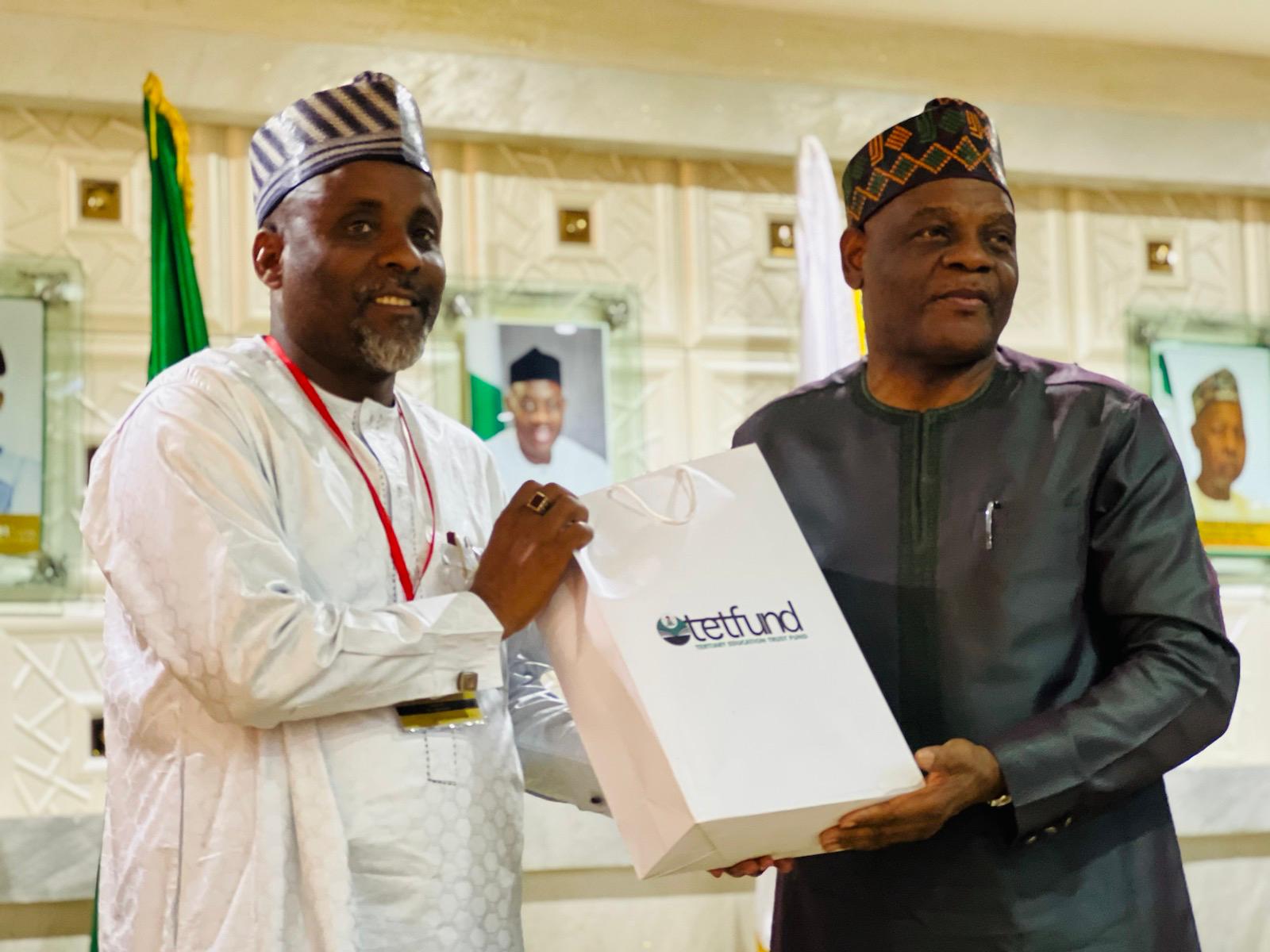
The National President of the Nigeria Union of Journalists (NUJ), Comrade Alhassan Yahya, has called for a strategic partnership with the Tertiary Education Trust Fund (TETFund) to strengthen educational development in Nigeria.
Yahya appealed on Monday while leading a delegation on a courtesy visit to the Executive Secretary of TETFund, Sonny Echono, in Abuja.
He commended the agency for its role in revitalising tertiary institutions across the country and pledged deeper collaboration to enhance public awareness of interventions within the education sector.
The NUJ president said the union had consistently monitored the agency’s activities and expressed satisfaction with the execution of projects nationwide.
“This visit is aimed at strengthening institutional partnership and exploring ways both organisations can work together to advance national development through improved education outcomes and informed public engagement,” he added.
Yahya described the Executive Secretary’s performance in implementing intervention programmes as commendable, noting that the union considered it necessary to engage directly with the agency to enhance visibility for its activities and ensure Nigerians are better informed about developments in tertiary education.
He disclosed that the NUJ is proposing a joint inspection tour of selected tertiary institutions across the six geopolitical zones to assess executed projects and showcase their impact.
According to him, the proposed tour would involve visits to selected states in each zone, enabling journalists to independently observe interventions and communicate their significance to the public.
Yahya recalled that the union had previously passed a vote of confidence in the agency’s leadership and had advocated increased federal funding for TETFund, stressing that the timely release of funds remains critical to sustaining intervention programmes.
He added that the proposed collaboration would include joint public sensitisation on ongoing projects, noting that broader awareness would help Nigerians appreciate the scale of work undertaken in tertiary institutions.
The NUJ president further appealed for support for the International Institute of Journalism (IIJ), an NUJ-owned training institution dedicated to strengthening professional standards and improving the quality of journalism practice in Nigeria.
He also proposed structured quarterly briefings between the union and TETFund.
“The platform would enable journalists to provide feedback from field observations and offer constructive input to support the Fund’s operations,” he said.
Yahya additionally sought TETFund’s support for the NUJ’s planned 2026 Media Summit in Abuja, which he said would bring together academia, policymakers and other stakeholders to deliberate on education funding and national security as they relate to sectoral development.
He expressed optimism that stronger collaboration between the media and TETFund would enhance public understanding of education interventions and contribute to national progress.
In his response, Echono said Nigeria’s tertiary education system requires sustained investment, public trust and stronger institutional support to address infrastructure and research gaps.
He explained that the agency was established to halt the decline in academic standards and restore confidence in universities and other higher institutions.
According to him, the creation of the Fund was a targeted response to reverse declining standards, strengthen institutional capacity and stimulate growth in the sector, particularly at a time when infrastructure deficits were severe and skilled personnel were leaving the system.
Although considerable progress has been made through sustained government support and structured intervention programmes, he acknowledged that major challenges persist.
He identified deficiencies in physical infrastructure, research facilities and the overall conditions for teaching, learning and research as areas requiring significant and long-term investment.
The Executive Secretary noted that extensive intervention projects have been undertaken nationwide, with visible improvements in facilities constructed, upgraded or rehabilitated to enhance academic delivery.
He stressed that communicating these achievements to the public is essential to building confidence in the system and sustaining national support for continued investment in tertiary education.
On collaboration with the media, Echono said the Fund engages journalists through coverage of project commissioning and academic publications that support institutional development.
He also pledged support for the NUJ’s International Institute of Journalism by sponsoring staff enrolment and expressed readiness to expand collaboration with the union to enhance national visibility.
Echono identified electricity costs as a major challenge, noting that institutional allocations are often insufficient to cover utility bills for extended periods.
He explained that the severity of these constraints has compelled the Fund to intervene in essential infrastructure beyond academic facilities, including power supply systems, access roads and water provision, describing such measures as necessary to sustain institutional operations.
He expressed appreciation to Bola Ahmed Tinubu for continued federal support to the education sector, noting that sustained government backing has strengthened the Fund’s capacity to implement critical interventions and stabilise institutions facing structural challenges.
“The sustainability of tertiary education depends not only on infrastructure development but also on broader policy support, stakeholder collaboration and consistent national commitment to education financing,” he said.
Echono thanked the visiting delegation and reaffirmed the Fund’s commitment to supporting institutions in addressing structural challenges, improving academic standards and sustaining progress in Nigeria’s tertiary education system.