

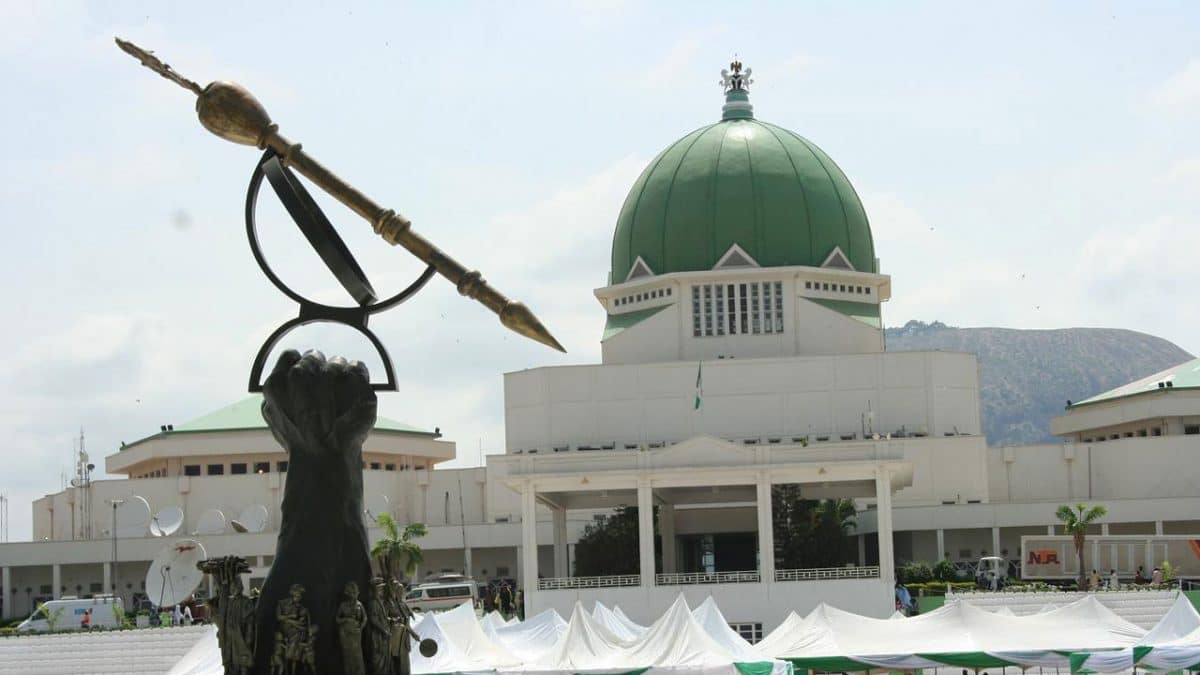
The National Assembly, or legislative arm of any nation, occupies a central position and plays a major role in any democracy.
The National Assemblies in the case of Nigeria, which is a bi-cameral system, the Senate and the House of Representatives are vested with the powers primarily to make laws.
They also enjoy some discretionary powers to shape and or influence public policies.
The significance of Assemblies in a democracy is further underscored by the fact that they are composed of politicians who represent the people rather than trained or expert government officials.
The National Assembly acts as a debating chamber and public forum in which government policies and major issues of national importance are openly discussed and analysed.
In Nigeria, the National Assembly has developed through successive institutional orientations beginning from the amalgamation of 1914 to its present stage. The development of the Nigerian National Assembly is linked to the history of modern Nigeria and its institutional development.
In Section 4, Sub-section one of the 1999 constitution as amended, the Nigerian National Assembly consists of the Senate, which comprises 109 Senators representing three Senatorial Districts from each of the 36 States of Nigeria, including one from the Federal Capital Territory, Abuja and the House of Representatives, which is made up of 360 Federal Representatives.
Nigeria’s core governance structure is made up of the Executive, the Legislature and the Judiciary. Among these three branches of government, the Legislature, because of its closeness to the people, is widely recognised as the most crucial institution in a democracy.
Apart from representing the people and making laws, the Legislature is expected to play the role of checks and balances on the Executive in addition to oversight functions.
The Nigerian National Assembly’s oversight powers are enshrined in Sections 88 and 89 of the Nigerian Constitution, which empower it to investigate the conduct of government agencies and officials.
This section of the Constitution gives the National Assembly the power to monitor and review the activities of the Executive arm of government. This includes scrutinising government policies, programmes, and projects to ensure they align with legislative intent and are efficiently and effectively implemented.
This important function is performed through the Standing and Ad-Hoc Committees. While the Standing Committees oversee relevant Ministries, Departments and Agencies of government, the Ad-Hoc Committees are created for specific assignments and dissolved afterwards. This power is aimed at holding Ministries, Departments and Agencies accountable to the public.
The effective conduct of oversight duties by the Legislature, therefore, faces several challenges. One of such is the incompetence of some members of the National Assembly. For example, those without competency or expertise in econometrics and statistics sometimes head sensitive Committees such as the Finance Committee, and this may lead to policy somersault at the end of investigations.
Therefore, new entrants need time to study the rudiments or skills, which do not happen fast enough for many.
Poor understanding of the core area of service and improper placement of most committee clerks give rise to deficient performance. The lack of experience of new entrants is yet another factor that contributes to or slows efficient oversight functions. Similarly, a delay in the submission of documents by organisations invited to appear before committees also creates bottlenecks.
The Executive’s resistance and impunity also negatively affect oversight functions. Where the President refuses to sign a Bill into law, the efforts of the legislature become unfruitful.
The dominance of one political party in both institutions of government, either the Executive or the National Assembly, also poses a danger to oversight activities.
In this wise, loyalty to the party in power influences the behaviour of legislators in matters of oversight duties.
This manifests in the failure of lawmakers to sometimes openly criticise the day-to-day activities of government.
The ineffective oversight function of the National Assembly has significant implications for democratic consolidation in Nigeria. Weak oversight functions enable the executive to act without accountability, leading to abuse of power and corruption. Inadequate oversight also hinders transparency in governance. This makes it difficult to track public funds and resources.
Since returning to democratic rule in 1999, Nigeria has had six consecutive legislatures, spanning a period of 25 years. Like the past Legislature, the current National Assembly, which is the 10th Assembly, is asserting these powers to strengthen, deepen and enhance the country’s democracy.
The Senate leadership, under the current Senate President, Senator Godswill Akpabio and the Speaker of the House of Representatives, Honourable Tajudeen Abbas, must therefore continue their engagements in robust legislative debates that will meet the expectations and the yearnings of Nigerians.
Nigeria is obviously at a critical moment, given the circumstances that place households under economic pressures and diverse issues that still complicate insecurity. In spite of these challenges, the world is waiting for Nigeria, not just as Africa’s most populous country, but also as its largest economy and democracy.
As the country celebrates sixty-five years of independence and twenty-six years of unbroken democracy, the National Assembly must therefore continue to support all the reforms of President Bola Tinubu with a view to resolving diverse challenges confronting the nation.