

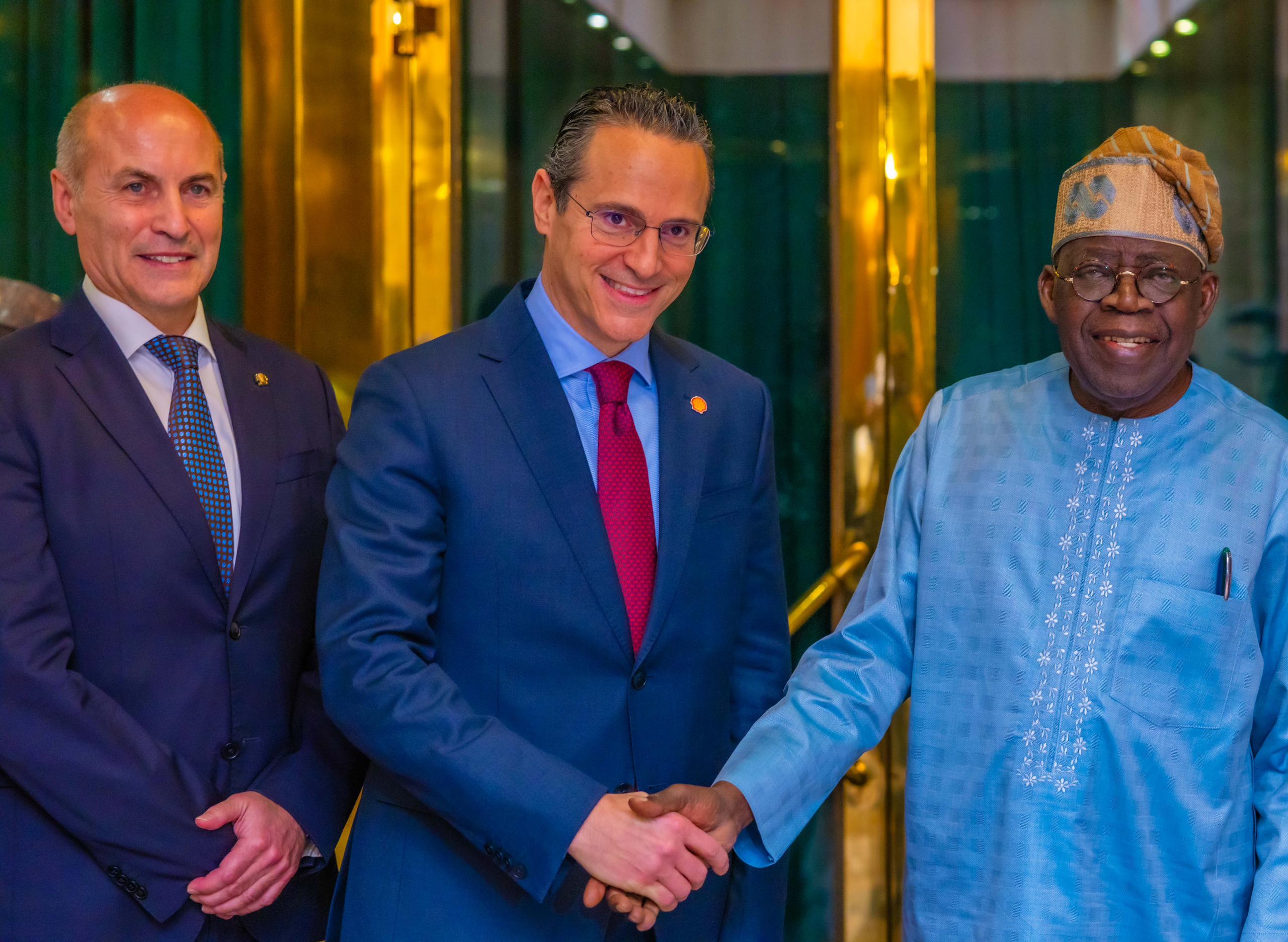
President Bola Tinubu has approved the gazetting of targeted, investment-linked incentives to support the proposed $20 billion investment by Shell and its partners in Nigeria’s Bonga South West deep-offshore oil project.
The President also directed the Special Adviser to the President on Energy, Mrs. Olu Verheijen, to facilitate the gazette of the incentives in line with Nigeria’s existing legal and fiscal frameworks.
Receiving the Shell delegation led by its Global Chief Executive Officer, Wael Sawan, President Tinubu said the incentives are disciplined, targeted, and globally competitive, designed to attract new capital without undermining government revenues.
“These incentives are not blanket concessions,” the President stated. “They are ring-fenced and investment-linked, focused on new capital and incremental production, strong local content delivery, and in-country value addition.
“My expectation is clear: Bonga South West must reach a Final Investment Decision within the first term of this administration.”
 President Tinubu emphasised that the Bonga South West project is strategic to Nigeria’s economy, with the potential to create thousands of direct and indirect jobs, generate significant foreign-exchange inflows, and deliver sustained government revenues over the life of the project.
He added that the project would also deepen Nigerian participation in offshore engineering, fabrication, logistics, and energy services.
The President reaffirmed his administration’s commitment to policy stability, regulatory certainty, and speed, noting that these reforms are critical to restoring investor confidence and positioning Nigeria as a preferred destination for large-scale energy investment.
He further noted that Shell and its partners have invested nearly US$7 billion in Nigeria in the past 13 months, particularly in Bonga North and HI, describing this as a clear sign that Nigeria’s economic and energy-sector reforms are delivering results.
In his remarks, Mr. Sawan said Nigeria’s investment climate has improved remarkably under the Tinubu administration, adding that Shell is increasingly confident in Nigeria as a destination for long-term investment.
Members of the Shell delegation included senior executives from Shell’s global and Nigerian leadership.
Earlier, Global energy giant, Shell Plc indicated plans to invest up to $20 billion in Nigeria over the next few years, reflecting renewed trust in the country’s oil and gas sector.
The development followed recent policy reforms introduced by the Tinubu-led administration.
The Group Chief Executive Officer of the Nigerian National Petroleum Company Limited (NNPC Ltd), Mr. Bayo Ojulari, disclosed this to State House Correspondents following a meeting between President Bola Ahmed Tinubu and Shell’s global leadership, led by its Chief Executive Officer, Mr. Wael Sawan, at the State House, Abuja.
First Ever
Ojulari said the visit marked the first time the global chairman of the Shell Group was meeting President Tinubu, explaining that the purpose was to formally appreciate the President for the executive orders issued early last year to improve Nigeria’s investment climate.
He said that while the Petroleum Industry Act (PIA) provided a critical framework for reform in the sector, further incentive measures were necessary to sustain Nigeria’s competitiveness in attracting global investment capital.
“The competition for investment is global,” Ojulari said, pointing out that other African countries, Guyana and parts of the Far East were continually adjusting policies to attract investors.
“One of the great things that Mr. President did was to announce those executive orders to put additional incentives in place to attract investments”, he added.
Open Investment Environment
Ojulari highlighted that the renewal of the policy enabled Shell to complete three major milestones in the last 18 months, beginning with the divestment of its onshore joint venture assets to Renaissance.
He said the completion of the deal signalled the administration’s resolve to maintain an open and predictable investment environment, where capital can flow in and out without undue constraints.
“That brought confidence to the international community, including Shell,” Ojulari said.
He explained that after the divestment, Shell reached a final investment decision of $5 billion on the Bonga North deepwater project, before subsequently approving an additional $2 billion investment for a shallow-water gas development.
“Overall, since Mr. President announced those incentives, just one company—Shell alone—has already invested over $7 billion,” he said, describing this as evidence of growing investor confidence in Nigeria’s economy.
Ojulari revealed that at the meeting, Shell gave a formal indication of its intention to explore further investment opportunities estimated at about $20 billion over the coming years, attributing the decision to confidence in President Tinubu’s leadership, transparency, and reform-driven agenda.
He said discussions also focused on Shell’s next major project, the Bonga Southwest development, on which the company is working toward a final investment decision.
The project, he noted, would require capital expenditure of close to $10 billion, in addition to substantial operating costs.
Extensive Employment
Providing further context, Ojulari noted that the developments would spur extensive employment, restore activity to previously inactive fabrication yards, and support long-term jobs spanning the 20 to 30-year lifecycle of oil and gas projects.
“For many years, fabrication yards have been idle because there were no projects. Those yards will come back to life,” he said, adding that Nigerians would benefit from construction, maintenance, manpower and supply contracts over decades.
Ojulari said NNPC Ltd, in its capacity as concession holder under Nigeria’s production sharing contracts with international oil companies including Shell, Chevron, ExxonMobil and TotalEnergies, would continue to collaborate with investors and relevant government agencies to develop bankable proposals for the required approvals.
“Our responsibility is to be the conscience of the government and the conscience of Nigerians, ensuring that the assumptions and promises being made are correct and authentic,” he said, expressing optimism that with continued presidential support, final investment decisions would be reached in due course.