


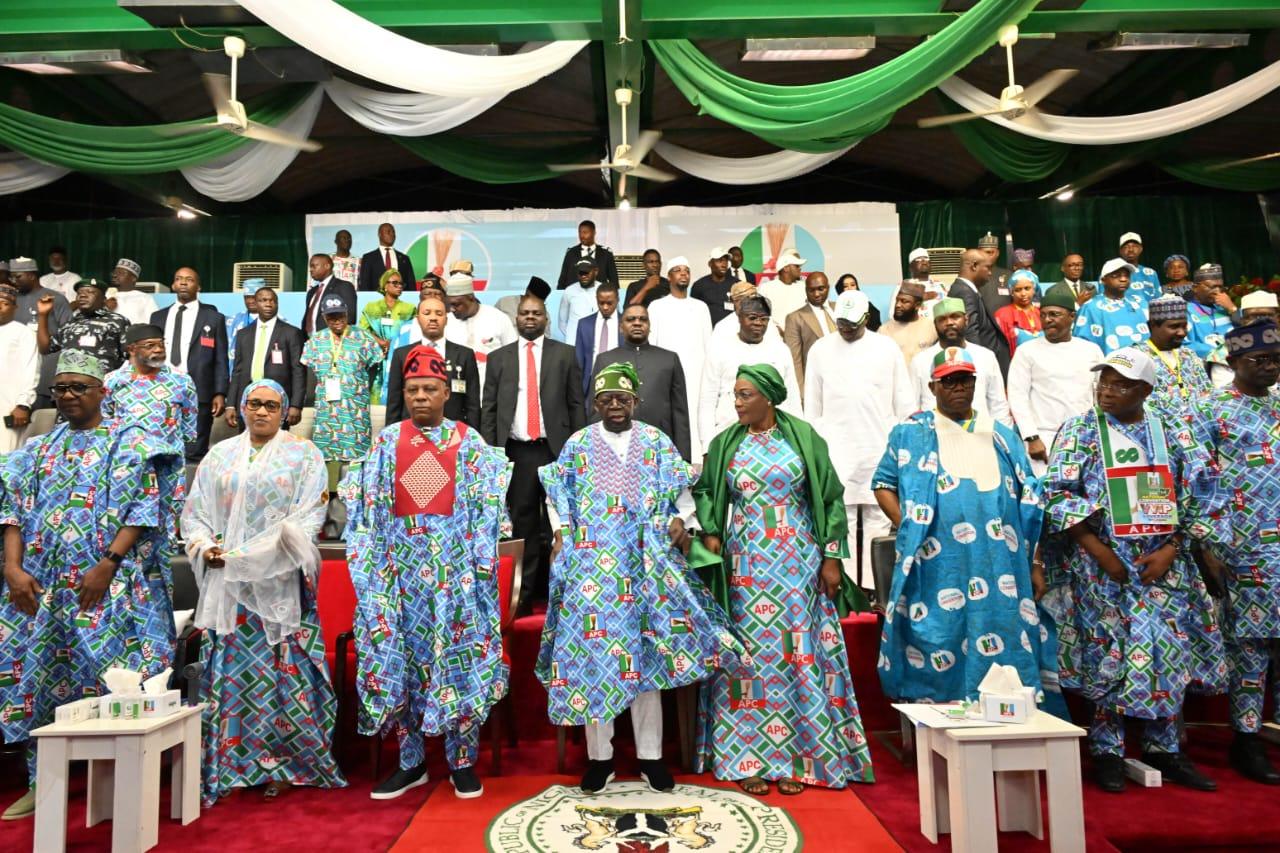
President Bola Ahmed Tinubu has assured citizens of imminent improvements in electricity supply, stating that ongoing reforms in the power sector will support the country’s industrialisation drive and broader economic recovery.
Declaring the 8th National Convention of the APC open in Abuja on Friday evening, President Tinubu acknowledged persistent structural challenges in the power sector, including debts owed to generation companies and gas suppliers, as well as ageing transmission infrastructure.
“Fellow compatriots, since assuming office, our government has remained focused on delivering on its mandate to the Nigerian people. Despite the complex global economic and political environment and the fact that we are currently experiencing another unanticipated blowout arising from the US-Israeli-Iranian War, we have made notable strides. We have made strides in infrastructure development, including the construction of superhighways and concrete-and-steel roads.
“Despite these achievements, we continue to face legacy issues such as electricity supply, debts to GENCOs and gas suppliers, and antiquated transmission infrastructure. Recently, we announced plans to address these challenges by establishing the Grid Asset Management Company (GAMCO), which will inject approximately 1,600 megawatts into a new grid corridor.”
The Nigerian leader assured that his administration’s programmes are delivering tangible and measurable results, dismissing claims that reforms are merely rhetorical.
President Tinubu noted that Nigeria is transitioning from economic survival to stability, with a clear trajectory towards sustained prosperity.
“Apart from roads, we are modernising our seaports and airports. We have begun the implementation of historic tax and fiscal policy reforms. We are implementing social investment programs and have begun efforts to strengthen our national security.
Highlighting improvements in macroeconomic indicators, the President said investor confidence in Nigeria has strengthened significantly, particularly in the oil and gas sector, which is once again attracting foreign investment.
He added that the country’s recent Eurobond issuance was oversubscribed by 400 per cent, while Nigeria’s exit from the Financial Action Task Force (FATF) Grey List signals renewed global financial credibility.
Reviewing progress since 2023, President Tinubu said the administration has remained focused despite global economic uncertainties, including emerging geopolitical tensions.
He cited ongoing investments in infrastructure, including superhighways and reinforced concrete roads, as well as efforts to modernise seaports and airports to boost trade and logistics efficiency.
The President further pointed to the implementation of major tax and fiscal reforms, expansion of social investment programmes, and strengthened national security architecture as part of a coordinated strategy to drive inclusive growth.
He added that foreign exchange buffers have been reinforced to shield the economy from external shocks, while the stock market continues to post strong gains with improved corporate performance.
“We have further built up foreign exchange buffers to protect the economy against external shocks. Our stock market is booming, and listed companies are recording mega profits. Our GDP is growing. We have successively recorded trade surpluses. Inflation has declined steadily for eight consecutive months to 14.45%, while food prices are easing, bringing gradual relief to households. Business confidence is returning, with 12 consecutive months of economic activity expansion.
Investor confidence has vastly improved. Our oil and gas sector has once more become attractive to foreign investment, following our reforms. “We oversubscribed our Eurobond issuance by 400%, and Nigeria exited the FATF Grey List, marking a decisive return to global financial credibility.”
President Tinubu added that Nigeria has recorded consistent trade surpluses, with inflation easing for eight consecutive months to 14.45 per cent, alongside a gradual decline in food prices.
He further noted that business confidence is rebounding, reflected in 12 consecutive months of economic expansion, signalling a steady return to growth and stability