

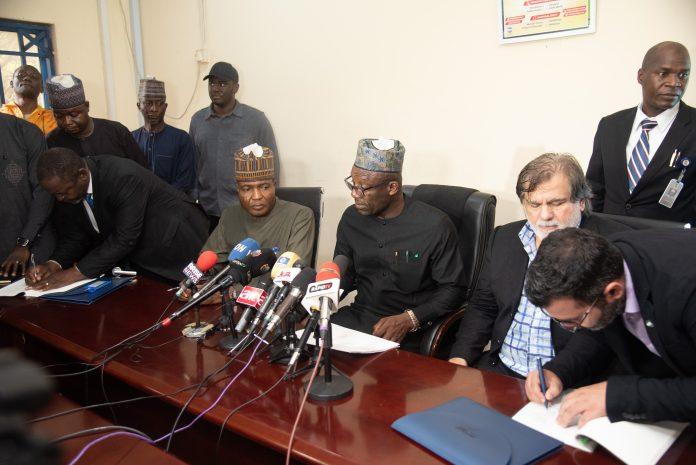
The flag-off of the project for the restoration of Voice of Nigeria’s 250-kilowatt Digital Radio Mondale Shortwave Transmitter is a significant landmark on Nigeria’s path to regain its place in international radio broadcasting.
The event, which took place on August 25, 2025, in Abuja, also points to the country’s appreciation of the power of the radio as the medium that overcomes the barriers of poverty, distance and illiteracy in reaching the greatest number of listeners in the global community.
In a world that has been shrunk by disruptive information and communication technology, the challenge for every international broadcaster in carving out and keeping its target audience through effective programming and content creation has become increasingly enormous. This challenge is better appreciated within the context of the need for countries to ensure that their perspectives in world affairs and issues are not relegated to the background.
The call by developing countries for a new world information and communication order, which began in the 1970s, was borne out of the glaring imbalance characterised by an asymmetrical and one-way flow of information between developed countries and those in the Global South. There is also the need to ensure that developing countries do not allow sustained cultural imperialism and neo-colonialism even after these countries have gained political independence.
Nigeria’s founding fathers and leaders at independence in 1960 were aware of this need to have a medium that would utilise the shortwave technology, which uses the layers of the ionosphere to reach heterogeneous, anonymous and spatially separated listeners across the world.
At the beginning, it was the External Service of the Nigerian Broadcasting Corporation and remained so till the early 1990s when the administration of retired General Ibrahim Babangida, who was the military President then, elevated it and created Voice of Nigeria, VON, as an autonomous corporation.
Since then, VON has been the International Radio Broadcasting Service of first choice for anyone genuinely interested in Nigeria and Africa.
It broadcasts news and programmes that reflect the Nigerian and African perspectives. It has also worked to create content to win and sustain the attention, respect and goodwill of listeners worldwide, particularly Nigerians and Africans in the Diaspora as well as making Nigeria’s voice be heard more positively in the shaping of the world. These are words from the vision and mission of the Voice of Nigeria, which have been driving its operations over the years.
However, for about a decade, poor funding arising from dwindling national resources had a negative impact on the corporation’s terrestrial broadcasting. This resulted in its inability to continue transmitting signals from the Ikorodu and Lugbe transmitting stations in Lagos and Abuja.
It is against this background that one welcomes the commencement of the project to revitalise a VON’s 250-kilowatt Digital Radio Mondiale (DRM) shortwave transmitter in Lugbe, Abuja, the Nigerian Federal Capital Territory. This is a demonstration of the commitment of the administration of President Bola Tinubu to ensure that Nigeria’s international engagements are driven by positive image of Nigeria, which VON is best positioned to create.
It also shows that Nigeria’s Minister of Information and National Orientation, Mohammed Idris, working with the management of the Voice of Nigeria, led by Mallam Jibrin Baba Ndace, recognises the pivotal role the corporation plays in positioning the country on the right pedestal to negotiate with other nations, collaborate with them and participate in international affairs.
Nigeria, Africa and the global community await the resumption of VON’s terrestrial broadcasting in its eight languages to its millions of listeners across the world. Listeners who have, over the years, been committed to tuning in to the Voice of Nigeria will begin again to receive news, programmes, laced with Nigerian and African music that will inform, educate and entertain them.
Sustaining this will be dependent on serious and regular maintenance of the equipment and technical objects at the transmitting station. It is necessary that regular maintenance be carried out on the transmitters to ensure that they do not deteriorate to a level where the VON signals would go off before the transmitters are fixed.
The restoration of the transmitters imposes huge responsibility on the management and staff of the Voice of Nigeria. For the management, providing the working tools and logistics for the staff to carry out their jobs effectively is imperative. However, management’s functions might not make a meaningful impact if the organisation’s content creators fail to complement these efforts by performing their functions effectively.
Competition for the airwaves, especially for an international broadcaster like the Voice of Nigeria, is increasingly becoming stiffer. Making Voice of Nigeria’s listeners keep their dials on the station, even with the restoration of terrestrial broadcasting, demands serious commitment.
The confidence that the Mallam Baba Ndace’s management and the seasoned professionals working in Voice of Nigeria will meet these set goals is not in doubt.