

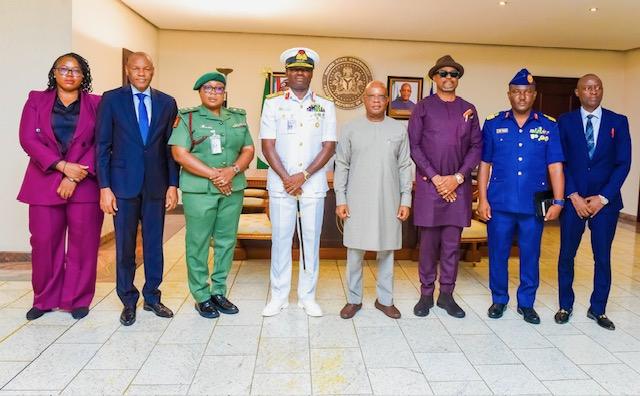
The Government of Rivers State has decried the persistent fragmentation of intelligence and lack of synergy among security stakeholders, describing it as a major impediment to the fight against maritime crimes in Nigeria.
Speaking during a courtesy visit by participants of the Advanced Defense Intelligence Officers Course 15 of 2025 from the Defence Intelligence College,The Administrator of Rivers State, Vice Admiral (Rtd) Ibok-, stressed the urgent need for stronger inter-agency coordination to combat evolving maritime threats. The visit took place at the Government House, Port Harcourt the state capital.
Vice Admiral Ibas emphasised that effective collaboration among critical security and intelligence agencies—including the Nigerian Navy, Marine Police, Nigerian Customs Service, Directorate of State Services (DSS), and NIMASA—is essential to addressing complex maritime crimes such as piracy, smuggling, illegal fishing, and maritime terrorism.
“Our nation’s maritime domain is a vital artery of economic prosperity, national security, and sovereignty,” he stated. “In an era where maritime threats are growing in sophistication, no single entity can effectively combat these challenges alone,” he said.
He commended the multi-agency composition of the visiting delegation and praised their course theme, “Maximising Intelligence Collaboration as a Catalyst for Enhanced Maritime Security,” as timely and strategic.
Recommendations
To enhance intelligence coordination, Vice Admiral Ibas proposed:
- Strengthened Information Sharing – Improved data exchange among agencies, state governments, and international partners.
- Inclusion of Local Stakeholders – Engaging fishing communities, port workers, and oil facility operators in intelligence frameworks.
- Technology-Driven Solutions – Deployment of real-time surveillance systems and AI-enabled threat analysis.
- Reinforced Regional Partnerships – Enhanced cooperation through the Gulf of Guinea Commission and collaboration with neighboring coastal states.
“Maritime security is inherently transnational,” he noted. “Strengthening partnerships with neighboring states and international maritime organizations will amplify our collective capacity to secure our waters.”
Highlighting Rivers State’s strategic importance as a coastal hub with major ports and oil export terminals, Vice Admiral Ibas reaffirmed the state’s commitment to supporting security agencies through community-based intelligence, local vigilance initiatives, and policy reforms.
“Our communities must not just be observers but active stakeholders in the security architecture,” “We are reviewing a maritime security engagement strategy and are willing to support joint trainings, provide logistic assistance, and promote policies that facilitate seamless intelligence collaboration,” he said.
Field Study Mission
In his remarks, the leader of the delegation, Rear Admiral Effah Patrick, Commandant of the Defense Intelligence College, Abuja, explained that the visit was part of a field study to deepen participants’ understanding of intelligence collaboration in maritime security.
“Our aim is to explore how a collaborative intelligence framework can bolster Nigeria’s efforts in securing our maritime environment. The insights gathered will inform actionable recommendations for the Nigerian intelligence community,” he said.
Vice Admiral Ibas urged security and intelligence agencies to adopt a unified, innovative approach, emphasising that sustained progress hinges on transparency, trust, and continuous communication among all stakeholders.
Hauwa Abu