

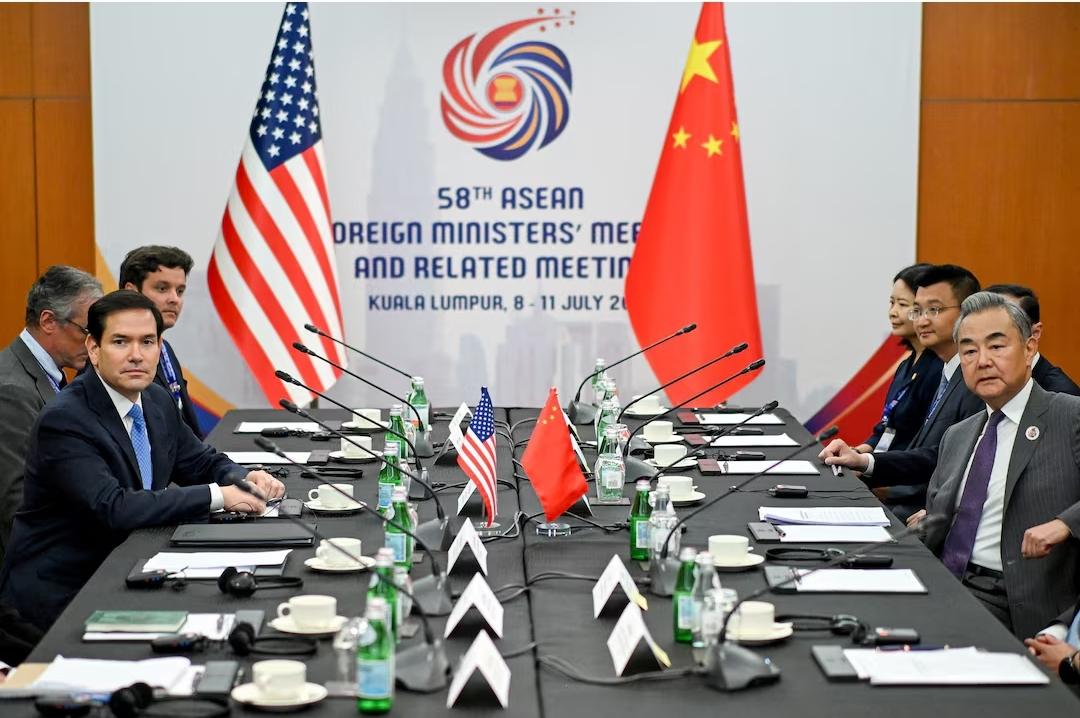
U.S. Secretary of State Marco Rubio met with Chinese Foreign Minister Wang Yi in Kuala Lumpur on Friday, as the two major powers vied to push their agendas in Asia at a time of simmering tension over a U.S. trade tariffs offensive.
Washington’s top diplomat is in Malaysia on his first trip to Asia since taking office, attending the East Asia Summit and ASEAN Regional Forum alongside counterparts from Japan, China, South Korea, Russia, Australia, India, the European Union and Southeast Asian states.
His meeting with Wang comes amid escalating friction globally over U.S. President Donald Trump’s tariffs, with China this week warning the United States against reinstating hefty levies on its goods next month.
Beijing has also threatened to retaliate against nations that strike deals with the United States to cut China out of supply chains.
Rubio’s visit is part of an effort to renew U.S. focus on the Indo-Pacific region and look beyond conflicts in the Middle East and Europe that have consumed much of the Trump administration’s attention.
But that has been overshadowed by this week’s announcement of steep U.S. tariffs on many Asian countries and U.S. allies that include 25% on Japan, South Korea and Malaysia, 32% for Indonesia, 36% for Thailand and Cambodia and 40% on Myanmar and Laos.
Analysts said Rubio would be looking to press the case that the United States remains a better partner than China, Washington’s main strategic rival, during the visit. The State Department said Rubio met counterparts of Thailand, Cambodia and Indonesia on Friday.
China, initially singled out with tariffs exceeding 100%, has until August 12 to reach a deal with the White House to keep Trump from reinstating additional import curbs imposed during tit-for-tat tariff exchanges in April and May.
‘Bullying Behaviour’
China’s Wang has been fierce in his criticism of the United States in Kuala Lumpur and told Malaysia’s foreign minister the U.S. tariffs were “typical unilateral bullying behaviour” that no country should support or agree with, according to remarks released by Beijing on Friday.
He told Thailand’s foreign minister the tariffs had been abused and “undermined the free trade system, and interfered with the stability of the global production and supply chain”.
During a meeting with his Cambodian counterpart, he said the U.S. levies were an attempt to deprive Southeast Asian countries of their legitimate right to development.
“We believe that Southeast Asian countries have the ability to cope with complex situations, adhere to principled positions, and safeguard their own interests,” Wang said, according to China’s foreign ministry.
The foreign secretary of U.S. ally the Philippines told Reuters on Friday President Ferdinand Marcos Jr would meet Trump in Washington this month and discussions would include the increase in the U.S. tariff on its former colony.
Rubio and Wang made no public remarks at the start of their talks on Friday, which lasted about an hour and were their first in-person since Rubio took office in January.
Source: Reuters/Ejiofor Ezeifeoma